


Engineering Guide to Wire Mesh Water Filter Systems in Industrial Applications
In industrial water treatment and process engineering, the selection of filtration media is a critical decision that impacts the longevity of downstream equipment, the quality of the final product, and the overall operational cost. A wire mesh water filter serves as a primary defense against particulate contamination, utilizing the mechanical properties of stainless steel to provide precise, repeatable, and durable separation. Unlike disposable polymer cartridges, metal wire mesh components offer high thermal stability, chemical resistance, and the ability to be cleaned and reused, making them a staple in heavy-duty industrial environments.
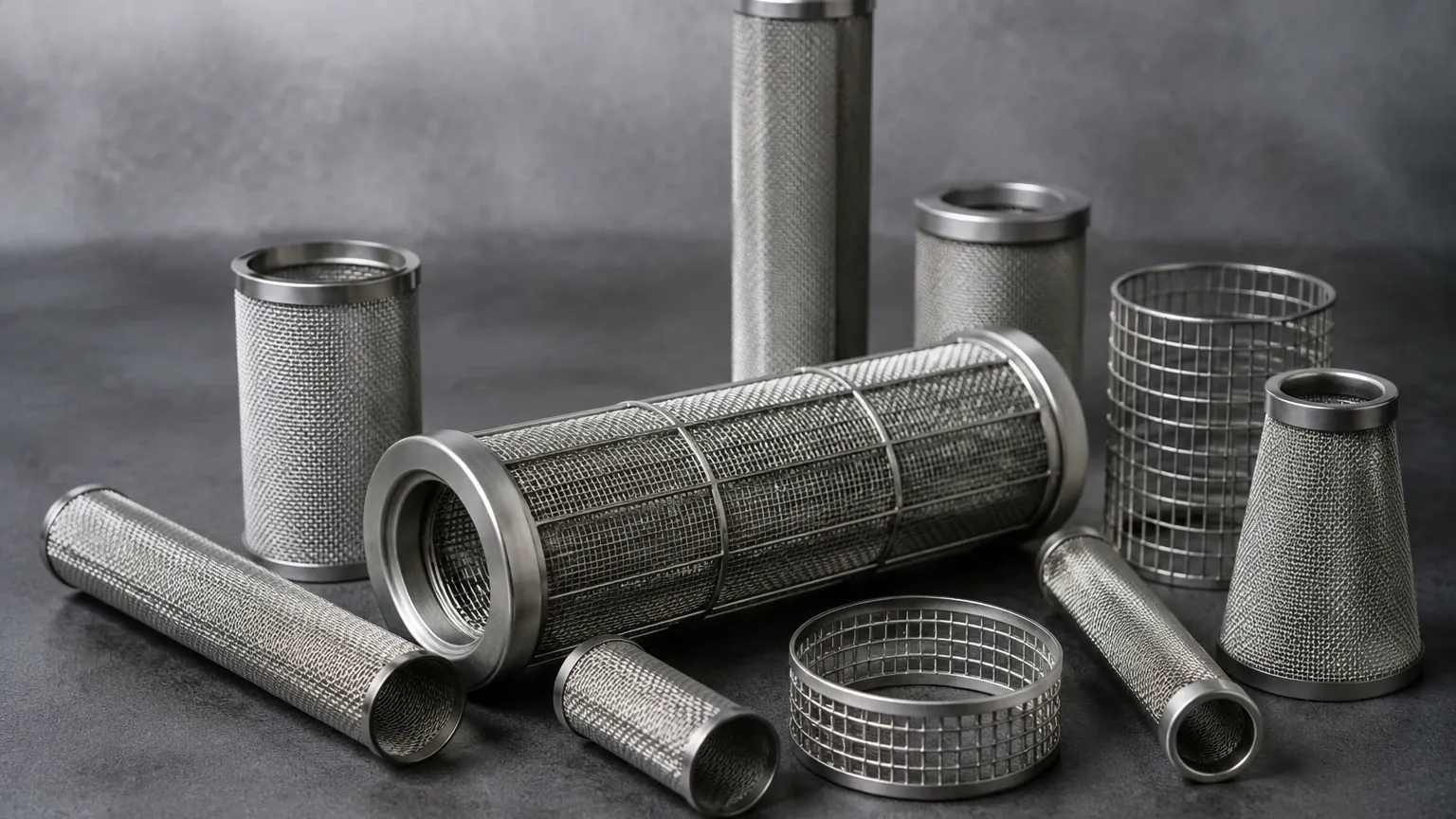
For engineers and procurement specialists, understanding the technical nuances of Wire Mesh Filter Cylinders & Tubes is essential for optimizing system performance. This guide examines the engineering principles, material considerations, and selection criteria necessary for implementing effective wire mesh filtration solutions.
1. Operating Principles of Wire Mesh Filtration
Industrial wire mesh filtration operates primarily on the principle of surface filtration. Particles larger than the mesh openings are mechanically trapped on the surface of the screen, while the fluid passes through. This mechanism differs from depth filtration, where particles are captured within the thick matrix of a filter medium.
Mechanical Sieving and Precision
The accuracy of a wire mesh water filter is determined by the uniformity of the weave. In high-precision applications, the aperture size must be strictly controlled. Because stainless steel wires can be drawn to very fine diameters and woven with high tension, manufacturers can produce filters with consistent micron ratings. This consistency ensures that the "cut point" of the filter is reliable, which is vital when protecting sensitive components like high-pressure spray nozzles or reverse osmosis (RO) membranes.
Flow Dynamics and Pressure Drop
One of the primary engineering concerns in any filtration system is the differential pressure ($ΔP$). As fluid flows through the wire mesh, the physical barrier of the wires creates resistance. The total open area (TOA) of the mesh determines the initial pressure drop. A higher TOA generally allows for higher flow rates with lower resistance. However, as particles accumulate on the surface—forming a "filter cake"—the resistance increases. Engineers must calculate the effective filtration area to ensure that the system can handle the required flow without exceeding the maximum allowable $ΔP$ before cleaning is required.
2. Structural Design: Wire Mesh Filter Cylinders & Tubes
The geometry of the filter element significantly influences its structural integrity and its integration into industrial housings. Wire Mesh Filter Cylinders & Tubes are the most common configurations due to their inherent strength and efficient use of space.
Single-Layer vs. Multi-Layer Construction
For low-pressure applications or coarse filtration, a single layer of robust wire mesh may suffice. However, in more demanding environments, multi-layer sintered or reinforced constructions are preferred.
* Reinforced Cylinders: These often feature a fine filtration mesh supported by a coarser mesh or a perforated metal core. The core provides the mechanical strength to withstand high collapse pressures, while the mesh provides the filtration accuracy.
* Sintered Mesh Tubes: In these designs, multiple layers of mesh are bonded together through a heat-treatment process (sintering). This creates a monolithic structure that does not migrate or deform under high pressure, offering the highest level of durability and precision.
End Cap Configurations and Sealing
The effectiveness of a wire mesh water filter is only as good as its seal. If fluid can bypass the mesh through the ends of the cylinder, the filtration process is compromised. Common end cap designs include:
* Double Open End (DOE): Requires gaskets at both ends to seal against the housing.
* Single Open End (SOE): Often features a threaded connection or an O-ring (such as 222 or 226 configurations) at one end and a closed cap at the other.
* Welded vs. Bonded Ends: For industrial applications, TIG (Tungsten Inert Gas) welding is preferred over adhesive bonding to ensure chemical compatibility and thermal resistance.
3. Material Selection for Industrial Water Environments
The choice of alloy is the most significant factor in determining the lifespan of a wire mesh water filter. While stainless steel is the standard, different grades offer varying levels of resistance to corrosion and chemical attack.
Stainless Steel 304 vs. 316L
* Grade 304: Suitable for general water filtration where the water is relatively neutral and low in chlorides. It is cost-effective and provides good mechanical strength.
* Grade 316L: Contains molybdenum, which significantly improves resistance to pitting and crevice corrosion in chloride-rich environments (such as brackish water or treated process water). The "L" denotes low carbon content, which minimizes carbide precipitation during welding, ensuring the integrity of the filter's joints.
Specialized Alloys
In highly aggressive environments, such as those involving seawater or acidic cleaning chemicals, standard stainless steels may fail. In these cases, engineers may specify Super Duplex stainless steel, Monel, or Hastelloy. These materials provide superior resistance to stress corrosion cracking and localized attack, though they come at a higher capital cost.
4. Selection Criteria: Micron Ratings and Weave Types
Choosing the correct mesh specification requires a balance between filtration efficiency and maintenance frequency.
Nominal vs. Absolute Ratings
* Nominal Rating: Indicates the ability of the filter to retain a majority of particles of a specific size (e.g., 90% of 20-micron particles).
* Absolute Rating: Refers to the diameter of the largest hard spherical particle that will pass through the filter under specific test conditions. For critical industrial processes, absolute-rated Wire Mesh Filter Cylinders & Tubes are often required to guarantee protection.
Common Weave Types
* Plain Square Weave: The simplest weave, offering high open area and low pressure drop. Best for coarse filtration (above 50 microns).
* Dutch Weave (Plain or Twilled): Uses larger diameter wires in the warp direction and smaller wires in the shute direction. This creates a dense, strong mesh with smaller triangular openings, suitable for fine filtration down to 5-10 microns and high-pressure applications.
5. Application Risks and Mitigation
While wire mesh filters are exceptionally durable, they are not immune to failure if improperly specified or maintained.
Clogging and Biofouling
In water applications, especially those involving raw source water, biofouling (the growth of algae or bacteria on the mesh) can lead to rapid clogging. If the $ΔP$ rises too quickly, it can cause the mesh to deform or burst. Implementing a regular cleaning cycle or using antimicrobial coatings can mitigate this risk.
Galvanic Corrosion
If a stainless steel wire mesh water filter is installed in a housing made of a different metal (like carbon steel) without proper insulation, galvanic corrosion can occur. This leads to the rapid degradation of the less noble metal. Engineers should ensure that housing materials and filter materials are compatible or use non-conductive gaskets to isolate the components.
Fatigue and Mechanical Stress
Frequent pressure pulsations, common in hydraulic systems or systems with reciprocating pumps, can lead to metal fatigue. Selecting a filter with a reinforced support core is essential in these scenarios to prevent the mesh from flexing and eventually cracking.
6. Maintenance and Cleaning Protocols
One of the primary advantages of stainless steel filtration is cleanability. Unlike synthetic filters that must be discarded, a wire mesh filter can be restored to near-original performance through several methods:
1. Backwashing: Reversing the flow of water through the filter to dislodge surface contaminants. This is often automated in large-scale industrial systems.
2. Ultrasonic Cleaning: Using high-frequency sound waves in a cleaning solvent to remove fine particles trapped deep within the weave. This is highly effective for Dutch weave meshes.
3. Chemical Cleaning: Soaking the filter in a compatible acid or alkaline solution to dissolve organic fouling or mineral scale (calcium carbonate). It is vital to ensure the cleaning agent does not attack the stainless steel alloy.
7. Procurement Checklist for International Buyers
When sourcing Wire Mesh Filter Cylinders & Tubes for global projects, providing precise technical data is necessary to ensure the product meets the application requirements. Buyers should confirm the following with the manufacturer:
* Material Certification: Request mill test reports (MTRs) to verify the alloy grade (e.g., 316L).
* Dimensional Tolerances: Specify the exact outer diameter (OD), inner diameter (ID), and overall length (OAL). Even minor deviations can prevent a proper seal in the housing.
* Micron Rating Verification: Confirm whether the rating is nominal or absolute and request the bubble point test data if precision is critical.
* Pressure Ratings: Define the maximum operating pressure and the maximum allowable differential pressure ($ΔP$).
* End Connection Specs: Ensure the end caps or threads (e.g., NPT, BSP, or specific O-ring codes) match the existing infrastructure.
By focusing on these technical parameters, engineering and purchasing teams can secure filtration solutions that provide the best balance of performance, durability, and total cost of ownership. Stainless steel wire mesh remains the gold standard for industrial water filtration where reliability and reuse are paramount.
