


Engineering Guide to Steel Mesh Water Filter Systems in Industrial Applications
In industrial water treatment and process engineering, the reliability of filtration components directly impacts downstream equipment longevity and final product quality. A steel mesh water filter serves as a primary or secondary barrier against particulate contamination, utilizing the mechanical properties of stainless steel wire to provide precise, repeatable separation. Unlike disposable fabric or paper media, these metallic filters offer structural rigidity, chemical resistance, and the ability to be cleaned and reused, making them a cornerstone of sustainable industrial design.
For engineers and procurement professionals, selecting the correct filtration hardware requires a deep understanding of fluid dynamics, material science, and the specific mechanical configurations of Wire Mesh Filter Cylinders & Tubes. This guide explores the technical foundations of stainless steel mesh filtration to support informed decision-making in demanding B2B environments.
1. Operating Principles of Stainless Steel Mesh Filtration
The fundamental function of a steel mesh water filter is mechanical straining. As contaminated water passes through the mesh, particles larger than the pore size (the "aperture") are intercepted on the surface of the wire. This is categorized as surface filtration, which differs from depth filtration (where particles are trapped within a thick medium).
The Sieve Effect and Pore Geometry
In a wire mesh structure, the precision of the weave determines the filtration accuracy. The "sieve effect" ensures that any solid larger than the defined micron rating is physically blocked. Because stainless steel wires are woven with high geometric regularity, the pore sizes remain consistent even under varying pressure conditions. This predictability is critical for applications where absolute filtration ratings are required to protect high-pressure nozzles or sensitive membranes.
Flow Dynamics and Pressure Differential
As particles accumulate on the surface of the mesh, a "filter cake" begins to form. While this cake can actually improve filtration efficiency by trapping smaller particles, it also increases the resistance to flow. This resistance is measured as the pressure differential ($ΔP$). Industrial systems must be designed to handle the maximum expected $ΔP$ before the cleaning cycle or replacement is triggered. High-quality Wire Mesh Filter Cylinders & Tubes are engineered to withstand these pressure gradients without deforming the mesh pores.
2. Engineering Selection Criteria for Industrial Water Filters
Selecting a steel mesh water filter involves more than just choosing a micron size. Engineers must evaluate several interconnected variables to ensure the component survives the operating environment.
Material Grade Selection
Stainless steel is the standard for industrial water filtration due to its corrosion resistance. The two most common grades are:
* AISI 304: Suitable for general water treatment, cooling towers, and non-corrosive process water.
* AISI 316L: Contains molybdenum, providing superior resistance to chlorides and acids. This is essential for seawater applications, chemical processing, and pharmaceutical environments where aggressive cleaning agents are used.
Mesh Weave Types
The method of weaving the wire affects both the flow rate and the strength of the filter:
* Plain Weave: The simplest pattern, offering high open area and low pressure drop. Best for coarse filtration (above 100 microns).
* Twill Weave: Allows for heavier wires in a given mesh count, increasing durability for high-pressure applications.
* Dutch Weave: Uses different wire diameters in the warp and shute directions, creating a dense, strong mesh capable of very fine filtration (down to 5-10 microns) while maintaining high mechanical strength.
Micron Rating: Absolute vs. Nominal
* Nominal Rating: An approximate value indicating that the filter will retain a majority of particles at that size.
* Absolute Rating: The diameter of the largest hard spherical particle that will pass through the filter under specified test conditions. For critical industrial processes, absolute ratings are preferred to ensure zero bypass of oversized contaminants.
3. Structural Design: Wire Mesh Filter Cylinders & Tubes
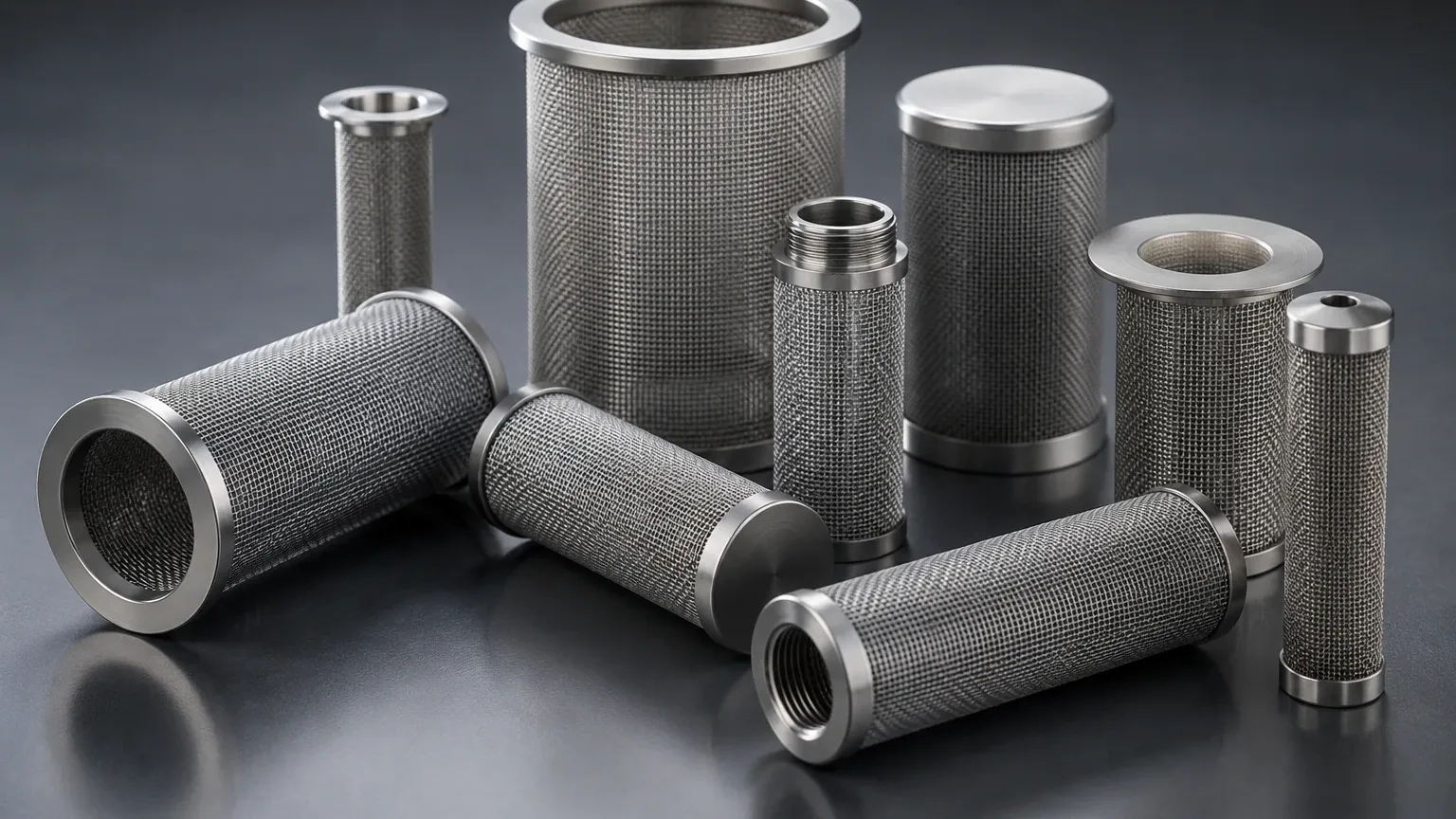
The physical configuration of the filter element determines how it integrates into the housing and how it handles mechanical stress. Wire Mesh Filter Cylinders & Tubes are the most common geometries in industrial settings due to their inherent structural strength.
Single-Layer vs. Multi-Layer Construction
For low-pressure, coarse filtration, a single layer of heavy-duty mesh may suffice. However, for finer filtration, a multi-layer approach is often used. This typically involves a fine filtration mesh sandwiched between coarser support layers. These layers can be sintered together (heated under pressure) to create a monolithic structure that prevents mesh migration and allows for high-pressure backwashing.
Reinforcement and End Fittings
In high-flow environments, cylinders may require internal or external perforated metal cores to prevent collapse or bursting. Furthermore, the method of attachment—whether via threaded fittings, flanges, or O-ring seals—must be precisely machined to prevent "bypass," where unfiltered water escapes around the edges of the filter element.
4. Installation Constraints and Application Risks
Proper installation is as critical as the filter design itself. Failure to account for system-level variables can lead to premature failure of the steel mesh water filter.
Orientation and Flow Direction
Most cylindrical filters are designed for outside-to-inside (O-I) flow, where contaminants collect on the outer surface. This maximizes the surface area available for filtration. If a system is accidentally plumbed for inside-to-outside flow without the proper internal reinforcement, the mesh can delaminate or burst.
Managing Water Hammer and Pressure Spikes
Industrial pumping systems often experience "water hammer"—sudden pressure surges when valves close or pumps start. While stainless steel is robust, repeated fatigue from pressure spikes can lead to stress corrosion cracking or mechanical failure of the weld seams. Engineers should specify reinforced Wire Mesh Filter Cylinders & Tubes if the system lacks surge protection.
Chemical Compatibility and Biofouling
In water treatment, biofouling (the growth of algae or bacteria) can quickly blind a mesh filter. While the steel itself is resistant, the organic buildup can cause localized pitting corrosion. Regular chemical shock treatments or UV sterilization upstream of the filter may be necessary to maintain performance.
5. Maintenance and Total Cost of Ownership (TCO)
One of the primary advantages of a steel mesh water filter is its cleanability. Unlike polymer cartridges that must be discarded, stainless steel elements can be cleaned via several methods:
* Backwashing: Reversing the flow of water to flush particles off the mesh surface.
* Ultrasonic Cleaning: Using high-frequency sound waves in a solvent bath to dislodge fine particles trapped deep in the weave.
* Chemical Cleaning: Using mild acids or bases to dissolve scale or organic deposits.
When calculating TCO, the higher initial capital expenditure (CAPEX) of a stainless steel filter is often offset by the reduction in operating expenses (OPEX). By eliminating the need for frequent replacement filters and reducing waste disposal costs, metal mesh solutions provide a superior return on investment (ROI) over a 5-to-10-year equipment lifecycle.
6. Procurement Checklist: Information for International Buyers
To ensure a manufacturer like Kaifil can provide the optimal solution, technical buyers should confirm the following parameters before placing an order for Wire Mesh Filter Cylinders & Tubes:
1. Fluid Characteristics: What is the pH level? Are there chlorides or abrasive solids present?
2. Flow Rate (GPM/LPM): What is the normal and maximum flow rate the filter must handle?
3. Operating Pressure and Temperature: What are the steady-state and peak conditions?
4. Target Particle Size: What is the specific micron rating required? Is it absolute or nominal?
5. Connection Standards: Does the housing require NPT, BSP, or custom flange dimensions?
6. Cleaning Protocol: Will the filter be cleaned manually or via an automated backwash system?
Conclusion
The integration of a high-performance steel mesh water filter is a strategic decision that affects the efficiency of the entire industrial water circuit. By focusing on material integrity, precise weave selection, and robust structural design, engineers can significantly reduce downtime and maintenance costs. Whether for pre-filtration in desalination plants or protecting precision nozzles in food processing, custom-engineered Wire Mesh Filter Cylinders & Tubes provide the durability and accuracy required for modern industrial standards.
For specialized applications, collaborating with a manufacturer that understands the nuances of wire mesh engineering ensures that the filtration component is perfectly matched to the hydraulic and chemical demands of the system.
