


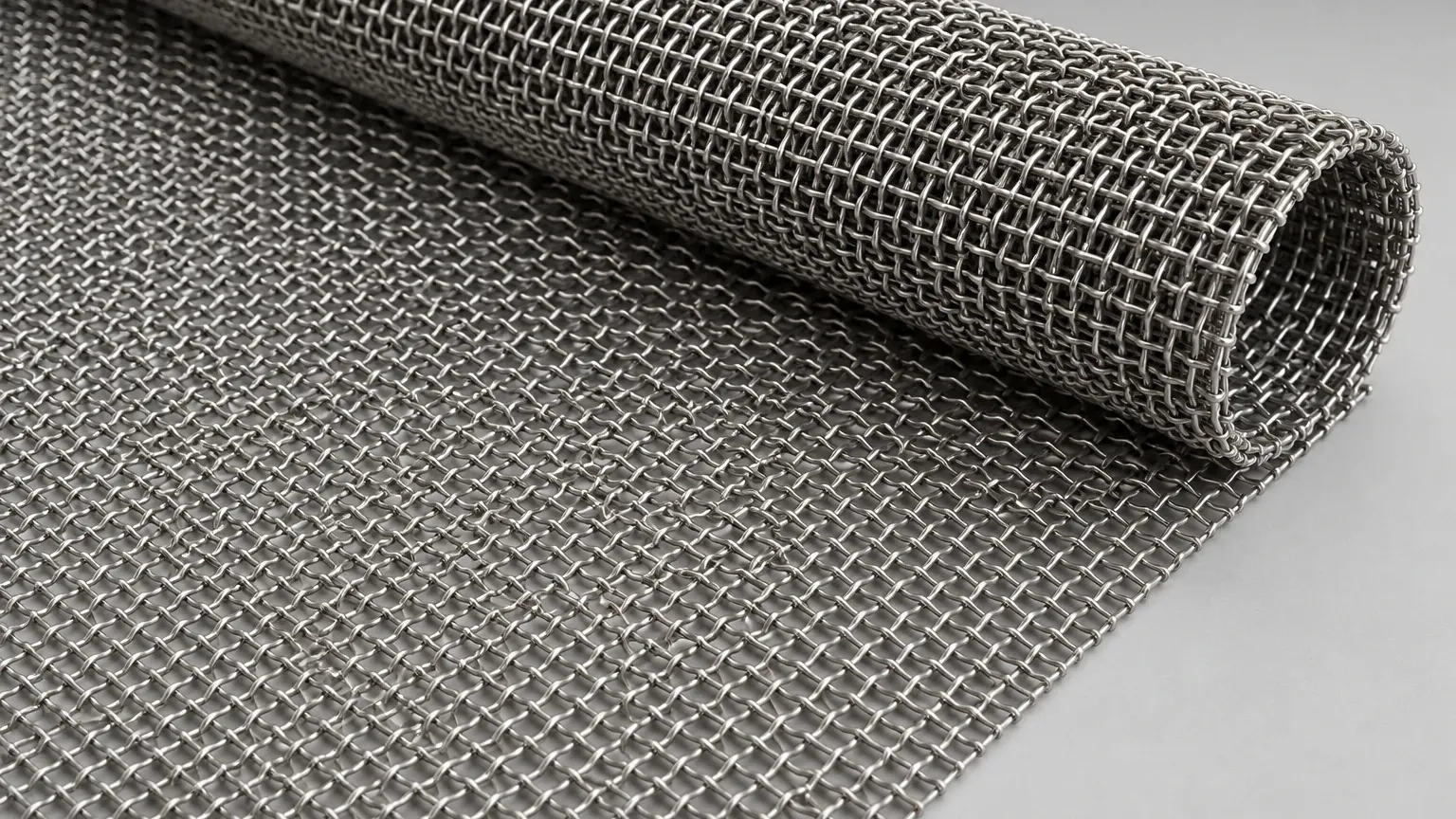
2×2 Woven Wire Mesh
In industrial filtration and separation, the selection of the correct mesh specification is critical to ensuring process efficiency, equipment longevity, and product purity. Among the various configurations available, 2×2 woven wire mesh occupies a specific niche. As a coarse mesh, it provides high structural integrity and significant open area, making it a foundational component in many multi-stage filtration systems and protective industrial barriers.
This guide examines the technical parameters, material considerations, and engineering applications of 2×2 woven wire mesh, providing technical professionals and purchasing teams with the data required for informed specification.
Understanding the Geometry of 2×2 Woven Wire Mesh
The term "2×2" refers to the mesh count, which is the number of openings per linear inch. In a 2×2 configuration, there are two wires and two openings in every inch of the mesh, measured from the center of one wire to the center of the wire one inch away.
Because the mesh count is low, the wire diameter used in 2×2 mesh is typically much larger than that found in fine filter cloths. This results in a product that is physically robust and capable of withstanding significant mechanical stress. The relationship between mesh count, wire diameter, and aperture (the clear opening between wires) is the most critical factor for engineers to consider.
Key Geometric Calculations
To specify woven wire mesh accurately, engineers must understand three primary variables:
1. Mesh Count (n): The number of openings per linear inch (in this case, 2).
2. Wire Diameter (d): The thickness of the wire before weaving.
3. Aperture (w): The clear distance between two adjacent parallel wires.
The formula for determining the aperture is:
`w = (1 / n) – d`
For a 2×2 mesh, this simplifies to:
`w = 0.5 – d`
For example, if a 2×2 mesh utilizes a 0.063-inch wire diameter, the resulting aperture is 0.437 inches. This large opening allows for high flow rates and minimal pressure drop, which is essential in high-volume fluid processing.
Percentage of Open Area
The open area percentage determines the throughput capacity of the mesh. It is calculated using the formula:
`OA = (w / (w + d))^2 * 100`
Coarse meshes like the 2×2 variety often boast an open area exceeding 60% to 70%, depending on the wire gauge. This makes them ideal for applications where flow resistance must be kept to an absolute minimum.
Material Science: Selecting Alloys for Industrial Environments
The performance of 2×2 woven wire mesh is heavily dependent on the alloy selected. While carbon steel and galvanized options exist, stainless steel is the industry standard for high-performance industrial filtration due to its corrosion resistance and mechanical properties.
Stainless Steel 304 (SS304)
SS304 is the most common material for industrial mesh. It offers excellent resistance to atmospheric corrosion and is suitable for many food-grade and general industrial applications. It is cost-effective but may be susceptible to chloride-induced pitting in marine or highly acidic environments.
Stainless Steel 316L (SS316L)
For chemical processing, pharmaceutical manufacturing, or applications involving saltwater, SS316L is preferred. The addition of molybdenum and a lower carbon content (the "L" designation) provides superior resistance to pitting and crevice corrosion. It also maintains better structural integrity during welding, which is crucial for custom-fabricated filter components.
Specialty Alloys
In extreme environments involving high temperatures or highly corrosive reagents, alloys such as Monel, Inconel, or Hastelloy may be specified. These materials are chosen when standard stainless steels would fail due to oxidation or chemical attack.
Engineering Performance: Strength and Flow
When integrating 2×2 mesh into a system, engineers must evaluate the balance between mechanical strength and hydraulic performance.
Structural Rigidity
Unlike finer meshes that may require a support grid, 2×2 mesh is often self-supporting. The heavy wire diameters (often ranging from 0.047" to 0.120") provide high tensile strength. This makes it suitable for use as a "backup mesh" or support layer in multi-layered filter elements, where it protects finer, more delicate mesh layers from collapsing under high differential pressure.
Pressure Drop Considerations
In any filtration system, the filter media introduces a restriction to flow, resulting in a pressure drop ($ΔP$). Because 2×2 woven wire mesh has such large apertures, the $ΔP$ is negligible at standard flow velocities. This allows it to serve as a primary screen for large debris without impacting the overall energy efficiency of the pump or gravity-fed system.
Common Industrial Applications for Coarse Mesh
The versatility of 2×2 mesh allows it to be utilized across diverse sectors, ranging from heavy industrial manufacturing to specialized architectural installations.
1. Industrial Pre-Filtration
In water treatment and chemical processing, 2×2 mesh is used as a primary intake screen. It prevents large solids, such as stones, wood debris, or large scale, from entering the system and damaging sensitive downstream equipment like pumps, valves, and fine filter cartridges.
2. Support Grids for Filter Media
In pleated filter elements or large-scale filter housings, a layer of 2×2 mesh often acts as the structural skeleton. It provides the necessary rigidity to hold finer stainless steel cloth in place against the force of the fluid stream.
3. Safety and Security Guarding
Beyond filtration, 2×2 mesh is frequently used for machinery guards. It allows for clear visibility and airflow while preventing personnel from coming into contact with moving parts. Its high impact resistance makes it a reliable safety barrier in manufacturing plants.
4. Heat Treatment and Drying Trays
In the food and pharmaceutical industries, 2×2 mesh is fabricated into trays for drying or heat treatment. The large open area ensures uniform airflow around the product, while the stainless steel construction allows for easy sterilization and resistance to high temperatures.
Fabrication and Customization Options
Standard rolls of mesh are often just the starting point. For B2B applications, customization is usually required to meet specific equipment dimensions and performance standards.
Weave Styles
Most 2×2 woven wire mesh is produced using a Plain Weave, where each shute wire passes alternately over and under each warp wire. However, for heavier wire gauges, a Pre-Crimp method may be used. In pre-crimped mesh, the wires are formed into a wave-like shape before weaving, which ensures the wires remain locked in place and prevents "racking" or shifting of the apertures under load.
Edge Treatments and Framing
To prevent fraying and to facilitate installation, mesh panels can be finished with various edge treatments:
* Hemmed Edges: The mesh is folded over itself.
* U-Binding/Framing: A metal channel is welded around the perimeter.
* Welded Edges: The wire ends are resistance-welded to a support ring or plate.
For technical procurement, it is essential to work with a manufacturer capable of providing Plain, twill and dutch woven wire mesh in SS304/316L — rolls, cut mesh and framed panels. Send mesh count or micron target for a technical quote. This level of customization ensures the mesh integrates seamlessly into the final assembly.
Procurement Guide: Confirming Specifications
When requesting a quote or preparing a specification sheet for 2×2 woven wire mesh, purchasing teams and engineers should confirm the following details to avoid common procurement errors:
1. Exact Wire Diameter
Do not simply specify "2×2 mesh." A 2×2 mesh with 0.063" wire has a significantly different aperture and weight than a 2×2 mesh with 0.120" wire. Always specify the wire gauge or diameter in decimals (inches or millimeters).
2. Tolerance Standards
Industrial mesh should be manufactured to recognized standards, such as ASTM E2016 (Standard Specification for Industrial Woven Wire Cloth). Confirm that the manufacturer can meet the required tolerances for wire diameter and aperture size.
3. Material Certification
Request Mill Test Reports (MTRs) to verify the chemical composition of the alloy. This is particularly important in regulated industries like food processing (FDA compliance) or pharmaceutical manufacturing.
4. Quantity and Format
Specify whether the mesh is needed in full rolls (typically 100 feet), cut-to-size pieces, or fully fabricated components. Providing a technical drawing for fabricated parts can significantly reduce lead times and ensure accuracy.
Maintenance and Longevity
One of the primary advantages of stainless steel woven mesh is its durability. However, to maximize the service life of 2×2 mesh in a filtration environment, a regular maintenance schedule should be implemented.
* Cleaning: Depending on the contaminant, mesh can be cleaned via high-pressure water jetting, ultrasonic cleaning, or chemical baths. Stainless steel's ability to withstand aggressive cleaning agents is a key benefit over synthetic media.
* Inspection: Periodically check for "wire blinding" (where particles become permanently lodged in the mesh) and signs of mechanical wear or corrosion. In high-vibration environments, check for wire fatigue at the points where the mesh is clamped or welded.
* Replacement Cycles: While 2×2 mesh is robust, it is not indestructible. Establishing a baseline for pressure drop across a clean mesh allows operators to identify when the mesh is becoming fouled or damaged, signaling the need for replacement before a failure occurs.
Conclusion
2×2 woven wire mesh is a versatile and essential component in the industrial landscape. Its combination of high flow capacity and structural strength makes it the preferred choice for coarse filtration, support structures, and protective screening. By understanding the geometric principles, material properties, and fabrication options discussed in this guide, engineering and procurement teams can ensure they select the optimal mesh configuration for their specific application requirements, ultimately leading to more reliable and efficient industrial processes.
