


316 Stainless Steel Woven Wire Mesh: A Technical Guide for Industrial Filtration
In industrial filtration, the selection of material and weave structure determines the efficiency, longevity, and cost-effectiveness of a processing system. Among the various alloys available, 316 stainless steel woven wire mesh stands as the industry standard for applications requiring high corrosion resistance and structural integrity. Unlike standard carbon steel or lower-grade stainless alloys, Type 316 provides the necessary chemical stability to withstand aggressive environments, particularly those involving chlorides or acidic solutions.
For engineers and procurement teams, understanding the technical nuances of Woven Wire Mesh is essential for optimizing filtration performance. This guide examines the material properties, weave geometries, and engineering considerations required to select the correct mesh for demanding industrial applications.
Material Science: Why 316 Stainless Steel?
The primary distinction between 304 and 316 stainless steel lies in the chemical composition. Type 316 contains approximately 2% to 3% molybdenum. This addition significantly enhances the material's resistance to pitting and crevice corrosion in chloride-rich environments.
In filtration, where the mesh is often exposed to continuous flow, high pressure, and varying temperatures, the stability of the alloy is paramount. 316 stainless steel maintains its mechanical properties across a wide temperature range, making it suitable for both cryogenic applications and high-heat processing in chemical plants. Furthermore, for the pharmaceutical and food and beverage industries, 316L (the low-carbon variant) is often preferred to prevent carbide precipitation during welding, ensuring that the filter components remain hygienic and resistant to intergranular corrosion.
Understanding Weave Structures in Woven Wire Mesh
The performance of a filter is largely dictated by how the wires are interlaced. The choice of weave affects the pore size, mechanical strength, and the "blindage" (clogging) characteristics of the mesh.
Plain Weave
This is the most common and straightforward construction. Each warp wire (running lengthwise) passes alternately over and under each weft wire (running crosswise). Plain weave provides the highest percentage of open area and is ideal for high-flow applications where the required filtration accuracy is relatively coarse.
Twill Weave
In a twill weave, each warp wire passes alternately over and under two weft wires. This allows for the use of heavier wire diameters than a plain weave of the same mesh count, resulting in greater mechanical strength and the ability to produce finer meshes that can withstand higher pressures.
Dutch Weave (Plain and Twill)
Dutch weaves utilize different wire diameters for the warp and weft. Typically, a smaller number of heavy warp wires are combined with a large number of fine weft wires. This creates a dense, strong mesh with very fine triangular openings. Dutch weaves are the preferred choice for high-pressure filtration and applications requiring precise micron ratings.
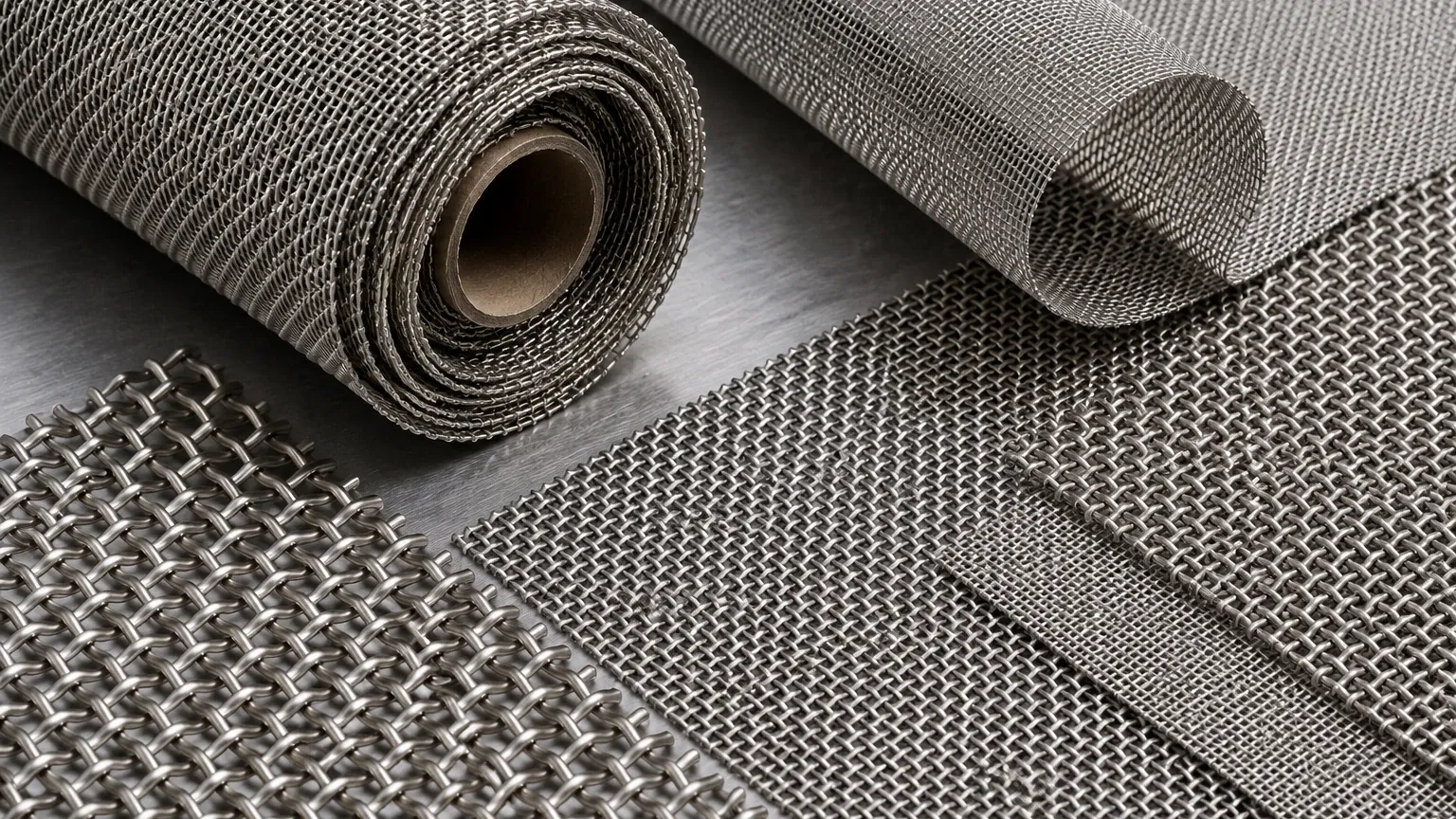
For specialized requirements, Plain, twill and dutch woven wire mesh in SS304/316L — rolls, cut mesh and framed panels. Send mesh count or micron target for a technical quote. provides a range of options to match specific flow and retention needs.
Technical Specifications: Mesh Count, Micron Rating, and Open Area
When specifying 316 stainless steel woven wire mesh, engineers must balance three critical metrics: mesh count, wire diameter, and open area.
1. Mesh Count: This refers to the number of openings per linear inch. A higher mesh count generally indicates finer filtration, but it must be evaluated alongside wire diameter to determine the actual pore size.
2. Micron Rating: This defines the particle size the mesh is intended to retain. In industrial contexts, it is important to distinguish between "nominal" (approximate) and "absolute" (exact) micron ratings. Precision metal filters often require absolute ratings to ensure process consistency.
3. Open Area Percentage: This is the ratio of the total area of the openings to the total area of the mesh. A higher open area results in a lower pressure drop across the filter, which improves energy efficiency and flow rates. However, increasing the open area often requires thinner wires, which may reduce the mesh's structural durability.
Calculating the relationship between these factors is a standard part of the engineering phase. For instance, a mesh with a high count but very thick wires will have a low open area, leading to rapid pressure buildup and frequent cleaning cycles.
Industrial Applications and Environmental Compatibility
316 stainless steel woven wire mesh is utilized across sectors where reliability is non-negotiable. Its application is typically driven by the chemical nature of the fluid being processed.
* Chemical and Petrochemical Processing: Used in the filtration of corrosive acids, alkaline solutions, and high-temperature hydrocarbons. The molybdenum content prevents the rapid degradation often seen in 304-grade filters when exposed to sulfurous or phosphoric acids.
* Food and Beverage: Stainless steel is inherently non-toxic and easy to sanitize. Woven mesh is used in everything from juice clarification to large-scale brewing processes, where it must resist both the organic acids of the product and the harsh caustic chemicals used in Clean-in-Place (CIP) cycles.
* Pharmaceuticals: Precision is critical here. Woven wire mesh is used in centrifuge bags, fluid bed dryers, and sterile filtration. The smooth surface of the 316L wire prevents bacterial growth and allows for complete sterilization.
* Hydraulic and Water Treatment: In hydraulic systems, mesh filters protect sensitive valves from particulate contamination. In water treatment, they serve as pre-filtration stages to remove sand and debris before finer membrane processes.
Engineering Customization and Secondary Processing
Standard mesh rolls are rarely the final product in an industrial setting. Most applications require customized filtration components designed to fit specific housing architectures.
Multilayer Sintered Mesh
For applications involving extremely high pressures or backwashing cycles, a single layer of mesh may lack the necessary rigidity. Sintering involves bonding multiple layers of Woven Wire Mesh together using heat and pressure without melting the wires. This creates a porous metal plate that combines the fine filtration of a Dutch weave with the mechanical support of a coarse square mesh.
Fabrication and Framing
Customization often includes cutting the mesh to precise shapes (discs, rectangles, or cylinders) and adding support structures. Framing the mesh with solid stainless steel flanges or edging prevents fraying and ensures a leak-proof seal within the filter housing. Kaifil specializes in these OEM solutions, providing precision-engineered components that integrate directly into existing industrial equipment.
Quality Assurance and Risk Mitigation in Procurement
The primary risk in purchasing industrial mesh is material substitution or inconsistent weave quality. If a supplier provides 304 stainless steel instead of 316, the filter may fail prematurely due to corrosion, leading to costly downtime or product contamination.
To mitigate these risks, procurement teams should demand:
* Material Certification: Mill test reports (MTRs) that confirm the chemical composition of the wire.
* PMI Testing: Positive Material Identification (PMI) using X-ray fluorescence (XRF) to verify the presence of molybdenum on-site.
* Dimensional Inspection: Verification of mesh count and wire diameter using calibrated optical comparators or digital microscopy.
* Bubble Point Testing: For fine filtration mesh, this test verifies the integrity of the weave and ensures there are no oversized pores that would allow contaminants to pass through.
Technical Checklist for Procurement Teams
Before finalizing a purchase order for 316 stainless steel woven wire mesh, engineers should confirm the following parameters with their manufacturer:
1. Operating Environment: What is the pH level, chloride concentration, and operating temperature? (This confirms if 316 or 316L is required).
2. Flow Requirements: What is the maximum allowable pressure drop ($ΔP$) across the filter? (This determines the required open area).
3. Filtration Target: What is the specific particle size (micron) that must be removed? Is an absolute or nominal rating required?
4. Mechanical Stress: Will the mesh be subjected to high-pressure pulses or mechanical cleaning? (This determines if a sintered or reinforced structure is necessary).
5. Compliance Standards: Does the mesh need to meet FDA, USP Class VI, or specific ISO standards for industrial filtration?
By addressing these technical details during the design and procurement phase, industrial operators can ensure they receive a filtration solution that balances performance with total cost of ownership. Woven Wire Mesh remains one of the most versatile tools in the engineer's arsenal, provided it is specified with a deep understanding of both the material's capabilities and the application's demands.
