


316l Stainless Steel Woven Wire Mesh
In industrial filtration, the selection of material and structure is a critical engineering decision that directly impacts process efficiency, equipment longevity, and product purity. Among the various media available, 316l stainless steel woven wire mesh stands out as a primary choice for demanding environments where corrosion resistance, mechanical strength, and high-precision filtration are non-negotiable. This guide provides a technical overview of 316L mesh, exploring its metallurgical properties, weave configurations, and the engineering considerations necessary for optimizing filtration performance.
Understanding the Metallurgy of 316L Stainless Steel
To understand why 316l stainless steel woven wire mesh is preferred over standard 304 or even standard 316 grades, one must look at its chemical composition. The "L" in 316L stands for "Low Carbon," specifically limiting the carbon content to a maximum of 0.03%. This is a crucial factor in industrial applications involving welding.
When standard stainless steel is heated during welding, carbon can react with chromium to form chromium carbides at the grain boundaries, a process known as sensitization. This depletes the surrounding area of chromium, leaving the material vulnerable to intergranular corrosion. By utilizing 316L, engineers can ensure that the mesh remains corrosion-resistant even after being welded into filter cartridges, frames, or support structures.
Furthermore, 316L contains 2% to 3% molybdenum. This addition significantly enhances the material's resistance to pitting and crevice corrosion, particularly in environments containing chlorides, such as seawater, brine, or chemical processing streams. For industries like pharmaceutical manufacturing and food processing, the high nickel and molybdenum content ensures that the Woven Wire Mesh does not leach contaminants into the product stream, maintaining strict hygiene and safety standards.
Weave Patterns and Their Functional Impact
The performance of Woven Wire Mesh is not solely determined by its material; the geometry of the weave dictates flow rates, particle retention, and pressure drop. Understanding the differences between weave types is essential for selecting the correct component for a specific application.
Plain Weave
The most common and straightforward weave, where each warp wire passes alternately over and under each shute wire. This creates a square or rectangular opening. Plain weave offers the highest open area, making it ideal for high-flow applications where low pressure drop is a priority. However, it is generally limited to coarser filtration tasks.
Twill Weave
In a twill weave, each warp wire passes over two and under two shute wires. This allows for the use of heavier wire diameters than would be possible in a plain weave of the same mesh count. Twill weave is often selected when the mesh must withstand higher mechanical loads or when a thicker, more robust filter medium is required.
Dutch Weave (Plain and Twill)
Dutch weaves utilize different wire diameters for the warp and shute directions. The shute wires are driven closely together, creating a "tortuous path" for the fluid. This results in a very dense mesh with high strength and extremely fine filtration capabilities. Plain Dutch Weave provides a high-strength filter cloth with relatively high flow, while Twill Dutch Weave allows for the finest micron ratings (down to 1-5 microns) by overlapping the shute wires.
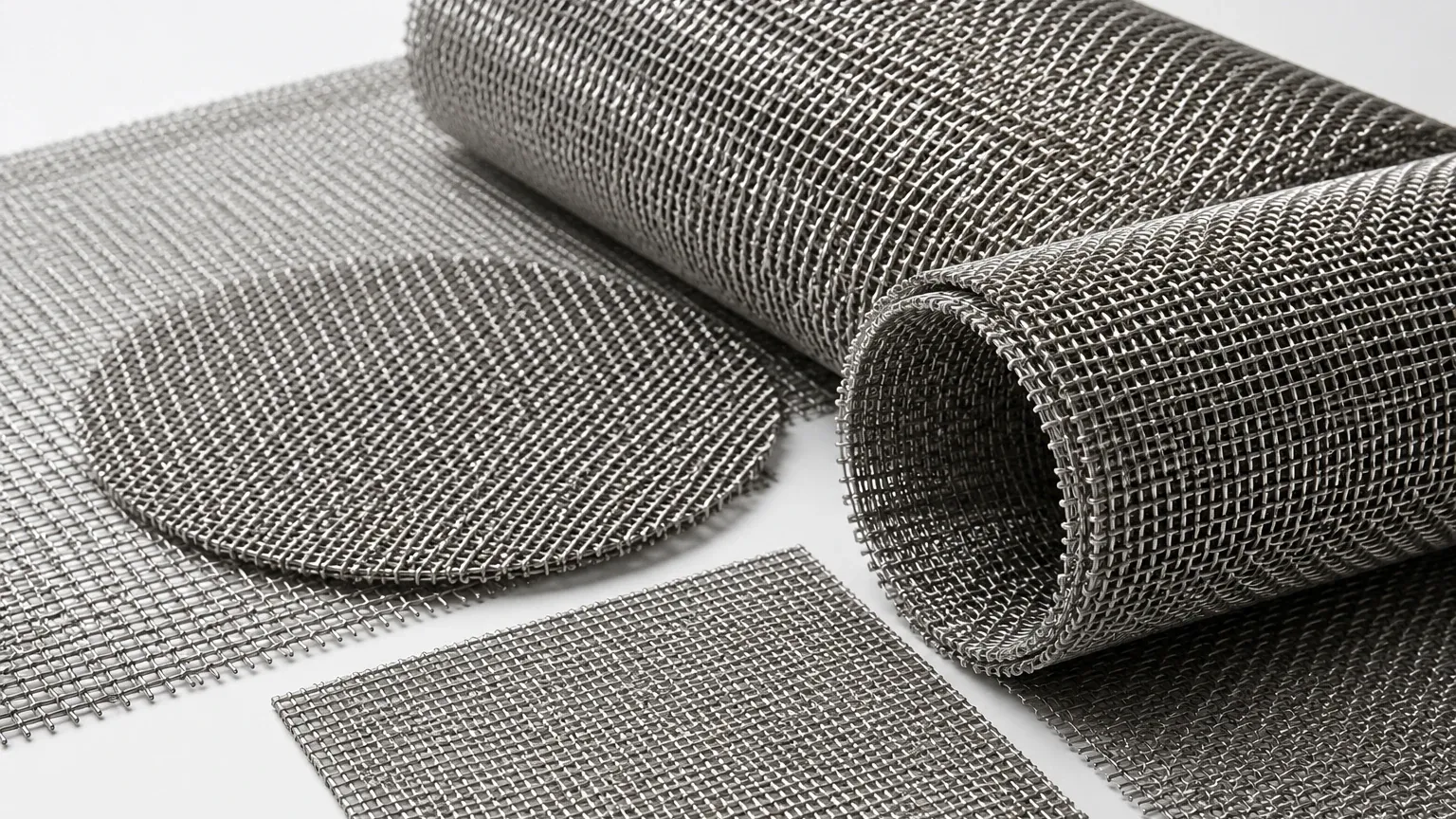
For those seeking specific configurations, Kaifil provides Plain, twill and dutch woven wire mesh in SS304/316L — rolls, cut mesh and framed panels. Send mesh count or micron target for a technical quote. to meet precise industrial requirements.
Engineering Selection: Mesh Count vs. Micron Rating
When specifying 316l stainless steel woven wire mesh, engineers must distinguish between mesh count and micron rating. These two metrics describe different aspects of the mesh's geometry and performance.
* Mesh Count: This refers to the number of openings per linear inch. A higher mesh count indicates smaller openings and finer wires. While mesh count is a standard industry descriptor, it does not account for wire diameter, which significantly affects the actual pore size.
* Micron Rating: This defines the size of the particles that the mesh can effectively retain. It is categorized into "Nominal" (the size at which a percentage of particles are retained) and "Absolute" (the size of the largest spherical particle that can pass through the mesh). For high-precision applications, such as hydraulic systems or pharmaceutical filtration, the absolute micron rating is the more critical specification.
Selecting the right balance requires calculating the Percentage Open Area (POA). A high POA reduces the velocity of the fluid passing through the mesh, which minimizes pressure drop and reduces the risk of particle "breakthrough" or mesh deformation. However, a higher POA often means thinner wires, which may reduce the structural integrity of the filter under high-pressure conditions.
Customization and OEM Capabilities for Precision Filtration
In many industrial settings, a standard roll of mesh is insufficient. Precision filtration often requires customized components designed to fit specific housings or to withstand unique operational stresses. 316l stainless steel woven wire mesh can be fabricated into various forms to enhance its utility:
1. Multi-layer Sintered Mesh: By vacuum-sintering multiple layers of mesh together, manufacturers create a composite material that combines the fine filtration of Dutch weave with the mechanical support of coarser mesh layers. This results in a rigid, durable filter medium that can withstand high-pressure backwashing.
2. Pleated Filter Cartridges: Pleating the mesh significantly increases the effective filtration surface area within a compact footprint. This extends the service life of the filter and reduces the frequency of maintenance shutdowns.
3. Framed and Reinforced Panels: For use in vibrating screens or large-scale water treatment systems, mesh is often tensioned and welded into stainless steel frames to provide dimensional stability and prevent sagging.
As a professional manufacturer, Kaifil specializes in these custom solutions, providing OEM support that ranges from material selection to the production of complex, multi-component filter assemblies. This ensures that the filtration solution is perfectly aligned with the hydraulic and chemical requirements of the system.
Evaluating Total Cost of Ownership (TCO) and Maintenance
While the initial cost of 316l stainless steel woven wire mesh may be higher than synthetic or lower-grade metal alternatives, the Total Cost of Ownership (TCO) is often significantly lower due to its durability and cleanability. Unlike disposable polymer filters, stainless steel mesh is a permanent or semi-permanent component.
Cleaning and Regeneration
One of the primary advantages of 316L mesh is its ability to be cleaned and reused. Common methods include:
* Ultrasonic Cleaning: Using high-frequency sound waves in a cleaning solution to dislodge fine particles trapped within the weave.
* Backwashing: Reversing the flow of the process fluid to push contaminants out of the mesh pores.
* Chemical Cleaning: Utilizing acids or solvents (to which 316L is resistant) to dissolve organic or mineral build-up.
Replacement Cycles
The replacement cycle for a stainless steel filter is typically determined by mechanical fatigue or irreversible blinding (clogging). In a well-designed system, a 316l stainless steel woven wire mesh filter can last for years. Engineers should monitor the differential pressure (ΔP) across the filter; a consistent increase in the "clean" pressure drop after multiple cleaning cycles usually indicates that the mesh has reached the end of its functional life.
Common Risks and Quality Assurance in Mesh Procurement
Procuring industrial mesh requires a focus on quality assurance to avoid premature system failure. There are several risks that purchasing teams and engineers should mitigate:
* Material Substitution: Without proper Material Test Reports (MTRs), it is difficult to distinguish 316L from 304 or standard 316. In a chloride-rich environment, using 304 instead of 316L can lead to rapid pitting and catastrophic failure of the filtration system.
* Dimensional Inaccuracy: Inconsistent wire diameters or irregular spacing in the weave can lead to "hot spots" where fluid velocity is too high, or areas where large particles can bypass the filter. High-quality manufacturers use automated optical inspection (AOI) to ensure the uniformity of the weave.
* Edge Fraying and Loose Wires: In applications involving high flow rates or vibrations, poorly finished mesh edges can shed wires into the downstream flow, potentially damaging sensitive equipment like pumps or valves. Proper edge treatment, such as welding or framing, is essential.
Conclusion
Selecting 316l stainless steel woven wire mesh is an investment in process reliability. Its unique combination of chemical resistance, thermal stability, and mechanical versatility makes it an indispensable tool in modern industrial filtration. By understanding the technical nuances of weave patterns, micron ratings, and fabrication options, engineering teams can design systems that achieve optimal performance while minimizing long-term operational costs.
When specifying mesh for your next project, consider the specific environmental challenges—such as chemical exposure and pressure requirements—and work with a manufacturer capable of providing verified materials and customized designs. Whether you require standard rolls or complex pleated cartridges, the integrity of the Woven Wire Mesh remains the foundation of a successful filtration strategy.
