


4mm Woven Wire Mesh
In the landscape of industrial filtration and structural separation, the selection of mesh specifications is a critical engineering decision. Among the various configurations available, 4mm woven wire mesh stands out as a robust solution for heavy-duty applications requiring a balance of high flow rates, mechanical strength, and significant particle retention. As a specialized manufacturer, Kaifil provides precision-engineered Woven Wire Mesh solutions designed to meet the rigorous demands of chemical processing, water treatment, and industrial manufacturing.
Understanding the technical nuances of 4mm mesh—ranging from material grade selection to the relationship between wire diameter and open area—is essential for procurement teams and engineers aiming to optimize system performance and longevity.
Defining 4mm Woven Wire Mesh Specifications
When discussing "4mm mesh," it is vital to distinguish between the aperture (the clear opening between wires) and the center-to-center distance. In most industrial B2B contexts, 4mm woven wire mesh refers to a mesh with a 4mm clear aperture. However, the performance of this mesh is heavily dictated by the wire diameter used in the weaving process.
Aperture vs. Wire Diameter
The aperture size determines the maximum particle size that can pass through the mesh. For a 4mm aperture, the wire diameter typically ranges from 0.8mm to 2.0mm, depending on the required structural integrity.
* Light Duty: A thinner wire (e.g., 1.0mm) increases the open area, allowing for higher flow rates but offering less resistance to mechanical impact.
* Heavy Duty: A thicker wire (e.g., 1.6mm or 2.0mm) reduces the open area but significantly enhances the mesh's ability to withstand high-pressure differentials and abrasive materials.
Weave Styles
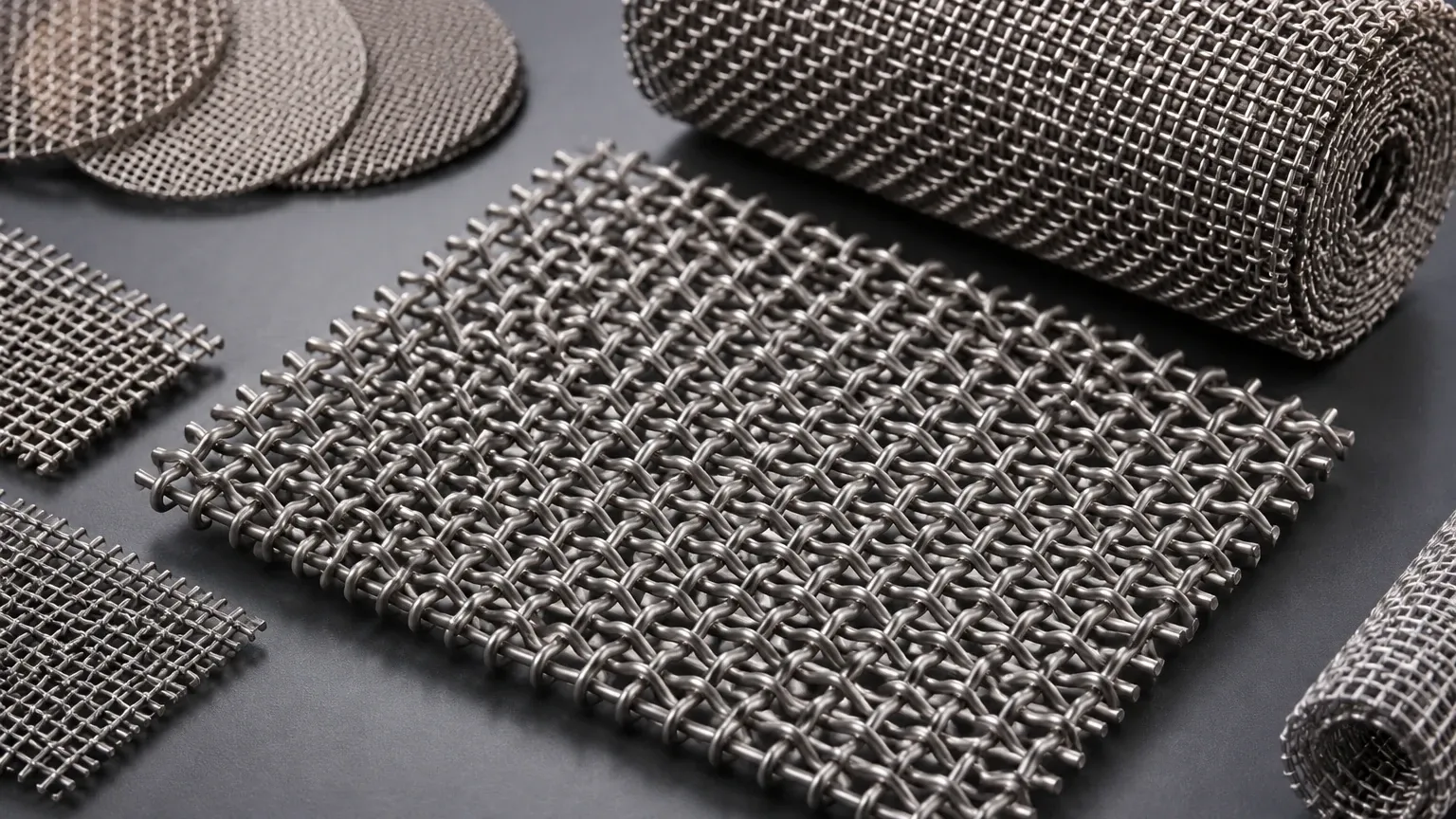
For a 4mm opening, the Plain Weave is the most common construction. In this style, each warp wire crosses alternately over and under each weft wire at 90-degree angles. This provides a stable, consistent aperture size. For specialized applications where higher stability is required under tension, Pre-Crimped weaves may be utilized, where the wires are formed into a wave pattern before being woven together, ensuring the 4mm openings remain precise even under heavy loads.
Material Selection for Industrial Environments
The choice of alloy is the primary factor in determining the chemical compatibility and thermal resistance of the mesh. At Kaifil, we focus on high-grade stainless steel to ensure durability in harsh industrial environments.
Stainless Steel 304 (SS304)
SS304 is the standard industrial grade for woven wire mesh. It offers excellent corrosion resistance in most atmospheric conditions and is widely used in food processing and general industrial screening. It is cost-effective and provides the necessary tensile strength for most 4mm aperture applications.
Stainless Steel 316L (SS316L)
For environments involving high chloride concentrations, marine exposure, or aggressive chemical processing, SS316L is the preferred choice. The addition of molybdenum enhances its resistance to pitting and crevice corrosion. In pharmaceutical and chemical filtration, 316L ensures that the mesh does not leach contaminants into the process stream, maintaining high purity standards.
High-Temperature Alloys
In applications such as heat treatment or exhaust filtration, specialized alloys like Inconel or high-chromium stainless steels may be required to prevent oxidation and maintain structural integrity at temperatures exceeding 600°C.
Engineering Performance: Open Area and Flow Dynamics
One of the most critical metrics for an engineer is the Percentage of Open Area (POA). This value determines the throughput capacity and the pressure drop across the filter or screen. For 4mm woven wire mesh, the POA is calculated using the formula:
`POA = (Aperture / (Aperture + Wire Diameter))² x 100`
Impact on Flow Rates
If a 4mm aperture mesh uses a 1.2mm wire, the open area is approximately 54.4%. If the wire diameter is increased to 1.6mm to handle higher mechanical stress, the open area drops to approximately 51%.
Engineers must balance these factors:
1. High Open Area: Lowers the initial pressure drop and reduces the energy required for pumping fluids through the system.
2. Low Open Area: Increases the structural rigidity and the lifespan of the mesh in abrasive environments but may lead to faster blinding (clogging) if the particle load is high.
Structural Integrity and Mechanical Properties
In heavy-duty industrial applications, the mesh is often subjected to vibration, tension, and impact. The mechanical properties of 4mm woven wire mesh are influenced by the crimping method and the tensile strength of the raw wire.
Tensile Strength and Fatigue Resistance
Industrial-grade stainless steel wire typically possesses high tensile strength, which is essential for maintaining the tension of the mesh in vibrating screens. Over time, constant oscillation can lead to metal fatigue. Selecting a mesh with a consistent weave and high-quality wire ensures that the 4mm apertures do not distort, which would otherwise compromise the filtration accuracy.
Edge Treatments and Framing
To integrate 4mm mesh into industrial machinery, the edges must be properly treated. Kaifil provides various finishing options:
* Raw Edges: Suitable for further fabrication or welding into custom housings.
* Hemmed or Bound Edges: Prevents fraying and provides a safer handling surface.
* Welded Frames: For use in vibrating separators or as removable filter panels, the mesh can be tensioned and welded into a stainless steel frame to ensure maximum stability.
Application Scenarios in Industrial Filtration
The versatility of 4mm woven wire mesh allows it to serve multiple roles across various sectors. Its relatively large aperture makes it ideal for "primary" or "coarse" filtration stages.
Water Treatment and Intake Screening
In municipal and industrial water treatment, 4mm mesh is frequently used as a trash screen at intake points. It effectively removes large debris, such as leaves, twigs, and plastic waste, protecting downstream pumps and finer filtration membranes from damage.
Chemical and Petrochemical Processing
In chemical reactors, 4mm mesh can serve as a catalyst support grid. It provides a stable platform for catalyst pellets while allowing the process gas or liquid to flow through with minimal resistance. The use of SS316L ensures that the grid remains intact despite exposure to corrosive reagents.
Food and Beverage Industry
During the initial processing of agricultural products, 4mm mesh is used for grading and scalping. It removes oversized contaminants or separates products by size. Because stainless steel is non-reactive and easy to sanitize, it meets the strict hygiene requirements of the FDA and other regulatory bodies.
Architectural and Security Applications
Beyond filtration, the aesthetic and structural properties of 4mm woven wire mesh make it a popular choice for architectural infill panels, machinery guards, and security screens. It provides a high level of transparency and ventilation while maintaining a formidable physical barrier.
Customization and OEM Integration
Every industrial system has unique requirements. A standard off-the-shelf mesh roll may not always suffice for complex engineering projects. Kaifil specializes in providing customized solutions that go beyond standard dimensions.
Tailored Dimensions and Shapes
Whether the project requires circular discs for extruder screens, rectangular panels for vibrating decks, or complex cylindrical shapes for basket strainers, precision cutting is essential. Utilizing advanced CNC and laser cutting technologies, we ensure that the 4mm mesh fits perfectly into the intended housing, eliminating bypass risks.
Multi-Layer Sintered Options
In some high-pressure applications, a single layer of 4mm mesh may be combined with finer mesh layers through a sintering process. This creates a composite material where the 4mm mesh acts as a drainage or support layer, providing the necessary mechanical strength while the finer layers handle the actual filtration.
Technical Consultation
Choosing the right wire diameter and alloy for a 4mm aperture requires a deep understanding of the specific application. Kaifil’s engineering team works closely with clients to evaluate factors such as flow velocity, chemical concentration, and temperature fluctuations to recommend the most cost-effective and durable mesh configuration.
Maintenance and Lifecycle Considerations
The total cost of ownership for industrial filtration components is determined not just by the purchase price, but by the maintenance requirements and replacement frequency.
Cleaning Protocols
4mm woven wire mesh is relatively easy to clean compared to finer meshes. Common methods include:
* Backwashing: Reversing the flow to dislodge trapped particles.
* Ultrasonic Cleaning: Effective for removing stubborn scale or chemical deposits in intricate weave patterns.
* Mechanical Brushing: Due to the robust nature of the 4mm aperture and thick wire, mechanical cleaning can often be performed without damaging the mesh structure.
Monitoring Wear and Tear
In abrasive applications, such as mining or aggregate screening, the wire diameter will gradually decrease over time. Regular inspections should be conducted to check for "wire thinning" or broken strands. Replacing the mesh before a total failure occurs prevents downstream contamination and unscheduled system downtime.
Sustainability and Recyclability
Stainless steel is a highly sustainable material. At the end of its service life, 4mm woven wire mesh is 100% recyclable, contributing to a circular economy and reducing the environmental footprint of industrial operations.
Conclusion
Selecting the correct 4mm woven wire mesh involves more than simply picking an aperture size. It requires a comprehensive evaluation of material science, mechanical engineering, and fluid dynamics. By focusing on high-quality stainless steel alloys and precision manufacturing, Kaifil ensures that our filtration components provide the reliability and performance required by modern industry.
For engineers and purchasing professionals looking to optimize their filtration processes, understanding these technical variables is the first step toward achieving efficient, durable, and cost-effective results. Whether you require standard rolls or custom-fabricated components, choosing a partner with deep technical expertise in Woven Wire Mesh is essential for the success of your project.
