


4×4 Woven Wire Mesh
In the landscape of industrial filtration and material separation, the selection of mesh specifications is a critical engineering decision that directly impacts throughput, durability, and process efficiency. Among the various configurations available, 4×4 woven wire mesh—commonly referred to as 4-mesh—serves as a versatile standard for coarse screening, protective barriers, and support structures. This guide examines the technical parameters, material considerations, and application-specific logic required for engineers and procurement teams to integrate this mesh effectively into industrial systems.
Understanding the Specifications of 4×4 Woven Wire Mesh
The term "4×4" in the context of Woven Wire Mesh indicates the mesh count, specifically that there are four openings per linear inch in both the warp and shute directions. While this might seem straightforward, the performance of the mesh is dictated by the relationship between the wire diameter and the resulting aperture size.
Mesh Count and Aperture Calculation
To determine the functional opening (aperture) of a 4-mesh screen, engineers must subtract the wire diameter from the center-to-center spacing of the wires. For a 4-mesh screen, the center-to-center distance is 0.250 inches (6.35 mm). If a standard wire diameter of 0.047 inches (1.19 mm) is used, the aperture is 0.203 inches (5.16 mm).
Changing the wire diameter significantly alters the mesh's characteristics:
- Thicker Wire: Increases the structural integrity and wear resistance but reduces the percentage of open area, which can limit flow rates or lead to higher pressure drops in filtration applications.
- Thinner Wire: Maximizes the open area and throughput but may require additional support structures to prevent deformation under mechanical loads or high-pressure differentials.
Percentage of Open Area
The open area is a vital metric for calculating flow capacity. It is expressed as a percentage and is calculated using the formula:
`Open Area % = (Aperture / (Aperture + Wire Diameter))^2 x 100`.
For a typical 4×4 woven wire mesh, the open area often ranges between 60% and 80%, making it an excellent choice for high-volume fluid or gas flow where minimal resistance is required.
Material Selection for Industrial Environments
Kaifil specializes in manufacturing filtration components from high-performance alloys. For 4-mesh applications, the choice of material is usually driven by the chemical environment, temperature, and hygiene requirements of the specific industry.
Stainless Steel 304
SS304 is the most common material for industrial wire mesh. It provides excellent mechanical properties and basic corrosion resistance. It is suitable for architectural applications, general machinery guards, and food processing environments where exposure to harsh chemicals is limited.
Stainless Steel 316L
For more demanding environments, such as chemical processing or marine applications, SS316L is the preferred choice. The addition of molybdenum enhances resistance to pitting and crevice corrosion, particularly in chloride-rich environments. In pharmaceutical and high-purity chemical filtration, 316L is often mandated to ensure no metallic contamination occurs during the process.
Specialty Alloys
In high-temperature or highly acidic environments, materials like Monel, Inconel, or Hastelloy may be required. These alloys maintain their structural integrity at temperatures where standard stainless steels might oxidize or lose tensile strength.
Engineering Considerations: Strength vs. Performance
When specifying 4×4 woven wire mesh, engineers must evaluate the mechanical stresses the mesh will encounter. Unlike finer meshes used for precision filtration, 4-mesh is often subjected to physical impact or heavy material loads.
Weave Types
While most 4×4 mesh is produced using a Plain Weave (where each shute wire passes over and under one warp wire), other weave styles are available depending on the application. For instance, if the mesh is intended to be a substrate for a finer filter cloth, the flatness and stability of the weave are paramount.
For specialized requirements, Kaifil provides Plain, twill and dutch woven wire mesh in SS304/316L — rolls, cut mesh and framed panels. Send mesh count or micron target for a technical quote. to ensure the structure matches the specific pressure and particle retention needs of the project.
Mechanical Stability
In vibrating screen applications, the mesh must resist "blinding" (clogging) and fatigue. The wire diameter must be large enough to withstand the constant oscillation without snapping. Furthermore, the crimping style—whether plain crimp, lock crimp, or intercrimp—affects how the wires remain seated. For a 4×4 mesh, a lock crimp is often used to ensure the wires do not shift, maintaining a consistent aperture size throughout the service life of the component.
Applications in Industrial Filtration and Separation
The coarse nature of 4×4 woven wire mesh makes it suitable for various primary and secondary industrial roles. It is rarely used as a final filter for fine particulates but is indispensable in the following areas:
1. Pre-Filtration and Trash Racks
In water treatment and hydraulic systems, 4-mesh screens act as the first line of defense. They remove large debris, such as stones, wood chips, or plastic fragments, protecting downstream pumps and high-precision filter cartridges from damage.
2. Catalyst Support and Bed Retention
In chemical reactors, heavy-duty woven mesh is used to support catalyst beds. The 4×4 configuration provides a robust platform that can support the weight of the catalyst while allowing the reaction gases or liquids to pass through with minimal pressure loss.
3. Sifting and Scalping
In the food and beverage industry, 4-mesh is used for "scalping"—the removal of oversized lumps or foreign objects from bulk raw materials like grain or sugar. Because it can be manufactured in food-grade SS304 or SS316L, it meets stringent hygiene standards and can withstand frequent CIP (Clean-in-Place) cycles.
4. Heat Treatment and Drying Trays
The high open area of 4-mesh makes it ideal for industrial drying trays and heat treatment baskets. It allows for maximum airflow or heat distribution around the parts being processed, ensuring uniform results and reducing cycle times.
Customization and Fabrication Options
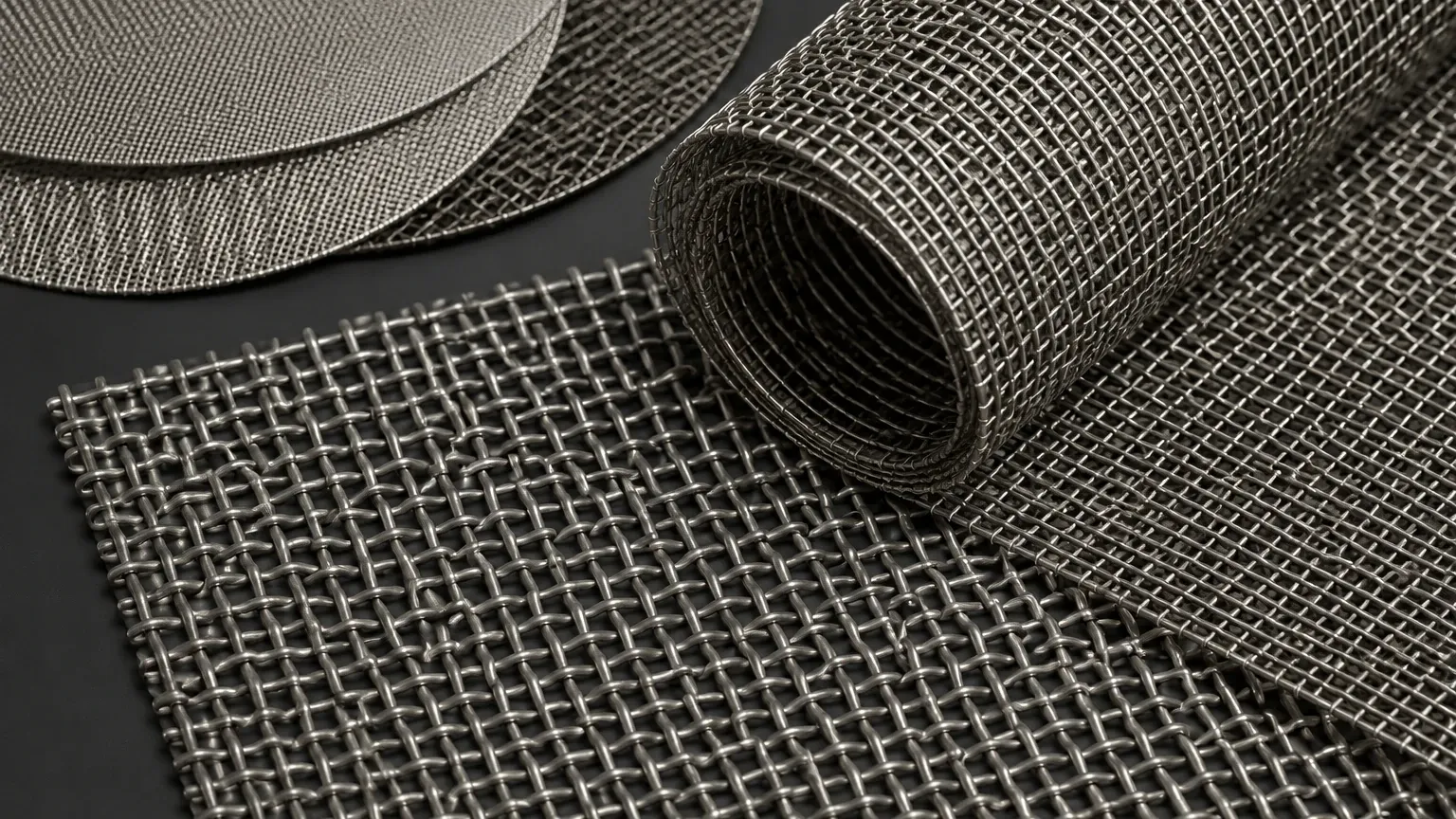
Standard rolls of mesh are often just the starting point. Most industrial applications require some level of customization to integrate the mesh into existing equipment. Kaifil’s manufacturing capabilities allow for several fabrication options that enhance the utility of the 4×4 woven wire mesh.
- Cut-to-Size Pieces: Precision laser or waterjet cutting ensures that the mesh edges are clean and the dimensions are exact, which is critical for fitting into recessed grooves or filter housings.
- Framed Panels: For use in vibrating screens or architectural partitions, the mesh can be welded into rigid frames. This prevents sagging and simplifies the replacement process.
- Edge Treatments: To prevent fraying and to protect operators, edges can be hemmed, bound with metal U-binding, or annealed to allow for easier forming.
- Multi-Layer Sintering: In some high-pressure hydraulic applications, a 4×4 mesh is used as a drainage or support layer, sintered together with finer mesh layers to create a composite filter element that combines high strength with fine filtration accuracy.
Quality Control and Performance Evaluation
When purchasing industrial mesh, it is vital to confirm that the product meets the stated technical specifications. Deviations in wire diameter or mesh count can lead to process inconsistencies or premature failure.
Verification Metrics
1. Dimensional Accuracy: Verification of the mesh count (4 openings per inch) and wire diameter using calibrated micrometers.
2. Material Certification: Positive Material Identification (PMI) testing to ensure the alloy composition (e.g., Chromium and Nickel levels in SS316L) matches the order requirements.
3. Flatness and Squareness: For panels, ensuring the weave is square and the surface is free from bows or ripples that could affect installation.
Total Cost of Ownership (TCO)
While the initial purchase price is a factor, engineers should consider the total cost of ownership. A cheaper mesh with inconsistent wire quality may suffer from accelerated corrosion or mechanical fatigue, leading to frequent downtime. Investing in high-quality Woven Wire Mesh from a manufacturer with proven OEM experience ensures longer replacement cycles and more predictable process performance.
Conclusion: Selecting the Right Solution
Choosing the correct 4×4 woven wire mesh requires a balance of material science and mechanical engineering. Whether the goal is to protect a high-pressure pump, support a chemical catalyst, or screen food products, the specific wire diameter and alloy choice will dictate the success of the application.
Before proceeding with a purchase, technical teams should confirm the following:
- The exact chemical composition of the fluid or gas being filtered.
- The maximum operating temperature and pressure differential.
- The required mechanical strength and whether the mesh will be a standalone component or part of a multi-layer assembly.
By focusing on these factual boundaries and engineering requirements, procurement teams can ensure they receive a filtration solution that is optimized for both performance and durability. For those requiring specific configurations, including various weave patterns and material grades, consulting with a specialized manufacturer like Kaifil provides the technical support necessary to move from general specifications to a high-performance industrial component.
