


Arrow Metal Brass Woven Wire Mesh: A Technical Guide for Industrial and Architectural Applications
In the landscape of industrial filtration and material science, selecting the appropriate medium requires a deep understanding of metallurgical properties, weave structures, and environmental compatibility. While stainless steel often dominates the conversation due to its ubiquity, brass woven wire mesh remains a critical component in specialized engineering sectors. High-quality standards, such as those exemplified by arrow metal brass woven wire mesh, provide a benchmark for precision, durability, and functional aesthetics.
For engineers and procurement professionals, the decision to utilize brass over other alloys involves balancing mechanical strength against specific requirements like electrical conductivity, spark resistance, and corrosion behavior in marine or alkaline environments. This guide examines the technical nuances of brass mesh, the engineering considerations for its implementation, and how it fits within the broader category of Woven Wire Mesh.
Understanding the Composition and Properties of Brass Mesh
Brass is a non-ferrous alloy primarily composed of copper and zinc. The ratios of these two elements significantly influence the mechanical and chemical properties of the resulting wire. In the production of arrow metal brass woven wire mesh, common alloys include 270 yellow brass (approximately 65% copper and 35% zinc) or 260 cartridge brass (70% copper and 30% zinc).
Key Material Characteristics
1. Corrosion Resistance: Brass offers excellent resistance to corrosion, particularly in fresh water and many organic solvents. However, it is susceptible to "dezincification" in certain acidic or high-chloride environments, where the zinc is selectively leached out, leaving a porous copper structure. For these specific cases, engineers often pivot toward stainless steel alternatives.
2. Electrical and Thermal Conductivity: Brass is significantly more conductive than stainless steel. This makes it a preferred choice for EMI (Electromagnetic Interference) shielding and RFI (Radio Frequency Interference) shielding in electronics and aerospace applications.
3. Malleability and Workability: Brass wire is softer and more ductile than stainless steel. This allows for easier forming, pleating, and shaping into complex filter geometries without the risk of work-hardening-induced brittleness found in some ferrous alloys.
4. Non-Sparking Nature: Unlike steel, brass does not produce sparks when struck. This is a critical safety feature in environments involving volatile gases or explosive dust, such as in chemical processing plants or fuel filtration systems.
Technical Specifications and Weave Patterns
The performance of a woven wire mesh is determined not just by the material, but by the geometry of the weave. The manufacturing process involves a loom where warp wires (running lengthwise) and shute wires (running crosswise) are interlaced.
Common Weave Types for Brass Mesh
* Plain Weave: The most common and simplest pattern where each shute wire passes over and under one warp wire. It provides high precision for aperture sizes and is used extensively in general screening and low-pressure filtration.
* Twill Weave: Each shute wire passes over and under two warp wires in a staggered pattern. This allows for a heavier wire diameter to be used for a given mesh count, increasing the mechanical strength and durability of the mesh.
* Dutch Weave (Plain and Twill): These weaves utilize different diameters for warp and shute wires, resulting in a dense, compact mesh with no visible apertures when viewed directly. This is the standard for high-pressure liquid filtration and fine particulate separation.
For those requiring specific configurations, Kaifil offers Plain, twill and dutch woven wire mesh in SS304/316L — rolls, cut mesh and framed panels. Send mesh count or micron target for a technical quote. to ensure the filtration accuracy meets the rigorous demands of industrial systems.
Comparing Brass with Stainless Steel Filtration Media
When specifying materials for a filtration project, engineers must weigh the benefits of brass against the industry-standard stainless steel (SS304 and SS316L).
When to Choose Brass
* Acoustic and Aesthetic Applications: In architectural projects, brass is often chosen for its gold-like appearance and its ability to develop a natural patina over time.
* Conductive Requirements: If the mesh must act as a ground or a shield for electrical components.
* Low-Friction Needs: Brass has a lower coefficient of friction than stainless steel, which can be beneficial in certain mechanical screening processes where material flow is a concern.
When to Choose Stainless Steel
* High-Temperature Environments: Stainless steel maintains its structural integrity at much higher temperatures than brass, which begins to soften and lose tensile strength above 200°C (392°F).
* Aggressive Chemical Exposure: For filtration involving strong acids or high concentrations of chlorides, SS316L (containing molybdenum) provides far superior pitting resistance compared to any brass alloy.
* High-Pressure Filtration: The higher tensile strength of stainless steel allows for thinner wires to withstand greater pressure differentials across the filter element.
Industrial Applications: From EMI Shielding to Precision Filtration
The versatility of arrow metal brass woven wire mesh allows it to bridge the gap between industrial utility and architectural design.
1. EMI/RFI Shielding
In the telecommunications and defense industries, brass mesh is integrated into enclosures to prevent electromagnetic leakage. The high copper content provides the necessary conductivity to attenuate signals, protecting sensitive electronics from interference.
2. Filtration and Separation
Brass mesh is frequently used in the filtration of hydraulic fluids, fuels, and lubricants. Its non-sparking properties are particularly valued in the oil and gas sector. In water treatment, it serves as a pre-filter to remove larger debris before the water reaches finer polishing stages.
3. Architectural and Interior Design
Beyond industrial use, brass mesh is a staple in architectural design. It is used for wall coverings, ceiling panels, and room dividers. The ability to specify custom open areas and wire diameters allows architects to control light diffusion and airflow while maintaining a high-end aesthetic.
4. Extrusion and Plastic Processing
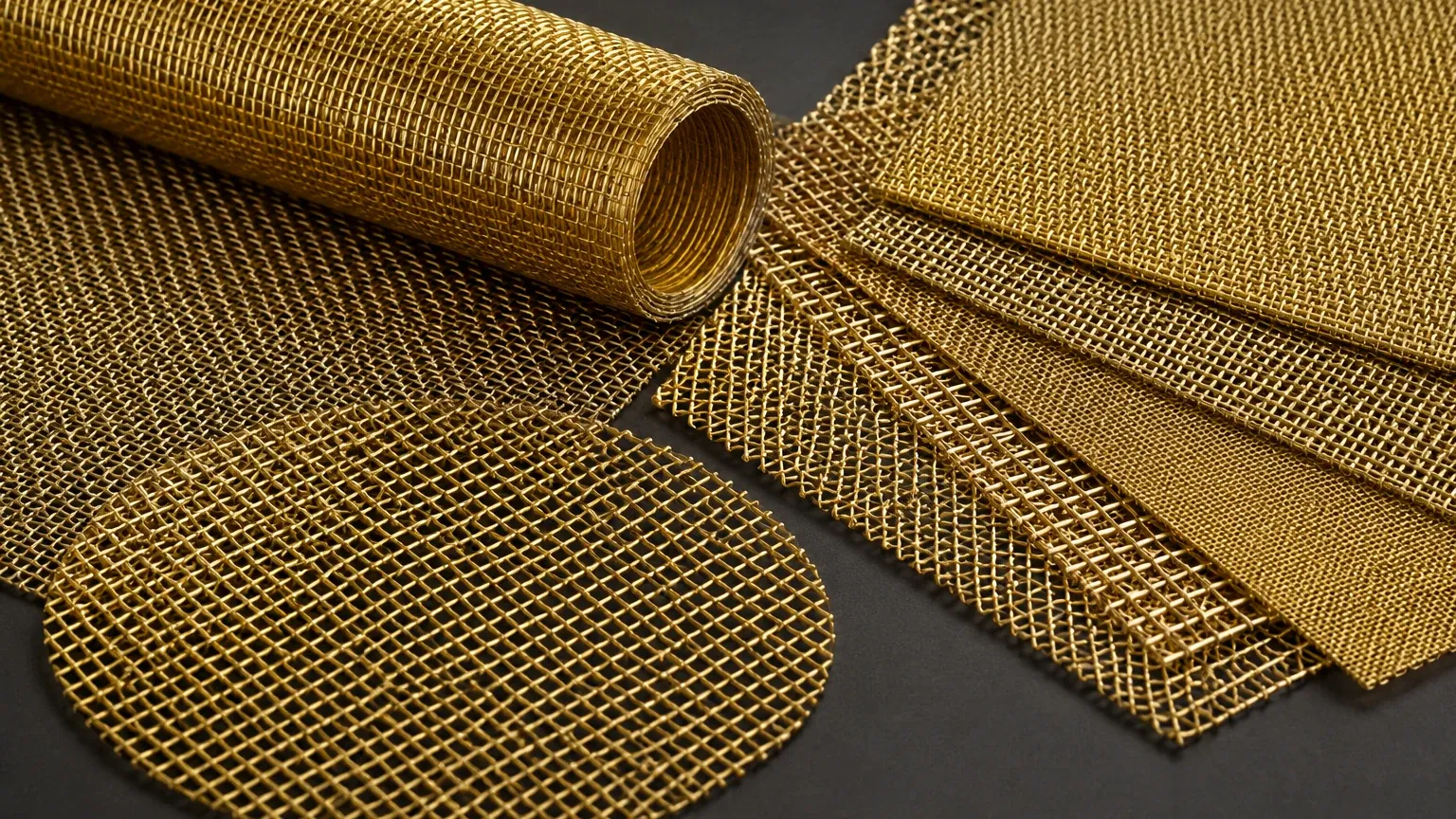
In the plastics industry, brass mesh circles are often used in extruder screen packs. The relative softness of the brass ensures that the mesh does not damage the expensive steel surfaces of the extruder if a screen break occurs.
Engineering Considerations for Selection and Customization
To ensure optimal performance and cost-effectiveness, engineers must confirm several technical parameters before finalizing a mesh order.
Mesh Count vs. Micron Rating
Mesh count refers to the number of openings per linear inch. However, for filtration, the micron rating (the size of the smallest particle the mesh will reliably trap) is more critical. It is essential to calculate the effective aperture size by subtracting the wire diameter from the pitch (the distance from the center of one wire to the next).
Open Area Percentage
The open area determines the flow rate and pressure drop across the mesh. A higher open area allows for greater throughput but may compromise the structural stability of the mesh panel. Engineers must find the "sweet spot" where the mesh is strong enough to withstand the system pressure without significantly impeding the flow.
Edge Treatment and Fabrication
How the mesh is finished is just as important as the weave itself. Options include:
* Cut-to-Size: Precise dimensions for integration into existing frames.
* Framed Panels: Mesh secured within a metal U-binding or welded frame for structural support.
* Sintering: For extreme durability, multiple layers of mesh can be sintered (diffusion bonded) together to create a rigid, high-strength filter plate.
Maintenance and Longevity in Demanding Environments
The total cost of ownership (TCO) for a filtration system is heavily influenced by the replacement cycle and ease of maintenance.
1. Cleaning Protocols: Brass mesh can be cleaned using ultrasonic baths, backwashing, or mild chemical cleaners. It is important to avoid harsh acids that could trigger dezincification.
2. Monitoring Pressure Drop: A sudden increase in pressure drop across the mesh usually indicates blinding (clogging). Regular monitoring allows for scheduled cleaning before the mesh undergoes mechanical deformation.
3. Environmental Monitoring: In marine environments, brass should be monitored for signs of green patina (verdigris). While this layer can protect the underlying metal, in filtration applications, it can change the aperture size and affect performance.
Conclusion
Whether used for its conductive properties in high-tech shielding or its durable filtration capabilities in industrial machinery, arrow metal brass woven wire mesh remains a vital engineering material. By understanding the specific alloy characteristics, weave patterns, and environmental limitations, technical professionals can make informed decisions that optimize both performance and longevity.
For projects requiring the highest standards of precision and material reliability, Kaifil provides comprehensive support in selecting the right filtration media. From standard rolls to customized framed panels, our expertise in Woven Wire Mesh ensures that your application—whether industrial, chemical, or architectural—is supported by the highest quality components available in the global market.
