


Buy Woven Wire Mesh
In industrial filtration and separation, the selection of woven wire mesh is a critical engineering decision that impacts the efficiency, longevity, and safety of a process. Whether the application involves chemical processing, pharmaceutical manufacturing, or hydraulic systems, the specific properties of the mesh—ranging from alloy composition to weave geometry—determine its performance under pressure and corrosive conditions.
When technical professionals and purchasing teams look to buy woven wire mesh, the process extends beyond simple price comparisons. It requires a deep understanding of material science, filtration physics, and manufacturing tolerances. This guide provides the factual framework necessary to navigate the complexities of mesh procurement, ensuring that the final product meets the rigorous demands of industrial environments.
Understanding Material Selection for Industrial Environments
The foundation of any high-performance filter is the material from which it is constructed. In the realm of industrial filtration, stainless steel remains the gold standard due to its mechanical strength and resistance to oxidation. However, selecting the specific grade is vital for preventing premature failure.
SS304 vs. SS316L
Most industrial applications utilize either Grade 304 or Grade 316L stainless steel.
* Grade 304: This is the most common stainless steel used in wire mesh. It offers excellent resistance to atmospheric corrosion and is suitable for most food-grade applications and general industrial use where high concentrations of chlorides are not present.
* Grade 316L: The "L" stands for low carbon, which improves weldability and prevents sensitization. Grade 316 contains molybdenum, which significantly enhances resistance to pitting and crevice corrosion in chloride-rich environments, such as marine applications or chemical processing involving salts and acids.
For specialized applications involving extreme temperatures or highly aggressive chemicals, manufacturers like Kaifil may also provide specialty alloys such as Monel, Inconel, or Hastelloy. Confirming the chemical compatibility of the mesh material with the process fluid is the first step in the procurement process.
Technical Specifications: Mesh Count, Wire Diameter, and Aperture
To buy woven wire mesh that performs as intended, engineers must specify three interdependent variables: mesh count, wire diameter, and aperture size. These factors collectively determine the filtration rating and the structural integrity of the mesh.
1. Mesh Count
The mesh count refers to the number of openings per linear inch (25.4 mm). A higher mesh count indicates a finer mesh with smaller openings. However, mesh count alone does not define the filtration capability, as it must be considered alongside the wire diameter.
2. Wire Diameter
This is the thickness of the wire before weaving. Choosing a larger wire diameter increases the mechanical strength and wear resistance of the mesh but reduces the open area. Conversely, a thinner wire increases the open area and flow rate but may result in a more fragile mesh that requires additional support structures.
3. Aperture (Opening Size)
The aperture is the clear distance between two adjacent wires. This is the most critical dimension for filtration, as it determines the maximum particle size that can pass through the mesh. The relationship is defined by the formula:
Aperture = (1 / Mesh Count) – Wire Diameter
4. Percentage of Open Area
The open area is the ratio of the area of the openings to the total area of the mesh. A higher open area results in a lower pressure drop across the filter and higher flow rates. Engineers must balance the need for high flow with the requirement for structural stability, especially in high-pressure hydraulic or gas filtration systems.
Analysis of Weave Types and Their Functional Roles
The method by which wires are interlaced—the weave type—fundamentally changes the characteristics of the Woven Wire Mesh. Different weaves are engineered to solve specific industrial challenges, from high-flow requirements to sub-micron particle retention.
Plain Weave
This is the most common and straightforward weave. Each warp wire (running lengthwise) passes alternately over and under each weft wire (running crosswise). Plain weave provides a high percentage of open area and is ideal for general screening and low-pressure filtration applications.
Twill Weave
In a twill weave, each warp wire passes over and under two successive weft wires. This allows for the use of heavier wires in a given mesh count compared to plain weave. Twill weave is often selected when the mesh needs to support heavier loads or when a higher degree of flexibility is required for forming the mesh into specific shapes, such as pleated cartridges.
Dutch Weave (Plain and Twill)
Dutch weaves utilize different diameters for the warp and weft wires. The weft wires are driven closely together, creating a dense, wedge-shaped opening.
* Plain Dutch Weave: Offers high mechanical strength and is suitable for high-pressure filtration.
* Twill Dutch Weave: Allows for the finest filtration ratings, often reaching down to the micron level. Because the openings are curved and tortuous, it provides excellent particle retention and is easier to clean via backwashing.
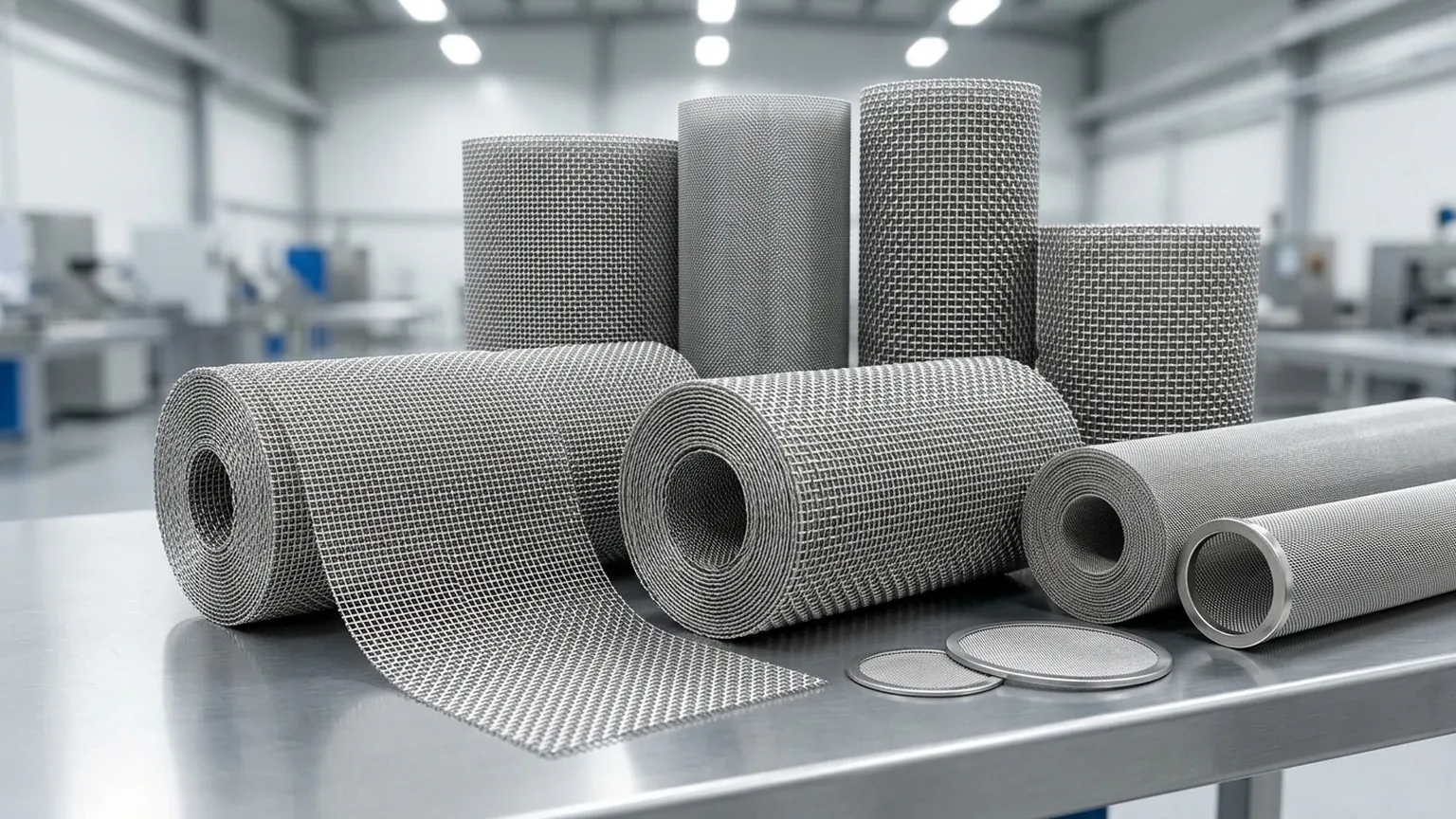
For those looking to Plain, twill and dutch woven wire mesh in SS304/316L — rolls, cut mesh and framed panels. Send mesh count or micron target for a technical quote., understanding these weave geometries is essential for matching the mesh to the specific pressure and particle size requirements of the project.
Engineering Considerations: Tolerances and Quality Standards
Industrial filtration is a precision science. When you buy woven wire mesh, the consistency of the aperture size across the entire surface area is paramount. Inconsistent openings lead to "bypass," where particles larger than the target rating pass through the filter, potentially damaging downstream equipment or contaminating the final product.
Manufacturing Tolerances
High-quality manufacturers adhere to international standards such as ISO 9044 or ASTM E2011. These standards dictate the allowable variations in wire diameter and aperture size. For critical pharmaceutical or aerospace applications, requesting a certificate of conformance or a material test report (MTR) is a standard industry practice to ensure the mesh meets the specified tolerances.
Surface Finish and Cleanliness
In the food and beverage and pharmaceutical industries, the surface finish of the mesh is a critical factor. Burrs or oil residues from the weaving process can contaminate the product. Precision metal filter components often undergo ultrasonic cleaning or electropolishing to ensure a sterile, smooth surface that resists bacterial growth and is easy to sanitize.
The Procurement Process: Confirming Project Requirements
To ensure a successful purchase, the intended project audience should confirm several key parameters before finalizing an order. This proactive approach minimizes the risk of receiving unsuitable materials and helps in calculating the total cost of ownership.
1. Filtration Rating (Micron Size): Clearly define the absolute or nominal filtration rating required. If the target is unknown, providing the particle size distribution of the contaminant can help the manufacturer recommend the appropriate mesh.
2. Flow Rate and Pressure Drop: Determine the maximum allowable pressure drop across the filter at the required flow rate. This will influence the choice of open area and weave type.
3. Physical Dimensions and Form: Specify whether the mesh is needed in bulk rolls, cut-to-size pieces, or fabricated into specific components like framed panels, cylinders, or multi-layer sintered discs.
4. Operating Environment: Provide details on the operating temperature, chemical exposure, and mechanical stresses (such as vibration or pressure surges) the mesh will encounter.
5. Customization and OEM Needs: For equipment manufacturers, sourcing a custom-engineered filtration component can simplify assembly and improve machine performance. Kaifil specializes in custom stainless steel filtration solutions, working closely with global customers to develop products tailored to specific OEM requirements.
Common Risks and How to Avoid Them
Procuring industrial mesh involves navigating several risks that can impact the long-term viability of the filtration system.
Material Substitution
A common risk in the global supply chain is the substitution of lower-grade alloys (like SS201) for specified high-grade alloys (like SS316). Lower-grade alloys lack the nickel and molybdenum content required for corrosion resistance. Verification through Positive Material Identification (PMI) testing can mitigate this risk.
Inaccurate Micron Ratings
Not all "10-micron" meshes are created equal. Some manufacturers may quote nominal ratings (which allow some percentage of larger particles through) instead of absolute ratings. It is vital to clarify the testing methodology used to determine the filtration rating.
Structural Failure
Using a mesh that is too fine for the system pressure without adequate support can lead to "blinding" (clogging) or mechanical failure. In high-pressure hydraulic applications, multi-layer mesh or sintered wire mesh—where multiple layers are bonded together through heat and pressure—may be necessary to provide the required strength while maintaining fine filtration.
Conclusion
Woven wire mesh is a sophisticated engineering component that requires careful selection based on material properties, weave geometry, and precise technical specifications. By focusing on factual data—such as aperture size, alloy composition, and manufacturing standards—engineers and purchasing teams can ensure they buy woven wire mesh that provides reliable, long-term performance in demanding industrial applications.
Whether the goal is to protect sensitive hydraulic valves, ensure the purity of a pharmaceutical batch, or optimize a chemical separation process, the right filtration solution begins with a technical partnership. Manufacturers like Kaifil provide the manufacturing expertise and engineering support necessary to transform raw wire mesh into high-performance filtration components that meet the specific needs of global industrial sectors.
