


High Temperature Woven Wire Mesh: An Engineering Guide to Selection and Performance
In industrial filtration and thermal processing, the structural integrity of a filter medium is often tested by extreme thermal loads. While standard Woven Wire Mesh serves a broad range of ambient-temperature applications, specialized high temperature woven wire mesh is required when operating environments exceed the physical limits of common austenitic stainless steels. For engineers and procurement teams, selecting the correct alloy and weave structure is not merely a matter of filtration accuracy; it is a critical decision that impacts safety, maintenance intervals, and the total cost of ownership.
This guide examines the technical variables of high-heat mesh applications, providing the factual foundation necessary to specify components that withstand oxidation, creep, and thermal cycling.
The Fundamentals of Thermal Stability in Wire Mesh
When a metal mesh is subjected to elevated temperatures, it undergoes several physical and chemical changes. The term "high temperature" in an industrial context generally refers to environments exceeding 500°C (932°F). At these levels, the mechanical properties of the wire—such as tensile strength and hardness—begin to degrade significantly.
High temperature woven wire mesh is engineered to maintain its geometric stability under these conditions. This is achieved through the use of specific alloys that form a protective oxide layer on the wire surface, preventing further atmospheric corrosion or "scaling." Without this stability, the mesh openings would distort, leading to a loss of filtration precision, or the wires would become brittle and fail under the mechanical stresses of fluid flow or vibration.
Material Selection: Beyond Standard Stainless Steel
Material selection is the most influential factor in the performance of high-heat filtration components. While Plain, twill and dutch woven wire mesh in SS304/316L — rolls, cut mesh and framed panels. Send mesh count or micron target for a technical quote. are the industry standards for general corrosion resistance, their utility diminishes as temperatures climb.
Stainless Steel 304 and 316L
These grades are suitable for continuous service up to approximately 800°C to 870°C in oxidizing atmospheres. However, they are prone to carbide precipitation in the 425°C–860°C range, which can lead to intergranular corrosion. In high-temperature filtration, 316L is often preferred over 304 due to its molybdenum content, providing slightly better resistance to pitting, though neither is considered a true "high-heat" alloy for extreme furnace or exhaust applications.
Stainless Steel 310S
Grade 310S is a high-chromium, high-nickel austenitic stainless steel designed specifically for high-temperature service. It can withstand continuous operation at temperatures up to 1100°C (2012°F). The high chromium content facilitates the formation of a stable chromic oxide scale, which protects the underlying metal from further oxidation. This makes 310S an ideal candidate for high temperature woven wire mesh used in kiln liners, furnace parts, and heat exchangers.
Stainless Steel 314
Similar to 310S but with a higher silicon content (approx. 1.5% to 3%), Grade 314 offers even better resistance to oxidation and carburization. It is particularly effective in environments where the mesh is exposed to fluctuating temperatures, as the silicon enhances the adherence of the protective oxide scale.
Inconel and Special Alloys
For environments exceeding 1100°C or those involving highly corrosive gases at heat, nickel-chromium-iron alloys like Inconel 600 or 601 are utilized. These alloys maintain high tensile strength at temperatures where stainless steels would experience rapid creep and structural failure.
Engineering Considerations: Creep, Oxidation, and Expansion
When specifying high temperature woven wire mesh, engineers must account for three primary physical phenomena that do not typically affect room-temperature filtration.
1. Creep Resistance
Creep is the tendency of a solid material to move slowly or deform permanently under the influence of persistent mechanical stresses. In a filter cartridge or mesh screen, the pressure of the fluid being filtered acts as a constant stress. At high temperatures, this stress can cause the wires to stretch. If the mesh is not rated for the specific temperature-load combination, the pore size will enlarge, allowing oversized particles to pass through the system.
2. Oxidation and Scaling
As the temperature rises, the rate of chemical reaction between the metal and the surrounding oxygen increases. Scaling occurs when the oxide layer grows too thick and flakes off, exposing fresh metal to further oxidation. This process eventually thins the wire diameter, reducing the structural integrity of the mesh. High temperature woven wire mesh must be selected based on its ability to form a "tenacious" oxide layer—one that sticks to the metal rather than flaking off.
3. Thermal Expansion
All metals expand when heated. In a constrained filtration system, such as a mesh disc welded into a heavy stainless steel housing, the mesh may expand at a different rate than the housing. This differential expansion can lead to buckling of the mesh or failure of the weld points. Engineers must calculate the thermal expansion coefficients of both the mesh and the support structure to ensure compatibility across the entire operating temperature range.
Weave Structures for High-Heat Applications
The mechanical performance of the mesh is also dictated by its weave pattern. Different weaves offer varying levels of stability and flow resistance, which become critical when the metal is softened by heat.
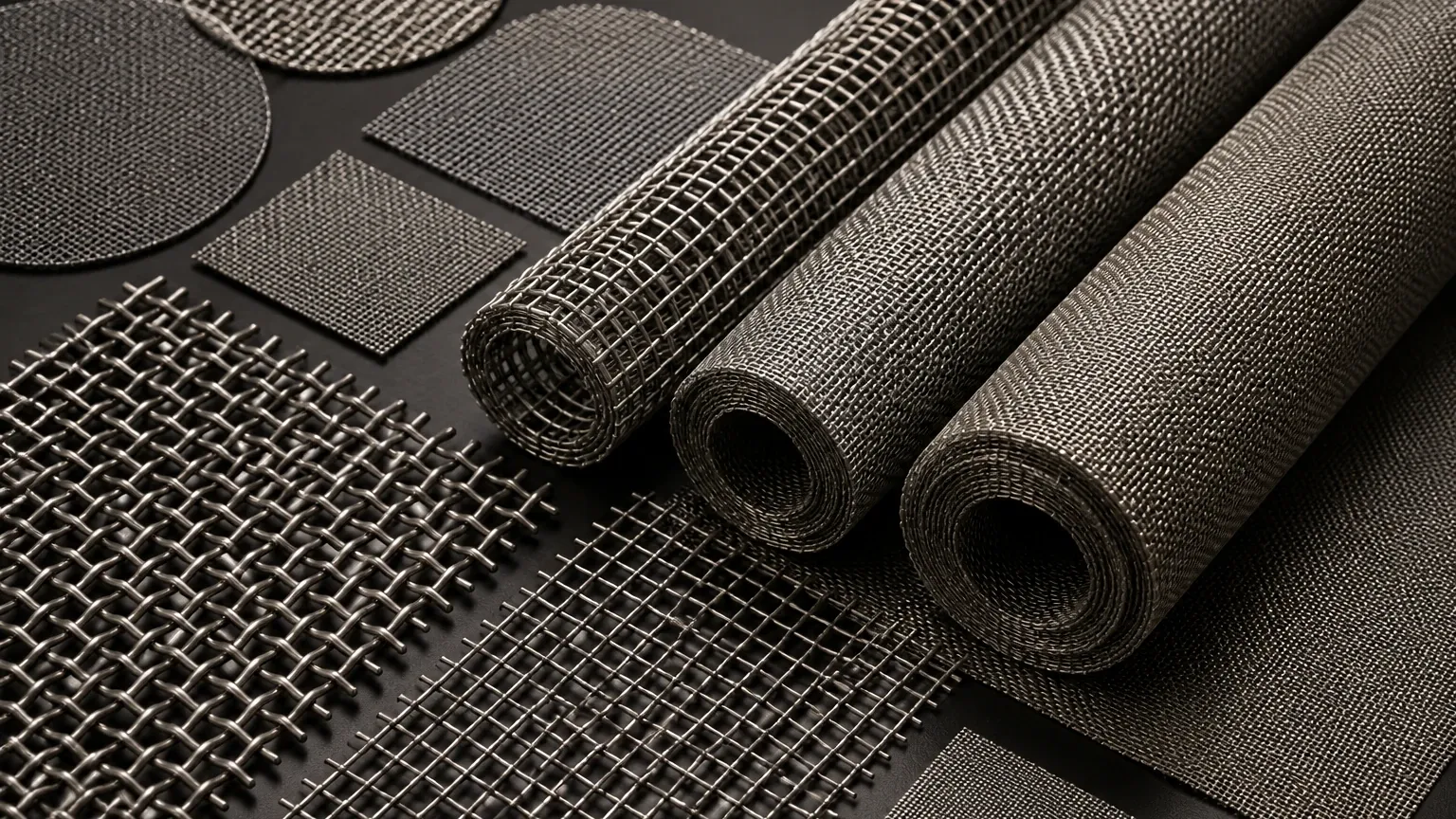
* Plain Weave: The simplest structure, where each warp wire crosses over and under each shute wire. It provides the highest open area but may be more susceptible to distortion under high-heat mechanical loads.
* Twill Weave: Each shute wire passes over and under two warp wires. This allows for a heavier wire diameter for a given mesh count, increasing the overall strength and heat capacity of the mesh compared to a plain weave of the same micron rating.
* Dutch Weave (Plain and Twill): These weaves feature a higher density of wires, creating a tortuous path for filtration. In high-temperature scenarios, Dutch weaves are often preferred for their superior mechanical strength and resistance to pressure-induced deformation. They are commonly used in high-pressure hydraulic filters and polymer melt filtration.
For those seeking specific configurations, Kaifil provides Woven Wire Mesh in various weave patterns tailored to balance filtration efficiency with thermal durability.
Common Risks and Failure Modes
Understanding why high temperature woven wire mesh fails is essential for optimizing replacement cycles. Most failures in these environments are not due to a lack of filtration but rather a loss of material integrity.
Thermal Fatigue
This occurs in processes characterized by frequent thermal cycling (repeated heating and cooling). The constant expansion and contraction create internal stresses within the wire. Over time, these stresses lead to micro-cracks, eventually resulting in the brittle fracture of the wires. Selecting alloys with high ductility can mitigate this risk.
Carburization
In environments rich in carbon (such as petrochemical processing), carbon can diffuse into the metal mesh at high temperatures. This forms internal carbides that make the wire extremely brittle. Once carburized, the mesh can shatter like glass if subjected to mechanical shock or vibration.
Metal Dusting
A specific and catastrophic form of carburization, metal dusting occurs in carbon-rich atmospheres between 400°C and 800°C. It turns the solid metal into a fine dust of metal particles and graphite. If your process involves syngas or hydrocarbon processing, the selection of high-nickel alloys for your mesh is mandatory to prevent this phenomenon.
Selection Criteria: A Checklist for Engineers
Before finalizing a specification for high temperature woven wire mesh, the following technical data should be confirmed:
1. Maximum Operating Temperature: Is the temperature continuous or intermittent? Intermittent peaks may allow for a lower grade of steel, but continuous high heat requires specialized alloys like 310S.
2. Chemical Environment: Are there oxidizing, reducing, or carburizing gases present? The presence of sulfur or chlorine can drastically change the required alloy.
3. Mechanical Load: What is the differential pressure across the mesh? High-pressure applications at high temperatures require thicker wire diameters or reinforced Dutch weaves.
4. Filtration Rating: Does the required micron rating allow for a wire diameter thick enough to resist oxidation for the desired service life?
5. Mounting Method: How will the mesh be attached? Welding high-temperature alloys requires specific filler metals to maintain the heat resistance of the joint.
Maintenance and Total Cost Considerations
In high-temperature B2B applications, the initial purchase price of the mesh is often a small fraction of the total cost. The real costs lie in downtime, labor for replacement, and potential downstream damage if a filter fails.
Standardizing on a higher-grade alloy, such as moving from 316L to 310S for an 800°C application, may increase the initial component cost but can double or triple the service life of the filter. Furthermore, high temperature woven wire mesh can often be cleaned and reused if the contaminants are non-reactive with the alloy, provided the cleaning process (such as ultrasonic cleaning or burnout) does not exceed the material's thermal limits.
Conclusion
High temperature woven wire mesh is a specialized engineering component that demands a deep understanding of metallurgy and mechanical design. By moving beyond standard stainless steel grades and considering the impacts of creep, oxidation, and thermal cycling, engineers can ensure their filtration systems remain reliable in the most demanding industrial environments.
Whether for catalyst recovery in chemical plants, hot gas filtration in power generation, or heat treatment components, selecting the right mesh is a balance of material science and application-specific engineering. For technical support in identifying the optimal mesh count, alloy, and weave for your high-heat application, consult with a specialist manufacturer to ensure your filtration solution is built for the rigors of your specific process.
