


Stainless Woven Wire Mesh: Engineering and Selection Guide for Industrial Filtration
In industrial filtration and separation processes, the selection of media is a critical engineering decision that directly impacts system efficiency, product purity, and operational longevity. Stainless woven wire mesh remains one of the most versatile and reliable materials for these applications due to its mechanical strength, thermal stability, and precise pore geometry.
As a specialized manufacturer, Kaifil provides engineered filtration solutions that leverage the unique properties of Woven Wire Mesh to meet the rigorous demands of chemical processing, pharmaceuticals, food and beverage production, and hydraulic systems. This guide examines the technical specifications, weave structures, and material considerations necessary for engineers and purchasing teams to specify the correct mesh for their specific application requirements.
Understanding the Fundamentals of Woven Wire Mesh
At its core, Woven Wire Mesh is produced by weaving individual metal wires on industrial looms, creating a structured grid with consistent openings. Unlike non-woven or expanded metals, the weaving process allows for high precision in aperture size, making it ideal for fine filtration where particle retention must be strictly controlled.
The performance of stainless woven wire mesh is defined by several key parameters:
* Mesh Count: The number of openings per linear inch (25.4 mm). A higher mesh count indicates finer openings.
* Wire Diameter: The thickness of the wire before weaving. This affects the mechanical strength and the total open area of the mesh.
* Aperture (Opening Size): The clear distance between two adjacent wires. This is the primary factor in determining the filtration rating.
* Open Area Percentage: The ratio of the area of the openings to the total area of the mesh. A higher open area results in lower pressure drops and higher flow rates, but often at the cost of mechanical durability.
For engineers, balancing these four factors is essential. For instance, increasing the wire diameter to improve pressure resistance will inevitably decrease the open area, potentially requiring a larger filter surface area to maintain the desired flow rate.
Comparative Analysis of Weave Structures
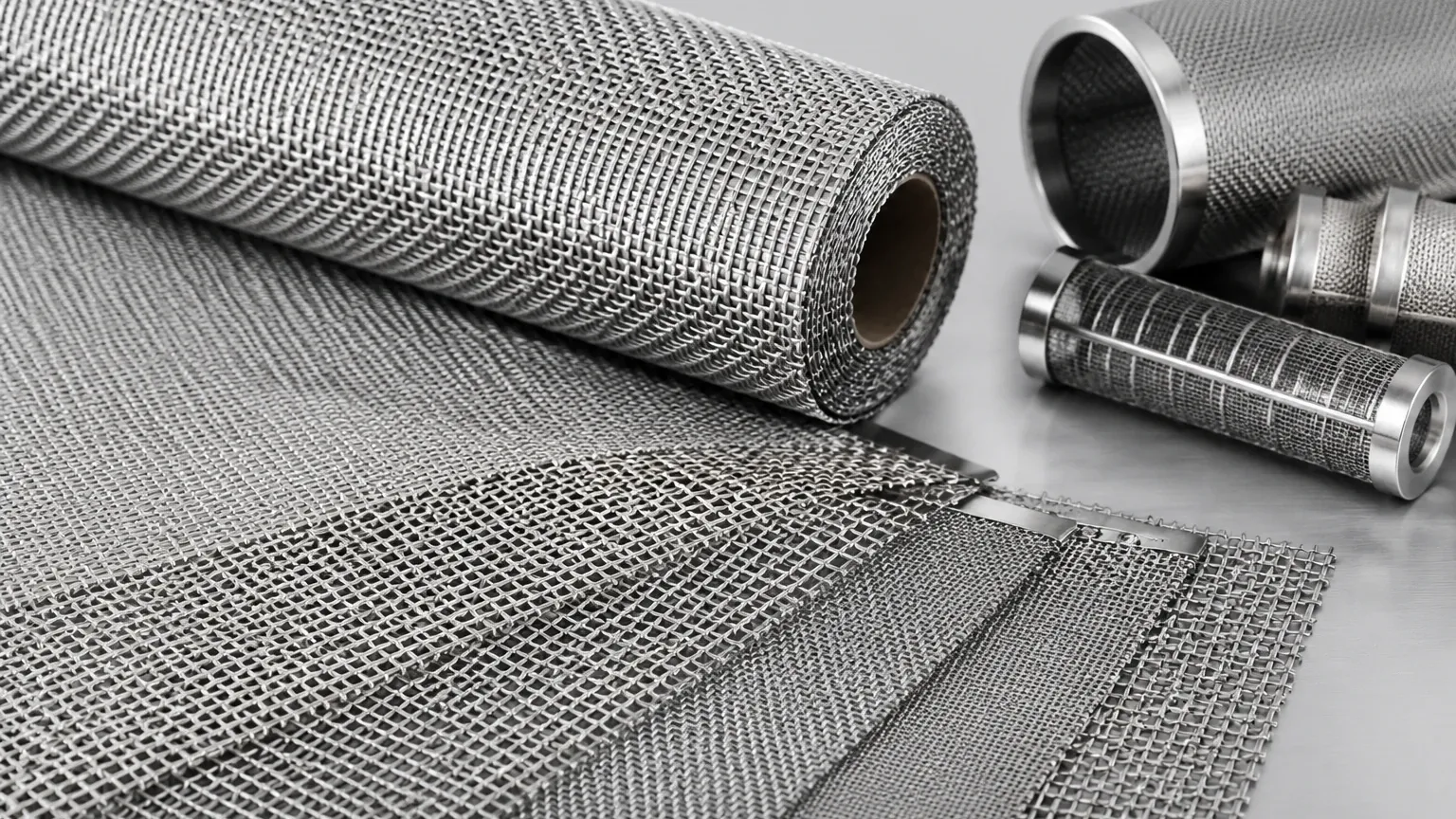
The method by which wires are interlaced—the weave pattern—determines the mesh's filtration characteristics, flow capacity, and physical robustness. Understanding these patterns is vital when selecting Plain, twill and dutch woven wire mesh in SS304/316L — rolls, cut mesh and framed panels. Send mesh count or micron target for a technical quote.
Plain Weave
This is the most common and straightforward weave, where each warp wire (running lengthwise) passes alternately over and under each shute wire (running crosswise). Plain weave provides the highest open area and the lowest pressure drop, making it suitable for high-flow liquid filtration and simple sifting applications. However, because the openings are square, it is generally limited to coarser filtration tasks compared to Dutch weaves.
Twill Weave
In a twill weave, each warp wire passes over two and under two shute wires. This allows for the use of heavier wire diameters than would be possible in a plain weave of the same mesh count. Twill weaves are often employed when a combination of fine filtration and high mechanical strength is required, as the structure is more flexible and resistant to deformation under load.
Dutch Weave (Plain and Twill)
Dutch weaves utilize different wire diameters for the warp and shute. Typically, fewer, heavier warp wires are combined with a higher number of finer shute wires. This creates a "zero-aperture" mesh where the openings are not visible when looking directly through the mesh. Instead, the fluid must follow a tortuous path through the weave.
* Plain Dutch Weave: Offers high mechanical strength and is easy to clean via backwashing. It is a standard choice for high-pressure filtration.
* Twill Dutch Weave: By combining the twill pattern with the Dutch wire configuration, manufacturers can achieve extremely fine filtration ratings (down to 5–10 microns) while maintaining the structural integrity needed for hydraulic systems and high-pressure chemical reactors.
Material Selection: SS304 vs. SS316L and Specialized Alloys
The chemical and thermal environment of the application dictates the choice of alloy for stainless woven wire mesh. While stainless steel is the industry standard, the specific grade is a primary cost and performance driver.
Stainless Steel 304 (SS304)
SS304 is the most widely used grade for general industrial applications. It offers excellent mechanical properties and good corrosion resistance in atmospheric conditions and with many organic and inorganic chemicals. It is a cost-effective solution for food processing, water filtration, and general industrial screening where extreme acid or chloride exposure is not expected.
Stainless Steel 316L (SS316L)
The "L" denotes low carbon, which improves weldability and prevents sensitization during the fabrication of filter cartridges. SS316L contains molybdenum, which significantly enhances resistance to pitting and crevice corrosion in chloride-rich environments (such as seawater) and acidic conditions. It is the preferred material for pharmaceutical manufacturing, marine applications, and aggressive chemical processing.
Specialized Alloys
In extreme cases where standard stainless steels fail—such as highly concentrated sulfuric acid or temperatures exceeding 800°C—Kaifil can provide mesh in specialized alloys like Monel, Inconel, or Hastelloy. These materials are selected based on the specific pH levels, temperature cycles, and chemical concentrations of the process fluid.
Engineering Considerations for Filter Integration
Selecting the right stainless woven wire mesh is only the first step. Engineers must also consider how the mesh will be integrated into the final filtration component to ensure optimal performance.
Pressure Drop and Flow Velocity
The resistance to flow, or differential pressure (ΔP), is a critical metric. A mesh with a low open area will cause a rapid increase in ΔP as particles accumulate on the surface. Engineers must calculate the "clean pressure drop" based on the fluid viscosity, flow velocity, and mesh geometry to ensure the system pump can handle the load throughout the filtration cycle.
Mechanical Support and Pleating
Fine mesh is often delicate. To withstand high differential pressures without bursting or deforming, it is frequently supported by a coarser backing mesh or a perforated metal core. In many high-performance filter cartridges, the Woven Wire Mesh is pleated. Pleating significantly increases the effective filtration area within the same footprint, leading to longer service intervals and lower flux rates (flow per unit area), which improves filtration efficiency.
Fabrication and Framing
For many B2B applications, the mesh is not used as a raw roll but is fabricated into specific shapes. This includes circular discs for extruder screens, framed panels for vibrating sifters, or cylindrical cartridges for hydraulic lines. Proper edge treatment—such as welding, soldering, or crimping into a metal frame—is essential to prevent bypass and ensure the mesh does not fray during operation.
Quality Assurance and Performance Validation
When sourcing stainless woven wire mesh, technical professionals must confirm that the product meets the stated specifications. At Kaifil, quality control involves several layers of verification:
1. Material Verification: Using X-ray fluorescence (XRF) analysis to confirm the alloy composition (e.g., ensuring SS316L actually contains the required molybdenum content).
2. Dimensional Inspection: Utilizing digital microscopy to measure wire diameter and aperture size across multiple points of the mesh roll to ensure uniformity.
3. Bubble Point Testing: For Dutch weave filters, the bubble point test is used to determine the largest pore size, providing a reliable indication of the absolute filtration rating.
4. Tensile Testing: Ensuring the mesh can withstand the mechanical stresses of the intended application without premature failure.
Common Risks and Mitigation Strategies
Failure to specify the correct Woven Wire Mesh can lead to significant operational risks, including product contamination, equipment damage, and unplanned downtime. Common issues include:
* Corrosion Fatigue: In vibrating screens, the combination of mechanical stress and a corrosive environment can lead to rapid failure. Selecting a higher-grade alloy or a stress-relieved mesh can mitigate this risk.
* Mesh Migration: If the mesh is not properly secured or if the wire diameter is too thin for the flow velocity, individual wires may break and enter the downstream flow. Using sintered wire mesh (where the contact points of the wires are thermally bonded) is a common solution for high-purity pharmaceutical or aerospace applications.
* Blinding and Plugging: This occurs when particles become wedged in the mesh openings. Selecting a Dutch weave or implementing an automated backwash system can help maintain flow.
Conclusion: Specifying the Right Solution
To ensure the successful procurement of stainless woven wire mesh, purchasing and engineering teams should provide manufacturers with a comprehensive set of requirements. This includes the target micron rating, the chemical composition of the fluid, operating temperature, maximum allowable pressure drop, and the physical dimensions or drawing of the required component.
As a manufacturer committed to precision and durability, Kaifil works closely with global customers to develop customized filtration solutions. Whether you require standard rolls of Woven Wire Mesh or complex, multi-layered sintered filter elements, understanding the technical boundaries of the material is the first step toward optimized filtration performance. By focusing on material integrity and precise weave geometry, engineers can achieve reliable, cost-effective separation in even the most demanding industrial environments.
