


Wire Mesh Brass Architectural Woven: A Technical Guide for Industrial and Aesthetic Applications
In the intersection of industrial functionality and high-end architectural design, wire mesh brass architectural woven materials occupy a unique position. Unlike standard industrial filtration components, architectural brass mesh must balance precise mechanical specifications with specific aesthetic requirements. For engineers, architects, and procurement professionals, selecting the right mesh involves understanding the metallurgical properties of brass alloys, the physics of various weave patterns, and the long-term performance of the material in diverse environments.
At Kaifil, we specialize in bridging the gap between custom industrial filtration and architectural precision. This guide provides a technical deep dive into the selection, specification, and application of woven brass wire mesh, ensuring that your project meets both structural integrity and design intent.
Understanding the Composition of Architectural Brass Mesh
Brass is an alloy primarily composed of copper and zinc. In the context of woven wire mesh, the ratio of these two elements significantly impacts the material's color, ductility, and corrosion resistance. The most common alloys used in architectural and industrial weaving include:
* C230 (Rich Low Brass): Containing approximately 85% copper and 15% zinc, this alloy offers a deep, bronze-like color. It is highly resistant to corrosion and is often selected for outdoor architectural installations where a natural patina is desired.
* C260 (Cartridge Brass): Comprising roughly 70% copper and 30% zinc, this is the standard "yellow brass." It provides excellent cold-working properties, making it ideal for complex weaving patterns and decorative grilles.
* C270 (Yellow Brass): Similar to C260 but with slightly higher zinc content, this alloy is frequently used in industrial applications where high tensile strength and cost-effectiveness are prioritized over the specific copper hue.
From an engineering perspective, brass is non-magnetic, spark-resistant, and possesses excellent thermal and electrical conductivity. While stainless steel is often the default for aggressive chemical filtration, brass is preferred in applications where electrical grounding is required or where the aesthetic evolution of the material (the development of a patina) is a functional design requirement.
The Engineering of Woven Wire Mesh Patterns
The performance of an architectural mesh is dictated by its weave. While the term "architectural" often implies a focus on appearance, the underlying structure follows the same rigorous standards as industrial filtration media. When specifying Woven Wire Mesh, it is essential to understand how different patterns affect light transparency, airflow, and structural rigidity.
Plain Weave
This is the most common pattern where each warp wire crosses alternately over and under each shute wire. It produces a stable, consistent aperture. In architectural contexts, plain weave brass mesh is often used for cabinet inserts, room dividers, and ventilation grilles where a uniform appearance is required.
Twill Weave
In a twill weave, each shute wire passes over and under two warp wires in a staggered pattern. This allows for the use of heavier wire diameters relative to the mesh count, resulting in a more robust and flexible cloth. For architectural facades or heavy-duty partitions, twill weaves provide a distinct diagonal texture and enhanced durability.
Dutch Weave (Plain and Twill)
Dutch weaves utilize different wire diameters for the warp and shute. This creates a dense, strong mesh with very small openings. While primarily used for high-pressure filtration, architectural projects utilize Dutch weaves for "blackout" effects or high-density cladding where the mesh needs to appear solid from a distance but remain breathable.
For those evaluating material options for specific industrial or design projects, Kaifil offers Plain, twill and dutch woven wire mesh in SS304/316L — rolls, cut mesh and framed panels. Send mesh count or micron target for a technical quote. to help you determine the best fit for your performance criteria.
Technical Specifications: Beyond the Mesh Count
When requesting a quote for wire mesh brass architectural woven products, engineers must provide specific data points to ensure the final product performs as expected. The three primary metrics are:
1. Mesh Count: The number of openings per linear inch. A higher mesh count results in a finer, more cloth-like material, while a lower mesh count results in a rigid, screen-like structure.
2. Wire Diameter: Measured in inches or millimeters, the wire diameter determines the strength and weight of the mesh. In architectural applications, "double-wire" configurations (where two wires are woven together) are often used to increase visual impact and structural stiffness.
3. Percentage of Open Area: This is a critical calculation for HVAC engineers and architects. It is calculated using the formula:
`Open Area % = (Space / (Space + Wire Diameter))^2 x 100`
This percentage dictates how much light, air, or sound can pass through the mesh. For example, a mesh intended for a radiator cover requires a high open area (typically >60%) to prevent overheating, whereas a privacy screen might require <30%.
Architectural Applications and Environmental Considerations
Brass mesh is a dynamic material. Unlike stainless steel, which remains relatively inert, brass reacts with its environment. This "living finish" is often the primary reason for its selection in high-end architecture.
Interior Applications
In controlled interior environments, brass mesh maintains its bright, polished, or brushed finish for long periods. It is commonly used for:
* Elevator Cab Interiors: Providing a durable, scratch-resistant surface that adds a premium feel.
* Ceiling Panels: Hiding mechanical systems while allowing for airflow and fire suppression (sprinkler) penetration.
* Wall Cladding: Adding acoustic diffusion and visual depth to lobbies and corporate spaces.
Exterior Applications and Patination
When used outdoors, wire mesh brass architectural woven materials will undergo a natural oxidation process. Initially, the bright yellow will deepen into a rich bronze, eventually developing a green verdigris patina in coastal or high-moisture environments. Engineers must account for this when specifying fasteners; using stainless steel fasteners with brass mesh can lead to galvanic corrosion. It is recommended to use brass or bronze hardware, or to ensure proper insulation between dissimilar metals.
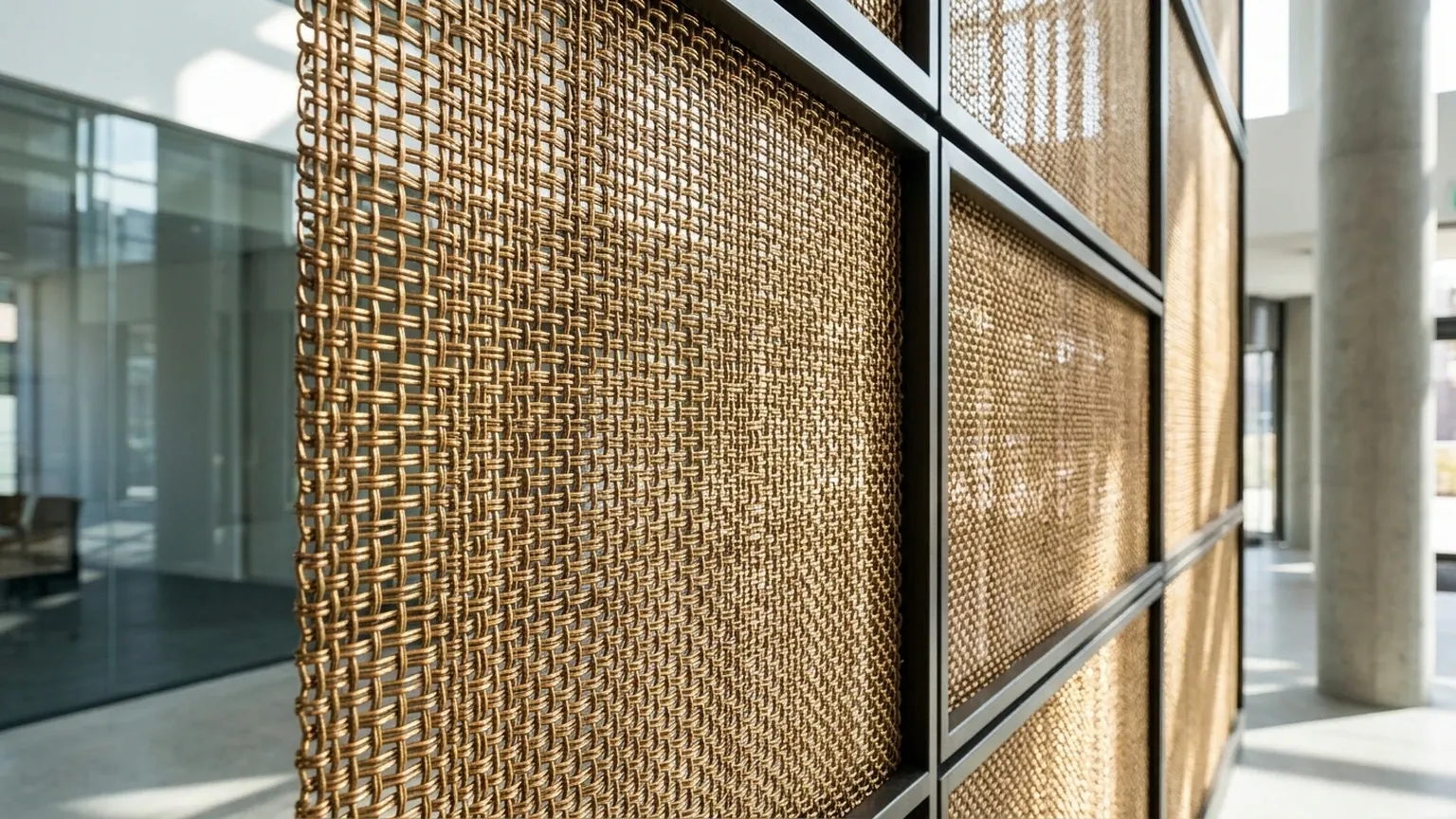
Customization and OEM Capabilities
Industrial projects rarely fit "off-the-shelf" specifications. As a manufacturer, Kaifil provides extensive customization options to meet the unique demands of both industrial filtration and architectural design.
Custom Slitting and Cutting
Standard mesh rolls are typically 36" or 48" wide, but architectural panels often require precise dimensions to fit into pre-existing frames. We provide precision slitting and die-cutting to ensure that the mesh arrives ready for installation, reducing on-site waste and labor costs.
Framing and Edging
Architectural mesh is often flexible. To be used as a partition or screen, it must be properly tensioned or framed. We offer custom framing solutions, including U-edging and welded frames, which provide the necessary structural support while maintaining the aesthetic integrity of the woven pattern.
Surface Treatments
While many appreciate the natural aging of brass, some projects require a "frozen" look. We can provide secondary processes such as clear-coating (to prevent oxidation), antique finishing (to provide an aged look immediately), or PVD coating for enhanced wear resistance.
Selection Criteria for Engineers and Purchasing Teams
Before finalizing a purchase order for architectural or industrial brass mesh, consider the following checklist to avoid common pitfalls:
* Load Requirements: Will the mesh be subject to impact or tension? If used as a balustrade infill, it must meet local building codes for safety loads.
* Environmental Exposure: Is the site near the ocean? If so, C230 (Rich Low Brass) is significantly more durable than standard yellow brass.
* Maintenance Access: How will the mesh be cleaned? Fine meshes can trap dust and may require ultrasonic cleaning or high-pressure air, whereas coarser architectural weaves can be wiped down.
* Total Cost of Ownership: While brass has a higher initial material cost than galvanized steel, its longevity, recyclability, and lack of need for painting or frequent replacement often result in a lower total cost over the building's lifecycle.
Conclusion
Wire mesh brass architectural woven products represent a sophisticated blend of metallurgy and textile engineering. Whether you are designing a high-performance filtration system that requires the non-sparking properties of brass or an architectural facade that demands a timeless aesthetic, understanding the technical boundaries of the material is key.
Kaifil remains committed to providing high-performance, customized filtration and mesh solutions. By focusing on precise manufacturing and engineering support, we help our global partners achieve durable and cost-effective results. For detailed technical specifications or to discuss a custom design, reviewing the available Woven Wire Mesh options is the first step toward optimizing your project's performance.
