


Woven Wire Fence Design: Engineering Principles for Industrial Barriers and Enclosures
In industrial environments, the selection of a barrier system extends beyond simple perimeter marking. Whether the application involves machine guarding, high-security partitioning, or debris containment in chemical processing plants, the engineering behind woven wire fence design determines the longevity, safety, and cost-effectiveness of the installation. Unlike standard chain-link alternatives, industrial-grade woven wire mesh offers a level of structural integrity and customization required for demanding technical sectors.
Selecting the right mesh involves a complex interplay of material science, mechanical engineering, and environmental assessment. For engineers and procurement teams, understanding the nuances of weave patterns, wire diameters, and alloy properties is essential to ensure the final design meets specific load-bearing and durability requirements.
The Fundamentals of Industrial Woven Wire Mesh
At its core, Woven Wire Mesh is produced by weaving individual wires over and under one another in a precise, repeatable pattern. In an industrial context, this process is performed on heavy-duty looms that maintain high tension, ensuring that the apertures (the openings between wires) remain consistent across the entire surface area.
For fence and barrier applications, the stability of the mesh is paramount. Unlike welded wire, which relies on spot welds at every intersection, woven mesh derives its strength from the mechanical interlocking of the wires. This allows for a degree of flexibility and energy absorption that is often superior in high-impact environments. When considering a woven wire fence design, the choice of weave—such as plain, twill, or dutch—will significantly influence the barrier’s physical properties, including its transparency, airflow, and resistance to deformation.
Key Engineering Considerations in Woven Wire Fence Design
Designing a functional industrial fence requires more than just picking a mesh size. Engineers must evaluate several critical parameters to ensure the barrier performs as intended under operational stresses.
1. Wire Diameter and Tensile Strength
The diameter of the wire directly correlates with the physical strength of the fence. Heavier gauges provide higher impact resistance but increase the weight and cost of the material. In B2B applications, it is common to specify the wire gauge based on the anticipated mechanical load. For example, machine guards in high-velocity environments require thicker wires to prevent penetration, while simple warehouse partitions may prioritize visibility and airflow with thinner wires.
2. Aperture Size and Open Area
The "opening" or aperture size is the clear distance between adjacent wires. In woven wire fence design, the aperture determines what can pass through the barrier. In filtration-adjacent fencing—such as screens used in water treatment or chemical runoff areas—the aperture must be precise. Furthermore, the percentage of open area affects wind loading. A fence with a low percentage of open area acts like a sail; in outdoor industrial sites, this requires much heavier structural support to prevent the fence from collapsing under high wind pressure.
3. Crimp Style and Structural Rigidity
Before weaving, wires are often "crimped" to provide better interlocking.
- Double Crimp: Both warp and shute wires are crimped at the points of intersection. This is ideal for smaller apertures where stability is the primary concern.
- Lock Crimp: Provides a more rigid structure by locking the wires into place at the intersections. This is frequently used in heavy-duty industrial fencing where the mesh must remain perfectly flat and taut over large spans.
- Flat Top: The crimping is hidden on one side, providing a smooth surface. This is often selected for safety barriers where workers might come into frequent contact with the mesh.
Material Selection: Why Stainless Steel Dominates Industrial Applications
The environment in which the fence will be installed dictates the material choice. While galvanized steel is common in commercial fencing, industrial B2B applications often demand the superior properties of stainless steel, specifically T-304 and T-316L.
SS304: The Industrial Standard
Type 304 stainless steel is the most common choice for industrial woven wire mesh. It offers excellent corrosion resistance against most oxidizing acids and is durable enough to withstand standard industrial cleaning protocols. It is the go-to material for internal partitions, safety guards, and general-purpose industrial fencing.
SS316L: For Extreme Environments
In chemical processing plants, coastal facilities, or pharmaceutical cleanrooms, SS316L is the preferred alloy. The addition of molybdenum provides enhanced resistance to pitting and crevice corrosion, particularly in chloride-rich environments. When the woven wire fence design is intended for a site exposed to salt spray or harsh chemical vapors, specifying SS316L ensures a significantly longer service life and reduces the total cost of ownership by minimizing replacement cycles.
Integrating Mesh into Structural Frames
A roll of woven wire mesh is only one component of a successful fence design. The method of integration into a framing system is critical for maintaining tension and structural integrity.
Tensioning Systems
For large-scale perimeter fencing, the mesh must be properly tensioned to prevent sagging. This often involves the use of tension bars and heavy-duty bolts. In B2B procurement, it is vital to confirm that the mesh's edge preparation (such as hooked edges or welded borders) is compatible with the intended tensioning hardware.
Welded Frame Enclosures
In many factory settings, woven wire mesh is cut to size and welded into angle iron or tube frames. This creates modular panels that can be easily installed or moved. When designing these panels, engineers must account for the "trim waste" of the mesh rolls to optimize costs. Standardizing panel sizes to match the width of the mesh rolls (typically 36", 48", or 60") can result in significant material savings.
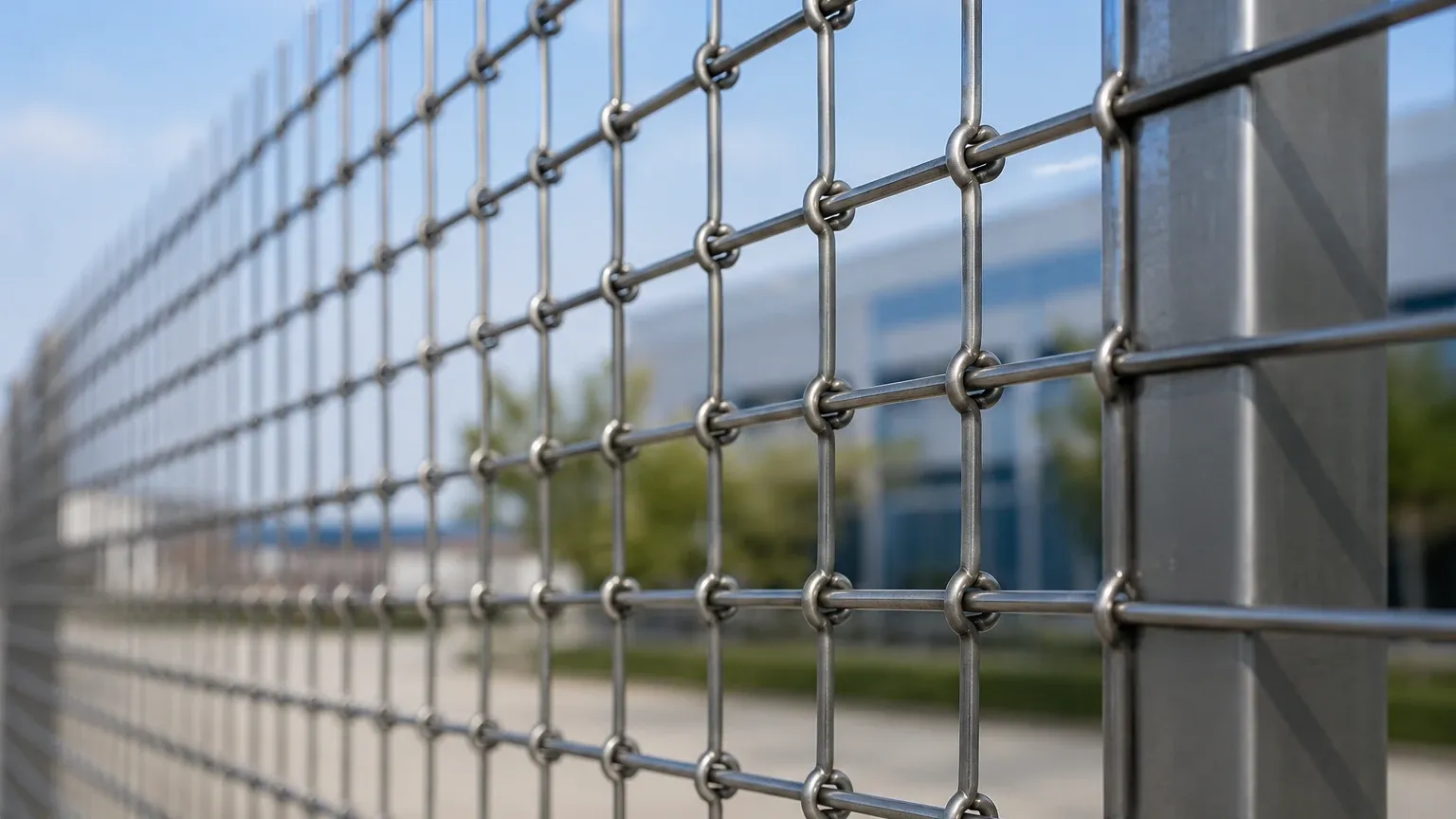
Applications of Specialized Woven Wire Fence Design
Industrial fencing is rarely just about keeping people out; it often serves a dual purpose.
- Machine Guarding: High-tensile woven mesh provides a transparent barrier that allows operators to monitor machinery safely. The design must ensure that the aperture is small enough to prevent fingers or tools from reaching moving parts.
- Acoustic and Airflow Management: In power plants or data centers, woven wire fences are designed to allow for maximum ventilation while providing a physical security barrier. The precision of the weave allows for predictable airflow calculations.
- Debris Containment: In mining or heavy manufacturing, woven wire barriers are used to contain flying debris. The energy-absorbing nature of the weave makes it more resilient than rigid solid panels, which may crack or dent under repeated impact.
Technical Procurement: What to Confirm Before Ordering
When transitioning from a design concept to a purchase order, technical accuracy is vital. Industrial suppliers like Kaifil emphasize that providing specific data points ensures the product meets the engineering requirement. Before finalizing a woven wire fence design, the following should be confirmed:
1. Mesh Count vs. Aperture: Clearly define whether you are ordering by the number of openings per inch or the specific clear opening size in millimeters or microns.
2. Wire Diameter: Specify the decimal inch or millimeter thickness rather than just a gauge number to avoid ambiguity.
3. Alloy Grade: Ensure the grade (e.g., SS316L) is appropriate for the chemical exposure of the site.
4. Edge Treatment: Determine if the mesh should be shipped with raw edges, hemmed edges, or integrated into a custom frame.
For those seeking high-performance materials, Plain, twill and dutch woven wire mesh in SS304/316L — rolls, cut mesh and framed panels. Send mesh count or micron target for a technical quote. This level of customization allows engineers to tailor the barrier to the exact needs of their facility, ensuring both safety and operational efficiency.
Conclusion
Effective woven wire fence design is a balance of material science and mechanical application. By focusing on the specific requirements of the industrial environment—whether that is corrosion resistance in a chemical plant or impact durability in a manufacturing cell—engineers can implement solutions that provide long-term value. Moving beyond generic fencing products to engineered woven wire mesh ensures that the barrier serves as a reliable component of the facility’s infrastructure, protecting both personnel and assets with precision and durability.
