


Woven Wire Fence Detail: Engineering Specifications for Industrial Enclosures and Barriers
In industrial environments, the term "fence" often transcends simple perimeter security. For engineers and facility managers in chemical processing, pharmaceutical manufacturing, and heavy industrial sectors, a woven wire fence detail refers to the precise technical specifications required for machinery guarding, safety partitions, and high-strength enclosures. Unlike standard commercial fencing, industrial-grade woven wire mesh must meet rigorous standards for material integrity, structural stability, and environmental resistance.
Selecting the right Woven Wire Mesh for these applications requires a deep understanding of wire metallurgy, weave patterns, and mechanical load requirements. This guide explores the critical engineering considerations for designing and procuring woven wire barriers that ensure both safety and operational efficiency.
1. Material Selection: SS304 vs. SS316L
The foundation of any technical woven wire fence detail is the material composition. In industrial settings, stainless steel is the gold standard due to its longevity and resistance to oxidation. However, the specific grade of stainless steel must be matched to the operational environment.
* Stainless Steel 304: This is the most common grade used for general industrial partitions and machinery guards. It offers excellent strength and good corrosion resistance for indoor applications or environments where exposure to harsh chemicals is limited. It is a cost-effective solution for standard safety barriers.
* Stainless Steel 316L: For facilities involving chemical processing, food and beverage production, or marine exposure, SS316L is the preferred choice. The addition of molybdenum provides superior resistance to chlorides and pitting. In a detailed fence specification, SS316L ensures that the barrier does not degrade when subjected to rigorous CIP (Clean-in-Place) cycles or corrosive vapors.
When evaluating a woven wire fence detail, engineers must confirm that the material certifications (MTRs) align with the project’s environmental stressors to avoid premature failure due to stress corrosion cracking or surface oxidation.
2. Understanding Weave Patterns in Industrial Barriers
The geometry of the weave determines the mesh’s open area, structural rigidity, and aesthetic profile. While filtration often requires complex Dutch weaves, industrial fencing and partitions typically utilize more straightforward patterns that prioritize visibility and airflow.
Plain Weave
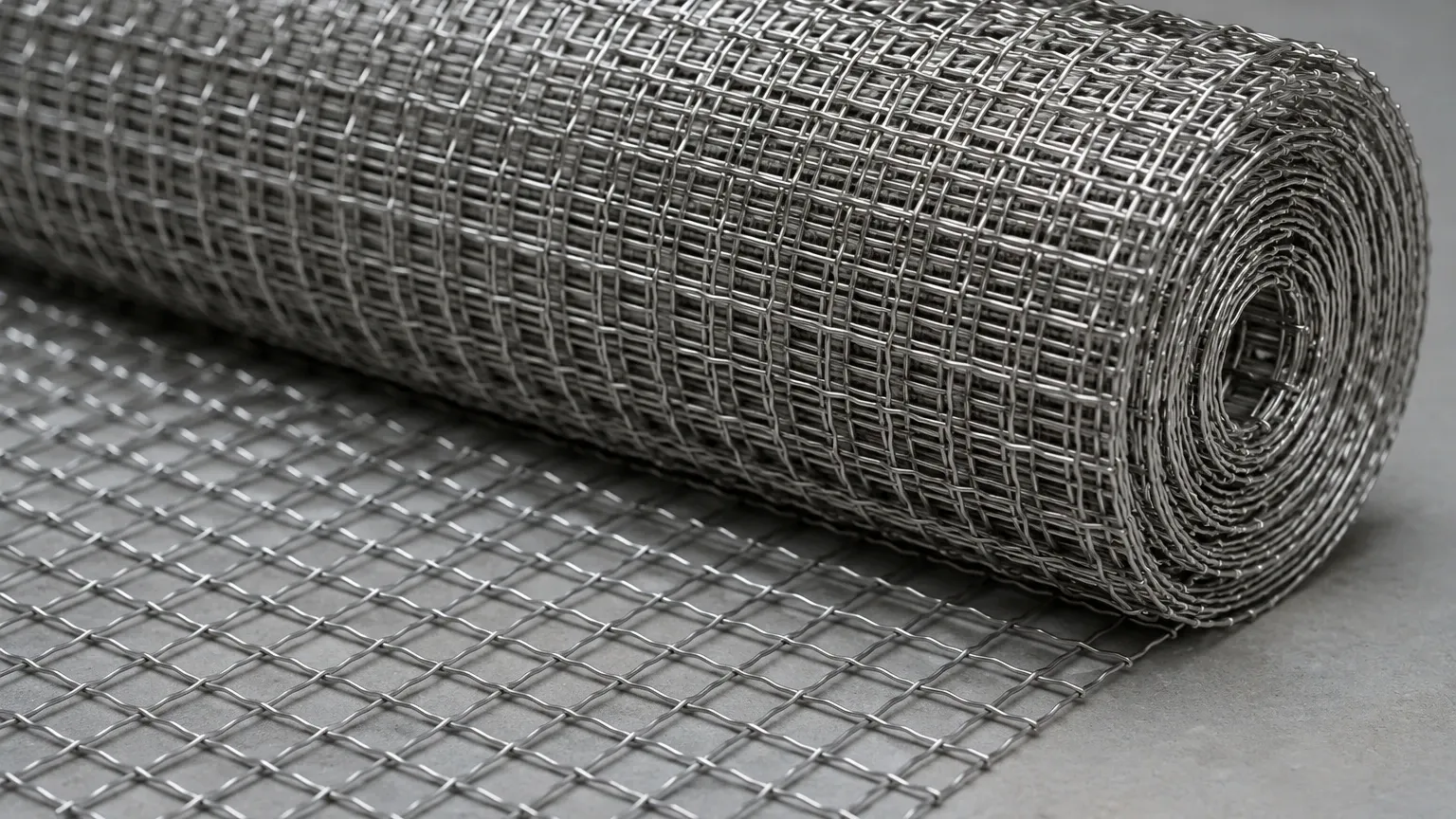
In a plain weave, each warp wire crosses alternately over and under each weft wire. This is the most stable and common pattern for industrial enclosures. It provides a consistent aperture size, which is critical for safety guards where finger-safe or object-safe clearances must be maintained according to OSHA or ISO standards.
Twill Weave
Twill weaves involve wires crossing over two and under two. This allows for the use of heavier wire diameters relative to the mesh count. In a woven wire fence detail, a twill weave might be specified when high impact resistance is required, as the heavier wire provides a more robust physical barrier against mechanical force.
Intercrimped Mesh
Often used in larger-scale industrial fencing, intercrimped mesh involves pre-crimping the wires before weaving. This locks the wires into place, providing exceptional dimensional stability even when the mesh is subjected to vibration or external pressure. This is a common detail in heavy-duty partitions used in warehouse automation and robotic cells.
3. Structural Engineering: The "Fence Detail" and Attachment Methods
A comprehensive woven wire fence detail is incomplete without specifying how the mesh is integrated into its supporting structure. The performance of the mesh is only as reliable as its mounting system.
Framing Systems
Industrial mesh is rarely used as a standalone fabric. It is typically welded or bolted into frames made of angle iron, flat bars, or square tubing. The detail should specify the weld type (e.g., tack welds vs. continuous beads) to ensure the mesh does not pull away from the frame under tension. For pharmaceutical or food-grade applications, the framing detail must eliminate "bug traps" or crevices where bacteria can accumulate.
Tensioning and Sag Prevention
For large-span partitions, the mesh must be properly tensioned. Engineers often specify a "U-bolt" or "tension bar" system within the fence detail to allow for periodic adjustments. Without proper tensioning, the mesh may sag over time, compromising both the safety distance (the gap between the guard and the moving parts) and the professional appearance of the installation.
Aperture and Wire Diameter Ratios
The relationship between the wire diameter and the opening size (aperture) dictates the mesh's strength. A high-security or high-impact woven wire fence detail will often specify a larger wire diameter with a smaller aperture, increasing the overall mass and resistance of the barrier.
4. Safety Standards and Compliance
When designing a woven wire fence detail for machinery guarding, compliance with international safety standards is paramount. Standards such as ISO 13857 (Safety of machinery — Safety distances to prevent hazard zones being reached by upper and lower limbs) dictate the maximum allowable aperture size based on the distance of the fence from the hazard.
* Finger-Safe Mesh: Typically requires apertures smaller than 6mm if the guard is close to the hazard.
* Hand-Safe Mesh: May allow for larger openings if the barrier is placed further back.
Engineers must ensure the mesh specification in their project profile accounts for these safety distances. Using a high-quality Woven Wire Mesh with precise tolerances ensures that the aperture remains consistent across the entire panel, preventing "weak spots" that could lead to safety violations.
5. Performance Evaluation and Longevity
To ensure the total cost of ownership remains low, the woven wire fence detail should include performance expectations regarding durability and maintenance. Industrial filters and barriers are often subject to harsh cleaning agents, high-pressure washing, and physical impacts.
Impact Resistance
In logistics and automated warehousing, barriers are often hit by forklifts or moving pallets. Specifying a crimped woven mesh within the fence detail provides a level of "give" that can absorb energy better than a rigid welded wire panel, which might snap at the weld points under sudden impact.
Maintenance and Cleaning
Stainless steel mesh is relatively low-maintenance, but in B2B environments, the ease of cleaning is a major factor. A plain weave mesh with a smooth surface finish (such as electro-polishing) is easier to sanitize than a complex weave. This detail is particularly important in pharmaceutical cleanrooms where particulate shedding must be minimized.
6. Customization and OEM Considerations
Every industrial facility has unique spatial and functional requirements. A standard off-the-shelf solution rarely suffices for complex engineering projects. This is where the flexibility of custom manufacturing becomes essential. When finalizing a woven wire fence detail, consider the following customization options:
* Custom Panel Sizes: Reducing the need for on-site cutting and welding by ordering pre-framed, custom-sized panels.
* Edge Treatments: Specifying hemmed edges, U-edging, or reinforced borders to prevent injury during installation and maintenance.
* Variable Mesh Counts: In some applications, a single panel may require different mesh counts—finer at the bottom to prevent small parts from escaping and coarser at the top for better ventilation.
By working with a manufacturer that understands both filtration and structural mesh, engineers can develop a woven wire fence detail that balances airflow, visibility, and physical protection.
Conclusion: Confirming the Details Before Procurement
Before moving forward with a purchase or a project implementation, technical professionals should confirm the following data points in their woven wire fence detail:
1. Material Grade: Is SS304 sufficient, or does the environment demand SS316L?
2. Mesh Count and Wire Diameter: Do these specs meet the required safety distances and impact ratings?
3. Finish: Is a standard mill finish acceptable, or is electro-polishing required for hygiene?
4. Framing and Mounting: How will the mesh be secured to ensure long-term stability?
Attention to these technical nuances ensures that the chosen Woven Wire Mesh performs reliably throughout its service life, protecting both personnel and expensive industrial assets. For specialized applications, consulting with a manufacturer that offers OEM capabilities can provide the necessary engineering support to optimize the design for specific industrial challenges.
