


Engineering Guide: Implementing Woven Wire Mesh Barriers on Sloped Industrial Terrain
In the realm of industrial infrastructure, the installation of a woven wire fence on slope represents a complex intersection of structural engineering, material science, and geometric precision. Unlike flat-surface installations where tension and alignment are relatively straightforward, sloped environments introduce gravitational shear, variable tension requirements, and the risk of aperture distortion. For engineers and procurement managers at chemical processing plants, water treatment facilities, and pharmaceutical labs, selecting the right Woven Wire Mesh is not merely a matter of perimeter security, but a calculation of long-term structural integrity and functional performance.
Industrial barriers on inclines serve multiple roles: they act as safety partitions, debris screens, and security envelopes. When these barriers are constructed from high-quality stainless steel mesh, they offer the durability required for harsh environments. However, the success of such an installation depends on a deep understanding of how woven materials behave under the unique stresses of a grade change.
1. Material Science: Why Stainless Steel Woven Mesh Dominates Sloped Applications
When specifying materials for a woven wire fence on slope, the choice of alloy and manufacturing method is paramount. Industrial environments often expose metal components to corrosive agents, high humidity, or extreme temperature fluctuations.
The Superiority of SS304 and SS316L
Stainless steel is the preferred medium for woven mesh due to its high strength-to-weight ratio and inherent corrosion resistance.
* Type 304: This is the standard industrial grade, containing approximately 18% chromium and 8% nickel. It provides the necessary durability for most indoor partitions and standard outdoor perimeters.
* Type 316L: For facilities located near coastal areas or those handling aggressive chemicals, 316L (low carbon) is essential. The addition of molybdenum significantly enhances resistance to pitting and chloride-induced stress corrosion—factors that are often exacerbated on slopes where runoff can concentrate corrosive elements at the base of the barrier.
Mechanical Flexibility of the Woven Structure
Unlike welded wire mesh, where the wires are fused at every intersection, Plain, twill and dutch woven wire mesh in SS304/316L — rolls, cut mesh and framed panels. Send mesh count or micron target for a technical quote. relies on a mechanical interlock. This "woven" nature allows for a degree of internal movement. On a slope, this flexibility is a critical asset. It allows the mesh to absorb structural shifts and thermal expansion without the brittle failure often seen in welded joints. This mechanical "give" ensures that the barrier remains taut and functional even as the ground settles or the temperature shifts.
2. Geometric Strategies: Racking vs. Stepping for Inclined Barriers
There are two primary methods for adapting a woven wire fence on slope: racking and stepping. Each method has distinct implications for the mesh's geometric stability and the overall security of the installation.
The Racking Method (Bias Adjustment)
Racking involves tilting the mesh panel so that the horizontal wires follow the slope of the ground while the vertical wires remain plumb.
* Engineering Consideration: Racking is highly dependent on the "open area" and the weave tightness. A standard plain weave mesh can typically be racked up to a certain degree before the wires "lock" against each other. If a slope is too steep, forcing a rack can distort the apertures, changing the mesh's filtration or screening properties.
* Application: This is ideal for maintaining a consistent gap (or lack thereof) between the bottom of the fence and the ground, which is vital for preventing the passage of small debris or wildlife.
The Stepping Method
In the stepping method, the mesh panels remain perfectly rectangular and are installed in a stair-step fashion down the slope.
* Engineering Consideration: This is the required method for rigid or framed panels, such as those used in heavy-duty industrial safety guards. Because the mesh itself is not distorted, the aperture size remains constant, ensuring that the technical specifications of the Woven Wire Mesh are preserved.
* Mitigation of Gaps: The primary challenge with stepping is the triangular gap created at the bottom of each panel. In industrial settings, these gaps are usually closed using custom-cut mesh "filler" pieces or kick-plates made from the same stainless steel alloy to maintain a continuous barrier.
3. Structural Loading and Tensioning on Sloped Grades
Gravity is the constant enemy of a woven wire fence on slope. On a flat surface, tension is distributed horizontally across the terminal posts. On a slope, a significant portion of that tension is converted into a downward vertical load.
Terminal Post Anchoring
On an incline, the "uphill" and "downhill" terminal posts experience asymmetrical forces. The uphill post must resist the downward pull of the entire mesh run. Engineers must specify deeper footings and often higher-PSI concrete for these anchors. In some cases, lateral bracing or "deadman" anchors are required to ensure the posts do not lean over time, which would lead to mesh sagging and a loss of security.
Tensioning Dynamics
Proper tensioning of woven mesh on a slope requires a top-down approach. By securing the mesh at the highest point and tensioning toward the bottom, installers can manage the natural accumulation of slack. For industrial applications, the use of tension bars—flat stainless steel bars threaded through the mesh at the ends—is mandatory. This ensures that the pulling force is distributed across every wire in the weave, preventing individual wires from stretching or snapping under the load.
4. The Impact of Weave Patterns on Slope Performance
Not all weave patterns are created equal when it comes to sloped installations. The choice of weave affects how much the mesh can rack and how it handles wind and debris loads.
* Plain Weave: The most common industrial weave, where wires cross over and under one another in a simple alternating pattern. It offers the best balance of racking flexibility and structural stability for slopes.
* Twill Weave: In this pattern, each shute wire passes successively over and under two warp wires. This creates a more pliable mesh that can handle steeper racking angles without the same level of internal stress as a plain weave.
* Dutch Weave: Characterized by a limited number of warp wires and a maximum number of shute wires, resulting in a very dense, rigid mesh. Dutch weaves are almost impossible to rack and must be installed using the stepping method. They are typically reserved for high-precision filtration rather than general perimeter fencing.
Engineers must also consider the "wire diameter to aperture" ratio. A mesh with a thick wire and a small aperture will be much more rigid and resistant to racking than a mesh with a fine wire and a large aperture.
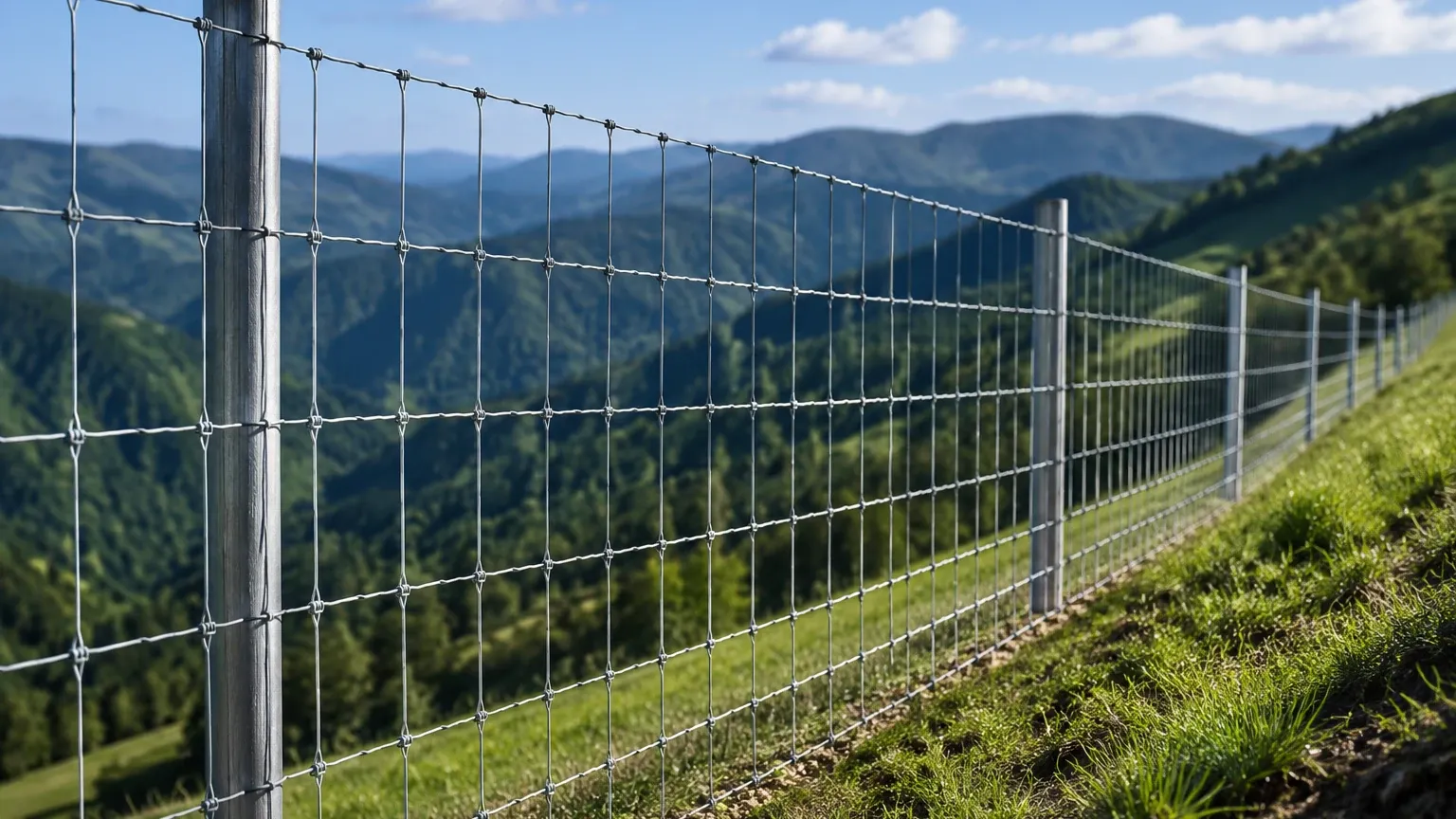
5. Environmental and Maintenance Considerations for Sloped Mesh
A woven wire fence on slope is often subject to harsher environmental conditions than one on flat ground. Understanding these factors is essential for calculating the Total Cost of Ownership (TCO).
Runoff and Debris Accumulation
Slopes naturally direct water and debris toward the base of the fence. If the mesh aperture is too fine, it can act as a dam, trapping silt and organic matter. This not only increases the lateral pressure on the fence during heavy rain but also creates a micro-environment where corrosion can thrive. Specifying SS316L and ensuring a proper cleaning schedule is critical for barriers located at the base of long embankments.
Wind Loading on Inclines
Topographic features can cause wind speeds to increase as they move up a slope (the Bernoulli effect). A woven mesh barrier acts as a semi-permeable sail. Engineers must calculate the wind load based on the "effective open area" of the mesh. On steep slopes, the wind force can combine with gravitational pull to create significant stress on the mounting hardware. High-quality stainless steel clips and fasteners are necessary to prevent the mesh from vibrating loose or tearing at the attachment points.
6. Customization and OEM Solutions for Complex Topography
For many industrial projects, standard off-the-shelf mesh rolls are insufficient for the complexities of a woven wire fence on slope. This is where the value of a specialized manufacturer like Kaifil becomes apparent.
Customization options that facilitate sloped installations include:
* Variable Mesh Counts: Adjusting the density of the weave for different sections of a project to balance visibility, airflow, and security.
* Pre-cut and Framed Panels: For stepping installations, factory-cut panels ensure that edges are properly finished (selvaged or welded), reducing on-site labor and ensuring a perfect fit.
* Edge Reinforcement: Adding extra-heavy wires or integrated mounting bars to the edges of the mesh can provide the extra strength needed for high-tension sloped runs.
By working closely with a manufacturer to define the specific requirements of the terrain, engineering teams can ensure that the Woven Wire Mesh they receive is optimized for the specific challenges of their site, from material grade to weave geometry.
Final Checklist for Procurement and Engineering
Before initiating a purchase for a sloped barrier project, the following technical points should be confirmed:
1. Slope Angle: Determine the exact degree of the incline to decide between racking and stepping.
2. Environmental Grade: Assess the presence of salts or chemicals to choose between SS304 and SS316L.
3. Aperture Requirements: Ensure that any necessary racking will not compromise the required hole size for safety or filtration.
4. Hardware Compatibility: Verify that all fasteners and tensioning bars are of the same alloy as the mesh to prevent galvanic corrosion.
5. Post Specification: Ensure posts are engineered for the increased vertical and lateral loads associated with sloped tensioning.
In conclusion, a woven wire fence on slope is a high-performance system that requires careful planning. By selecting the appropriate stainless steel woven wire mesh and employing sound structural principles, industrial facilities can achieve a barrier solution that is as durable as it is effective, regardless of the complexity of the terrain.
