


Woven Wire Mesh Panel: Engineering Specifications and Industrial Applications
In industrial filtration and separation, the woven wire mesh panel serves as a critical component where structural integrity must meet precise filtration performance. Unlike bulk mesh rolls, a panel is a finished engineering unit, often framed or reinforced, designed to integrate directly into housings, vibratory separators, or fluid processing streams. For engineers and procurement specialists, selecting the correct panel involves balancing mechanical load requirements, chemical compatibility, and hydraulic efficiency.
As a specialized manufacturer, Kaifil provides high-performance stainless steel filtration solutions. Understanding the technical nuances of Woven Wire Mesh construction is essential for optimizing the service life and reliability of these components in demanding environments such as chemical processing, pharmaceuticals, and food production.
Material Science and Alloy Selection
The performance of a woven wire mesh panel begins with the metallurgy of the wire. While various alloys are available, stainless steel remains the industry standard due to its mechanical strength and resistance to oxidation.
304 Stainless Steel
The most common grade for industrial applications, Type 304 provides excellent durability and cost-effectiveness. It is suitable for most water treatment and general industrial applications where high-intensity chemical corrosion is not a primary concern.
316L Stainless Steel
For applications involving chlorides, acids, or high-salinity environments, 316L is the preferred specification. The addition of molybdenum enhances pitting resistance. The "L" (low carbon) designation is particularly important for welded panels, as it minimizes carbide precipitation during the welding process, ensuring the heat-affected zones around the frame remain corrosion-resistant.
Specialized Alloys
In extreme environments, such as high-temperature petrochemical processing or highly acidic pharmaceutical synthesis, alloys like Duplex stainless steel, Monel, or Inconel may be specified. These materials offer superior resistance to stress corrosion cracking and thermal degradation.
Understanding Weave Patterns and Their Mechanical Impact
The geometry of the weave determines both the filtration accuracy (micron rating) and the physical robustness of the woven wire mesh panel. Engineers must select a weave that aligns with the particle size distribution of the media and the expected differential pressure.
Plain Weave
This is the most straightforward construction, where each weft wire passes over and under one warp wire. Plain weave panels offer the highest open area and lowest pressure drop, making them ideal for high-flow liquid filtration and protective screening. However, they have lower mechanical stability compared to denser weaves.
Twill Weave
In a twill weave, each wire passes over two and under two wires. This allows for the use of heavier wire diameters for a given mesh count, resulting in a significantly stronger panel. Twill weaves are often used when the panel must withstand higher mechanical loads or back-pulsing pressures.
Dutch Weave (Plain and Twill)
Dutch weaves utilize different diameters for warp and weft wires, creating a dense, three-dimensional filtration path. These are specified for precision filtration where absolute micron ratings are required. A Dutch woven wire mesh panel provides superior strength and is capable of capturing very fine particles while maintaining structural rigidity under high-pressure differentials.
Structural Design: Framing and Edge Reinforcement
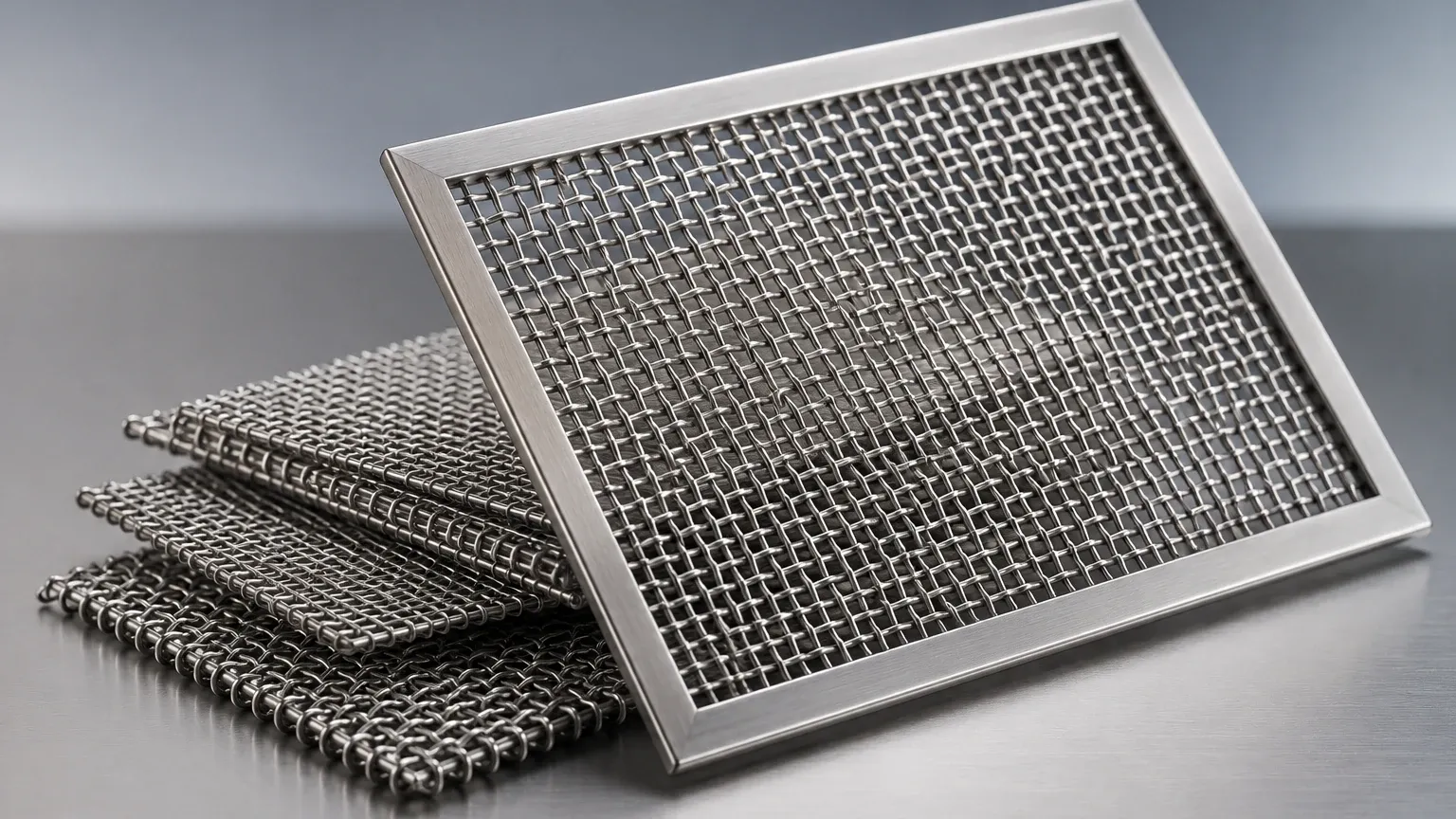
A standalone piece of mesh is prone to fraying and lacks the rigidity required for industrial mounting. A woven wire mesh panel is defined by its edge treatment and framing, which provide the necessary interface for installation.
U-Channel Frames
The most common framing method involves encasing the mesh edges within a stainless steel U-channel. This provides a smooth, safe edge and significant structural reinforcement. U-channels are typically secured via spot welding or continuous TIG welding, depending on the sanitary requirements of the application.
Flat Bar and Angle Frames
For heavy-duty applications, such as large-scale intake screens or vibratory decks, flat bars or angle irons are used. These frames allow the panel to be bolted directly to a support structure, ensuring it can handle the weight of the media or the forces of vibration without deforming.
In-Fill and Support Grids
In large panels, the mesh may require an underlying support grid (such as perforated metal or expanded metal) to prevent sagging or "ballooning" under flow pressure. This multi-layer construction ensures that the fine filtration mesh remains flat and functional throughout its service life.
Performance Metrics: Micron Ratings and Open Area
When specifying a woven wire mesh panel, engineers must look beyond the "mesh count" (the number of openings per linear inch) and focus on the functional performance metrics.
Aperture vs. Micron Rating
The aperture is the clear distance between two adjacent wires. In industrial filtration, the micron rating can be "nominal" (representing a percentage of particles retained) or "absolute" (the size of the largest spherical particle that can pass through). For critical pharmaceutical or chemical processes, absolute ratings are mandatory to ensure process consistency.
Percentage of Open Area
The open area determines the flow capacity and the initial pressure drop across the panel. It is calculated using the formula:
*Open Area % = (Aperture / (Aperture + Wire Diameter))² × 100*
A higher open area reduces energy costs associated with pumping but may decrease the mechanical lifespan of the mesh. Finding the "sweet spot" between flow rate and durability is a key part of the engineering selection process.
Industrial Application Profiles
Chemical and Petrochemical Processing
In these sectors, panels are used for catalyst recovery, crude oil filtration, and gas-liquid separation. The primary challenges are chemical corrosion and high temperatures. Stainless steel panels with reinforced frames are essential to prevent bypass, which could lead to downstream equipment damage.
Food and Beverage Production
Sanitary design is paramount here. Woven wire mesh panels used in food processing must be free of crevices where bacteria can grow. This requires full-perimeter welding and polished finishes. Common uses include sifting flour, filtering juices, and supporting carbonation processes.
Pharmaceutical Manufacturing
Precision and traceability are the focus in pharmaceutical applications. Panels must often meet stringent FDA or USP standards. Dutch weave panels are frequently used here for the recovery of active pharmaceutical ingredients (APIs) and sterile air filtration.
Water Treatment and Desalination
Large-scale panels serve as intake screens to protect pumps and membranes from debris. In desalination, the high chloride content of seawater necessitates the use of 316L or Duplex stainless steel to prevent rapid failure due to corrosion.
Engineering Selection Guide: Procurement Checklist
Before finalizing a specification for a woven wire mesh panel, technical teams should confirm the following parameters to ensure the product is fit for purpose:
1. Media Characteristics: Is the fluid corrosive? What is the temperature range? What is the particle size distribution?
2. Flow Requirements: What is the maximum allowable pressure drop (ΔP)? What is the required flow rate (GPM or m³/h)?
3. Mechanical Load: Will the panel be subjected to vibration, back-flushing, or high-pressure surges?
4. Mounting Interface: How will the panel be secured? Does it require gaskets, bolt holes, or specific frame dimensions?
5. Compliance: Are material mill test reports (MTRs) or food-grade certifications required?
For specialized requirements, consulting with a manufacturer during the design phase can prevent costly over-specification or premature field failure. Plain, twill and dutch woven wire mesh in SS304/316L — rolls, cut mesh and framed panels. Send mesh count or micron target for a technical quote.
Maintenance and Lifecycle Considerations
The total cost of ownership for a woven wire mesh panel is determined by its durability and cleanability. Unlike disposable polymer filters, stainless steel panels are designed for long-term reuse.
Cleaning Protocols
Depending on the application, panels can be cleaned via back-washing, ultrasonic baths, or chemical CIP (Clean-In-Place) cycles. The choice of weave impacts cleanability; for instance, plain weaves are easier to clean than complex Dutch weaves, which may trap particles deeper within the mesh structure.
Monitoring Wear
Engineers should implement a regular inspection schedule to check for wire thinning (due to abrasion), frame fatigue, or mesh blinding. Monitoring the differential pressure across the panel is the most effective way to determine when a cleaning cycle or replacement is necessary.
Conclusion
A woven wire mesh panel is a sophisticated engineering tool that requires careful selection of materials, weave types, and structural reinforcements. By focusing on the specific hydraulic and mechanical demands of the application, engineers can ensure efficient filtration, reduced downtime, and a lower total cost of ownership. Whether for high-pressure hydraulic systems or sanitary food processing, the quality of the mesh and the precision of the panel construction are the foundations of process reliability.
