


Woven Wire Mesh Stainless: A Technical Guide for Industrial Filtration and Separation
In the landscape of industrial separation and filtration, woven wire mesh stainless stands as a critical material for engineers and procurement professionals. Its unique combination of mechanical strength, chemical resistance, and precise geometric stability makes it indispensable for applications ranging from pharmaceutical processing to high-pressure hydraulic systems. Unlike synthetic filters or perforated metals, woven wire mesh provides a predictable and repeatable pore structure that can be engineered to specific micron ratings.
Selecting the right Woven Wire Mesh requires a deep understanding of metallurgy, weave patterns, and fluid dynamics. For technical teams, the challenge is not simply finding a mesh that fits, but identifying a configuration that balances filtration efficiency, flow rate, and service life under specific environmental stressors. This guide provides a factual exploration of the technical parameters and engineering considerations essential for selecting and implementing stainless steel wire mesh in industrial environments.
Understanding the Fundamentals of Woven Wire Mesh Stainless
At its core, woven wire mesh stainless is produced by weaving individual wires over and under one another on a loom, creating a structured grid. The precision of this process determines the uniformity of the apertures (the openings between wires), which directly impacts the mesh's ability to retain particles of a specific size.
Stainless steel is the preferred material for industrial mesh due to its inherent resistance to oxidation and corrosion. In many industrial processes, filters are exposed to aggressive cleaning agents, high temperatures, or corrosive process fluids. The structural integrity of the mesh must remain intact to prevent "media migration"—where bits of the filter material break off and contaminate the downstream product. Because stainless steel is a non-shedding material, it is often the primary choice for sterile or high-purity environments.
Material Selection: Grades 304 vs. 316L
The performance of woven wire mesh stainless is largely dictated by the alloy used. While many stainless steel grades exist, the industrial filtration sector primarily utilizes Type 304 and Type 316L.
Type 304 Stainless Steel
Type 304 is the most common grade used in wire mesh. It is an austenitic alloy containing approximately 18% chromium and 8% nickel. It offers excellent durability and is resistant to most oxidizing acids. For general-purpose filtration in food processing or standard industrial water treatment, 304 provides a cost-effective solution with high tensile strength.
Type 316L Stainless Steel
For more demanding environments, Type 316L is the industry standard. The addition of molybdenum (usually 2-3%) significantly enhances its resistance to pitting and crevice corrosion, particularly in chloride-rich environments. The "L" designation stands for "Low Carbon," which improves weldability and reduces the risk of sensitization—a form of corrosion that occurs near weld joints. This makes 316L the preferred choice for marine applications, chemical processing, and pharmaceutical manufacturing where rigorous CIP (Clean-in-Place) protocols involve harsh chemicals.
Mechanical Structures and Weave Types
The method by which the wires are interlaced determines the mesh's filtration characteristics, mechanical stability, and pressure drop. Understanding these weave types is essential for matching the mesh to the application requirements.
Plain Weave
This is the most straightforward weave, where each warp wire (running lengthwise) passes alternately over and under each weft wire (running crosswise). Plain weave provides the highest open area and is ideal for high-flow applications where the required filtration is relatively coarse (typically above 75 microns).
Twill Weave
In a twill weave, each warp wire passes over and under two weft wires. This allows for the use of heavier wire diameters relative to the mesh count, resulting in a stronger and more durable mesh. Twill weaves are often employed when a high mesh count is needed but the wire must be thick enough to withstand mechanical stress.
Dutch Weave (Plain and Twill)
Dutch weaves utilize different wire diameters for the warp and weft. Typically, the warp wires are heavier and spaced further apart, while the weft wires are finer and driven closely together. This creates a "zero-aperture" mesh where the openings are not visible when looking directly through it. Instead, the fluid must pass through a tortuous path.
* Plain Dutch Weave offers high mechanical strength and is excellent for high-pressure filtration.
* Twill Dutch Weave allows for even finer filtration, often down to the 5-10 micron range, by layering the wires more densely.
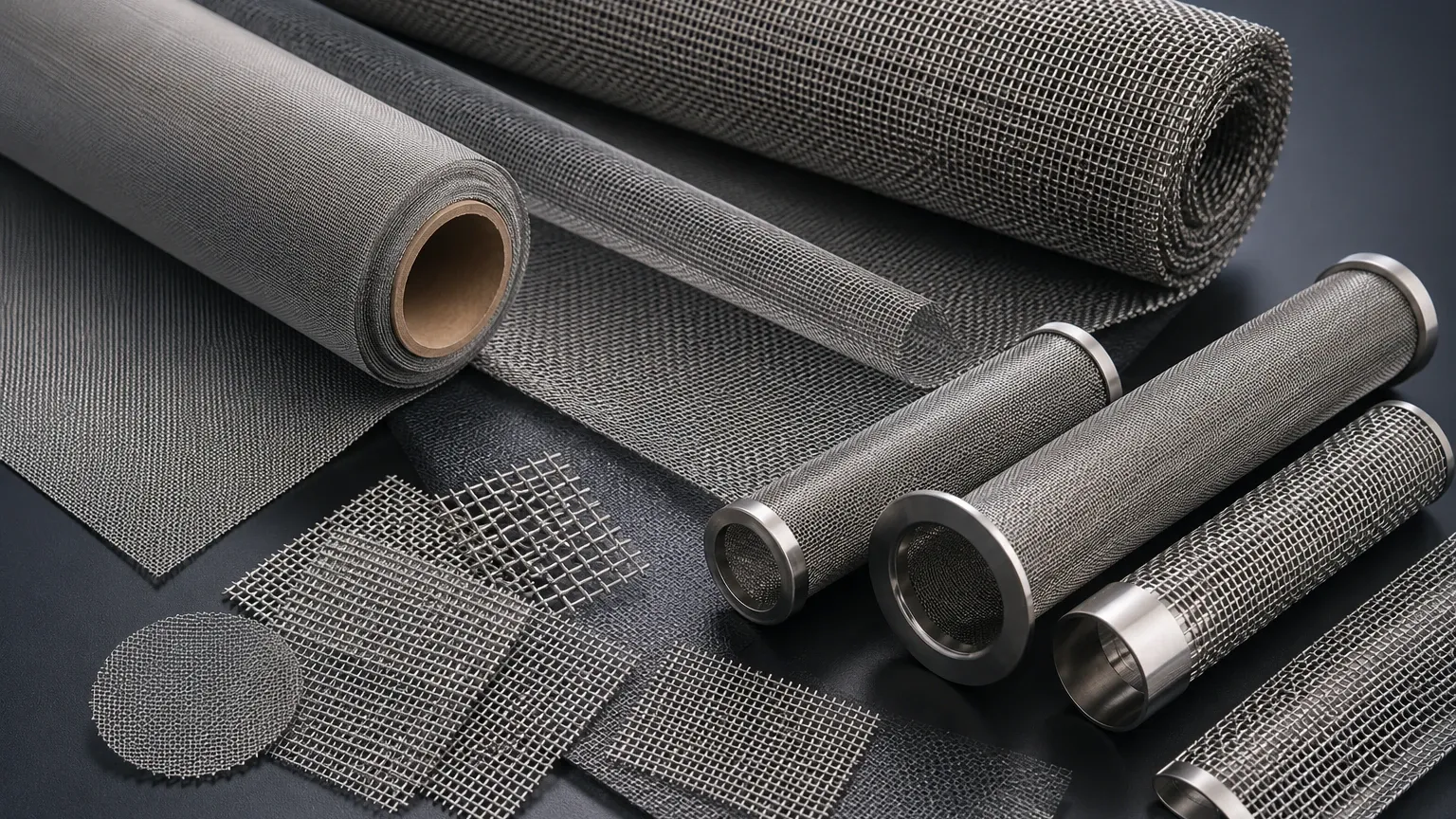
For those seeking specific configurations, Plain, twill and dutch woven wire mesh in SS304/316L — rolls, cut mesh and framed panels. Send mesh count or micron target for a technical quote. provides a comprehensive starting point for technical evaluation.
Technical Specifications: Mesh Count, Micron Rating, and Open Area
When specifying woven wire mesh stainless, engineers must navigate three primary metrics that define performance: mesh count, micron rating, and percentage of open area.
Mesh Count
Mesh count refers to the number of openings per linear inch. A 100-mesh screen has 100 openings per inch in both directions. While mesh count is a common shorthand, it does not fully define filtration capability because it does not account for the wire diameter.
Micron Rating
The micron rating defines the size of the particles the mesh is intended to retain. There are two types of ratings:
1. Nominal Micron Rating: An approximate value indicating that the mesh will retain a major percentage of particles of that size.
2. Absolute Micron Rating: The size of the largest spherical particle that can pass through the mesh under laboratory conditions. For critical applications like hydraulic fluid filtration, the absolute rating is the more reliable metric.
Percentage of Open Area
This is the ratio of the total area of the openings to the total area of the mesh. A higher open area results in a lower pressure drop and higher flow rates but may compromise the mechanical strength of the mesh. Calculating the open area involves a specific formula: `(Aperture / (Aperture + Wire Diameter))^2 x 100`. Engineers must balance the need for throughput with the structural requirements of the filter housing.
Industrial Applications and Performance Requirements
Woven wire mesh stainless is utilized across a vast spectrum of industries, each with unique performance demands.
* Chemical Processing: In this sector, mesh must resist corrosion from acids, bases, and solvents. 316L or even higher alloys like 904L are often required. The mesh is used for catalyst recovery, solvent filtration, and removing impurities from chemical streams.
* Food and Beverage: Cleanability is the priority here. Stainless steel mesh is used in juice filtration, dairy processing, and frying oil recovery. The material must be FDA-compliant and capable of being sanitized repeatedly without degrading.
* Pharmaceuticals: Precision and purity are paramount. Woven mesh is used in fluid bed dryers, centrifuges, and sterile air filtration. The smooth surface of stainless steel prevents bacterial growth and allows for validated cleaning processes.
* Hydraulics and Aerospace: These applications involve high-pressure differentials. Dutch weave patterns are frequently used to provide the necessary strength to prevent the mesh from deforming or bursting under the force of the fluid flow.
Engineering Considerations for Custom Filtration Solutions
Off-the-shelf mesh rolls are often just the starting point. Most industrial applications require some level of customization to integrate the mesh into a larger system. When working with a manufacturer like Kaifil, engineers should consider the following:
Edge Treatment and Framing
Raw cut mesh can fray, leading to wire fragments entering the system. Custom solutions often involve welding the mesh into a frame, adding a U-binder edge, or sintering multiple layers together to create a rigid, non-fraying component.
Multi-Layer Sintering
For extreme environments, single-layer mesh may lack the necessary rigidity. Sintering involves bonding multiple layers of Woven Wire Mesh together using heat and pressure without the use of binders. This creates a composite material that combines the fine filtration of a Dutch weave with the structural support of a coarse mesh.
Pleating and Shaping
To increase the surface area within a fixed volume, mesh can be pleated. This is common in filter cartridges, where maximizing the filtration area reduces the frequency of cleaning or replacement. The ductility of stainless steel allows it to be formed into cylinders, cones, or complex custom shapes without losing its filtration integrity.
Maintenance and Total Cost of Ownership
While the initial cost of woven wire mesh stainless may be higher than disposable synthetic filters, the total cost of ownership (TCO) is often lower due to its durability and cleanability.
Cleaning Methods
Stainless steel mesh can be cleaned using several methods:
* Backwashing: Reversing the flow of fluid to dislodge particles trapped on the surface.
* Ultrasonic Cleaning: Using high-frequency sound waves in a cleaning solution to remove fine particles from the interstitial spaces of the weave.
* Chemical Cleaning: Using acids or alkalis to dissolve organic or inorganic fouling.
* Thermal Cleaning: Burning off organic contaminants in a controlled furnace.
Replacement Cycles
The lifespan of a stainless steel filter depends on the abrasive nature of the particles being filtered and the frequency of cleaning. Unlike synthetic media, which can stretch or tear, stainless steel maintains its pore size over many cleaning cycles. However, engineers should monitor the pressure drop across the filter; a permanent increase in the "clean" pressure drop indicates that the mesh is becoming blinded and may require professional deep cleaning or replacement.
Conclusion
Selecting woven wire mesh stainless is a technical decision that impacts the efficiency, safety, and cost-effectiveness of industrial operations. By understanding the nuances of material grades, weave structures, and geometric specifications, technical professionals can ensure they are using the most appropriate filtration media for their specific application. Whether for simple screening or precision pharmaceutical separation, the reliability of stainless steel mesh remains a cornerstone of modern industrial engineering.
When evaluating providers, it is essential to partner with manufacturers who understand these technical boundaries and can provide the necessary documentation and customization to meet rigorous industrial standards. From initial material selection to the final custom-fabricated component, every detail in the weaving and finishing process contributes to the ultimate performance of the filtration system.
