


7 Filter Water Purifier
In the landscape of industrial and commercial water treatment, the 7 filter water purifier represents a comprehensive approach to achieving high-purity output. These multi-stage systems are engineered to address a wide spectrum of contaminants, from large suspended solids to microscopic chemical compounds and biological pathogens. For engineers and system designers, the effectiveness of a 7-stage system is not merely defined by the number of stages, but by the technical integrity and precision of the individual components within those stages.
At the core of these sophisticated systems are specialized filtration elements that ensure each stage operates at peak efficiency. Components such as Filter Discs & Packs play a critical role in providing the mechanical filtration and structural support necessary for long-term system reliability. This article examines the technical architecture of 7-stage filtration, the engineering considerations for component selection, and the role of high-precision metal filters in modern water purification.
The Engineering Logic Behind a 7 Filter Water Purifier
A 7 filter water purifier is designed on the principle of progressive filtration. By sequencing different filtration technologies, the system can target specific contaminants while protecting the more sensitive (and often more expensive) downstream components, such as Reverse Osmosis (RO) membranes or Ultrafiltration (UF) modules.
Typically, the stages in a high-performance 7-stage system include:
1. Primary Sediment Filtration: Utilizing coarse mesh or fiber to remove sand, rust, and large particulates.
2. Granular Activated Carbon (GAC): Targeted at chlorine, VOCs, and organic chemicals that affect taste and odor.
3. Carbon Block (CTO): Provides secondary chemical adsorption and finer sediment removal.
4. Fine Sediment/Pre-Membrane Filtration: This is where precision Filter Discs & Packs are often employed to ensure no fine carbon fines or debris reach the membrane.
5. Reverse Osmosis (RO) or Ultrafiltration (UF): The primary purification stage for removing dissolved solids, heavy metals, and bacteria.
6. Post-Carbon Polishing: Refines the water quality after storage or membrane processing.
7. Final Treatment (UV, Alkaline, or Mineralization): Ensures biological safety or adjusts the pH and mineral content for specific industrial or potable requirements.
For B2B applications, maintaining the integrity of these stages is paramount. A failure in a pre-filter can lead to the premature fouling of the RO membrane, resulting in significant downtime and increased operational costs.
Integrating Filter Discs & Packs in Multi-Stage Systems
While polymer-based filters are common in many stages, stainless steel Filter Discs & Packs are essential in high-pressure or high-temperature environments, as well as in applications requiring extreme durability and cleanability. In a 7 filter water purifier, these metal components serve several critical functions:
Media Retention and Support
In stages involving granular media (like GAC or mineralization beads), filter discs act as the physical barrier that prevents the media from escaping the housing and migrating into the plumbing. Unlike plastic meshes, stainless steel discs offer the structural rigidity to withstand the pressure of the water flow without deforming.
High-Precision Pre-Filtration
Multi-layer filter packs are engineered to provide depth filtration. By sintering or welding multiple layers of stainless steel wire mesh together, manufacturers can create a filter element that captures particles across a range of sizes. This is particularly useful in the fourth or fifth stage of a 7 filter water purifier, where protecting the RO membrane from microscopic debris is the priority.
Flow Distribution
The uniform pore structure of precision-woven wire mesh ensures that water is distributed evenly across the surface of the filter. This prevents "channeling," where water finds a path of least resistance, thereby bypassing the filtration media and reducing the overall efficiency of the purifier.
Material Integrity: Stainless Steel vs. Synthetic Media
When specifying components for a 7 filter water purifier, material selection is a primary engineering concern. While synthetic fibers (like polypropylene) are cost-effective for disposable stages, stainless steel (AISI 304 or 316L) offers distinct advantages for industrial-grade systems.
* Corrosion Resistance: 316L stainless steel, containing molybdenum, provides superior resistance to chlorides and acidic environments, making it ideal for treating diverse water sources.
* Thermal Stability: In applications where water may be processed at elevated temperatures, metal filter discs maintain their pore size and structural integrity, whereas polymers may soften or leach chemicals.
* Chemical Compatibility: Stainless steel is inert and does not react with the chemical additives often used in industrial water treatment, ensuring that the filter itself does not become a source of contamination.
* Longevity and Reusability: Metal filter packs can often be cleaned via backwashing or ultrasonic cleaning, extending their service life significantly compared to single-use cartridges.
Optimizing Filtration Accuracy and Flow Dynamics
The performance of a 7 filter water purifier is a balance between filtration accuracy (micron rating) and flow rate. High-precision Filter Discs & Packs are characterized by their specific weaving patterns, which dictate these performance metrics.
1. Plain Weave: Offers a straightforward, square opening for high flow rates and low pressure drop, suitable for early-stage sediment removal.
2. Dutch Weave: Provides a much denser mesh with smaller openings, ideal for the fine filtration stages where high-pressure resistance is required.
3. Sintered Mesh: For the most demanding stages of a 7 filter water purifier, multiple layers of mesh are fused together. This creates a robust, fixed-pore structure that cannot migrate or shift under pressure surges, providing the most reliable protection for downstream membranes.
Engineers must calculate the total pressure drop across all seven stages. Using high-permeability metal discs in strategic locations can help minimize the energy required to pump water through the system, thereby reducing the total cost of ownership (TCO).
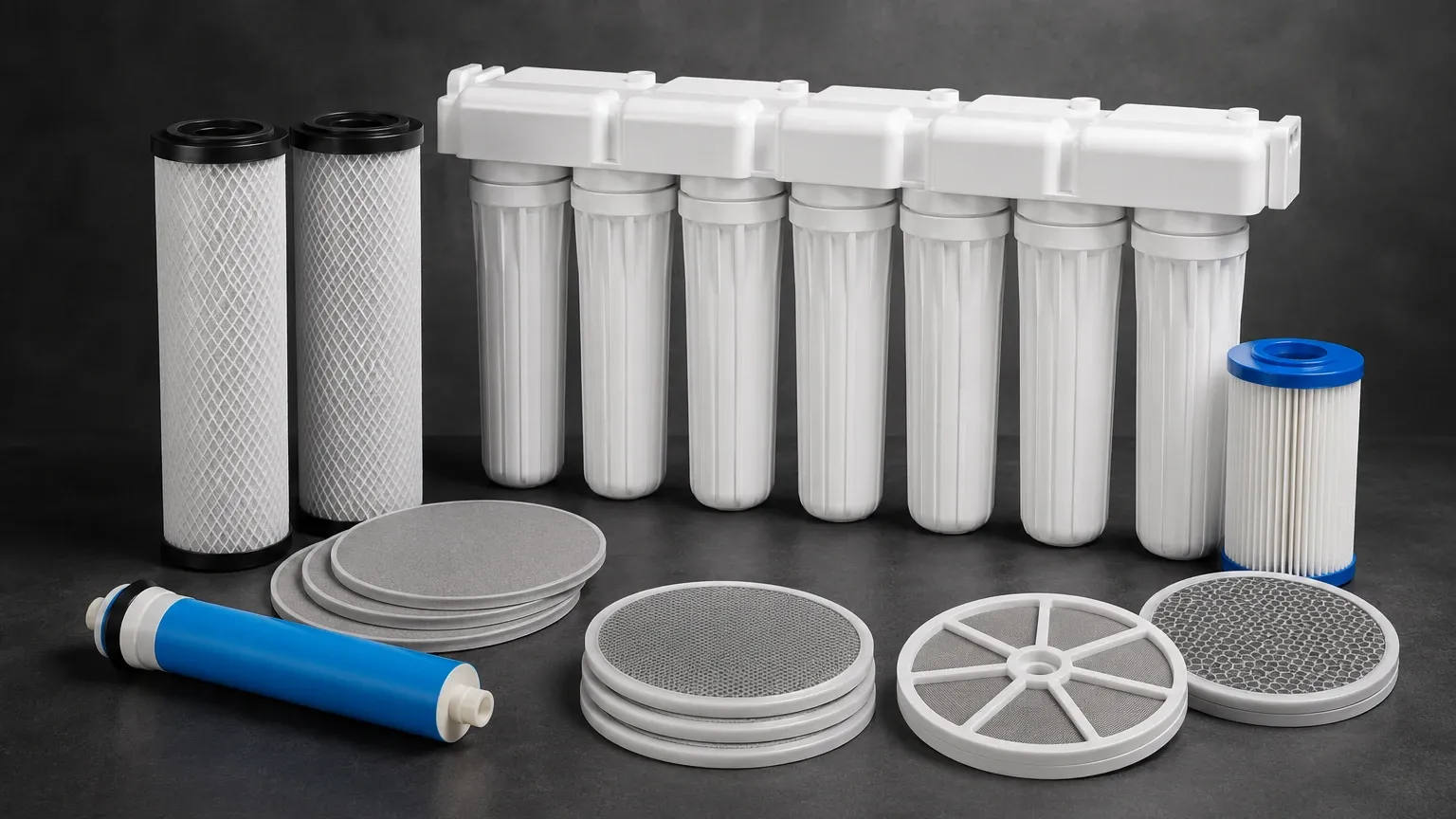
Custom OEM Solutions for Water Treatment Manufacturers
Manufacturers of 7 filter water purifier systems often require bespoke filtration components that fit specific housing geometries or meet unique performance criteria. Customization options for Filter Discs & Packs include:
* Variable Layering: Combining different mesh counts (e.g., a 100-mesh support layer with a 5-micron filtration layer) to achieve specific depth-loading characteristics.
* Edge Treatment: Discs can be provided with spot-welded edges, aluminum or stainless steel rims, or specialized gaskets to ensure a bypass-free seal within the filter housing.
* Geometric Variety: Beyond standard circular discs, components can be manufactured in oval, rectangular, or complex multi-part shapes to accommodate compact system designs.
By partnering with a manufacturer that understands the nuances of wire mesh engineering, OEM teams can optimize their 7-stage systems for specific industrial challenges, such as high-salinity water or high-particulate process water.
Evaluating Durability and Replacement Cycles
In a B2B context, the reliability of a 7 filter water purifier is measured by its uptime. The use of durable metal components in critical stages reduces the frequency of emergency maintenance. While the initial investment in stainless steel Filter Discs & Packs may be higher than that of plastic alternatives, the long-term savings are realized through:
* Reduced Replacement Frequency: Metal filters do not suffer from the structural fatigue common in polymer meshes.
* Predictable Performance: The fixed-pore geometry of a metal pack ensures that the filtration efficiency remains constant throughout its service life.
* Simplified Maintenance: Many stainless steel components are designed for easy removal and cleaning, allowing for faster turnaround during scheduled maintenance intervals.
When designing or purchasing a 7 filter water purifier, engineers should confirm the micron rating, material grade, and pressure limits of every internal filter. Ensuring that the pre-filtration stages are equipped with high-quality metal discs is a proven strategy for maximizing the lifespan of the entire purification system.
Conclusion
The complexity of a 7 filter water purifier demands components that can withstand the rigors of multi-stage processing. By integrating high-precision Filter Discs & Packs, manufacturers and engineers can ensure that their systems deliver consistent, high-purity water while protecting sensitive downstream equipment. Whether for chemical processing, food and beverage production, or pharmaceutical applications, the choice of filtration media is a decisive factor in the success of the water treatment strategy.
