


Disc Filter Air
In industrial environments, the quality of compressed air and process gases is a critical factor in maintaining equipment longevity and ensuring product purity. The use of a disc filter air system is often the primary line of defense against particulate contamination that can compromise pneumatic components, sensitive instrumentation, and chemical processes. Unlike disposable synthetic filters, stainless steel Filter Discs & Packs provide a robust, high-precision solution capable of withstanding the unique pressures and temperatures associated with industrial air filtration.
Selecting the correct filtration component requires a deep understanding of the relationship between air flow dynamics and the physical properties of the filter media. For engineers and procurement specialists, the goal is to achieve an optimal balance between filtration efficiency, pressure drop, and mechanical durability. This guide examines the technical considerations essential for integrating disc filter air solutions into industrial systems.
The Role of Disc Filter Air in Industrial Pneumatic Systems
Air and gas filtration differs significantly from liquid filtration due to the compressibility of the medium and the higher velocities involved. In a disc filter air application, the primary objective is to remove solid particles, such as rust from piping, desiccant dust from dryers, and atmospheric particulates that have bypassed intake filters.
Stainless steel wire mesh is the preferred material for these applications because it maintains its pore structure under high-velocity air streams. When air passes through the mesh, particles are captured through a combination of inertial impaction, interception, and diffusion. For larger particles moving at high speeds, inertial impaction is the dominant mechanism, where the particle's momentum prevents it from following the air stream around the wire, causing it to strike and adhere to the mesh.
In precision pneumatic tools and control valves, even microscopic debris can cause mechanical wear or blockages. Utilizing high-quality Filter Discs & Packs ensures that the air reaching these components meets the required ISO 8573-1 air quality classes for solid particles. The rigidity of the metal disc prevents "media migration," a common failure in fiber-based filters where the filter material itself sheds particles into the downstream air flow.
Material Selection and Technical Specifications for Air Filtration
The performance of a disc filter air assembly is largely determined by the alloy and weave type used in its construction. Kaifil specializes in manufacturing these components from various grades of stainless steel, each offering distinct advantages for specific air and gas environments.
Stainless Steel Grades
* Type 304: The standard choice for general industrial air filtration. It provides excellent strength and good corrosion resistance in non-extreme environments.
* Type 316L: Recommended for applications involving corrosive gases or high humidity, such as in offshore environments or chemical processing. The low carbon content and addition of molybdenum enhance resistance to pitting and intergranular corrosion.
* High-Temperature Alloys: For specialized gas filtration in exhaust systems or high-heat manufacturing, alloys that maintain structural integrity above 500°C may be required.
Weave Patterns and Micron Ratings
The weave pattern dictates the air permeability and the particle size the filter can effectively block.
* Plain Weave: Offers a straightforward aperture and high open area, making it suitable for high-flow, low-pressure drop air applications.
* Dutch Weave: Provides a much finer filtration rating (down to 5-10 microns) by using a denser packing of wires. This is ideal for disc filter air systems requiring high precision in gas chromatography or laboratory-grade air supply.
* Twilled Weave: Used when a thicker, more robust mesh is needed to handle higher pressure differentials without deforming.
Evaluating Filtration Efficiency and Air Permeability
For engineers, the most critical performance metric for any disc filter air component is the relationship between filtration efficiency and pressure drop (delta P). A filter that is too restrictive will cause a significant drop in pressure, forcing compressors to work harder and increasing energy costs. Conversely, a filter that is too open will fail to protect downstream equipment.
Air permeability is measured by the volume of air that can pass through a specific area of the mesh at a given pressure differential. When selecting Filter Discs & Packs, it is essential to calculate the "face velocity"—the speed at which the air approaches the filter surface. If the face velocity is too high, it can lead to particle re-entrainment, where captured debris is pushed through the mesh by the force of the air.
Technical professionals should also distinguish between nominal and absolute filtration ratings. A nominal rating refers to the ability of the mesh to retain a majority of particles of a certain size, while an absolute rating indicates the size of the largest spherical particle that can pass through the mesh. In critical disc filter air applications, such as sterile air for pharmaceutical packaging, absolute ratings are often mandatory to ensure process safety.
Structural Configurations: From Single Discs to Multi-Layer Packs
The mechanical demands of an air system often exceed the capabilities of a single layer of wire mesh. To address this, Filter Discs & Packs are frequently engineered in multi-layer configurations. These "packs" are designed to provide both fine filtration and structural support.
Multi-Layer Sintered Mesh
In high-pressure disc filter air applications, multiple layers of mesh are sintered together. This process uses heat and pressure to fuse the contact points of the wires without melting them, creating a porous, monolithic structure. This prevents the mesh from shifting or deforming under the pulses and surges common in compressed air lines.
Rimmed vs. Unrimmed Discs
The method of edge finishing is a vital engineering consideration.
* Spot Welded Packs: Multiple layers are joined at specific points, which is cost-effective but may leave edges susceptible to fraying if not handled correctly.
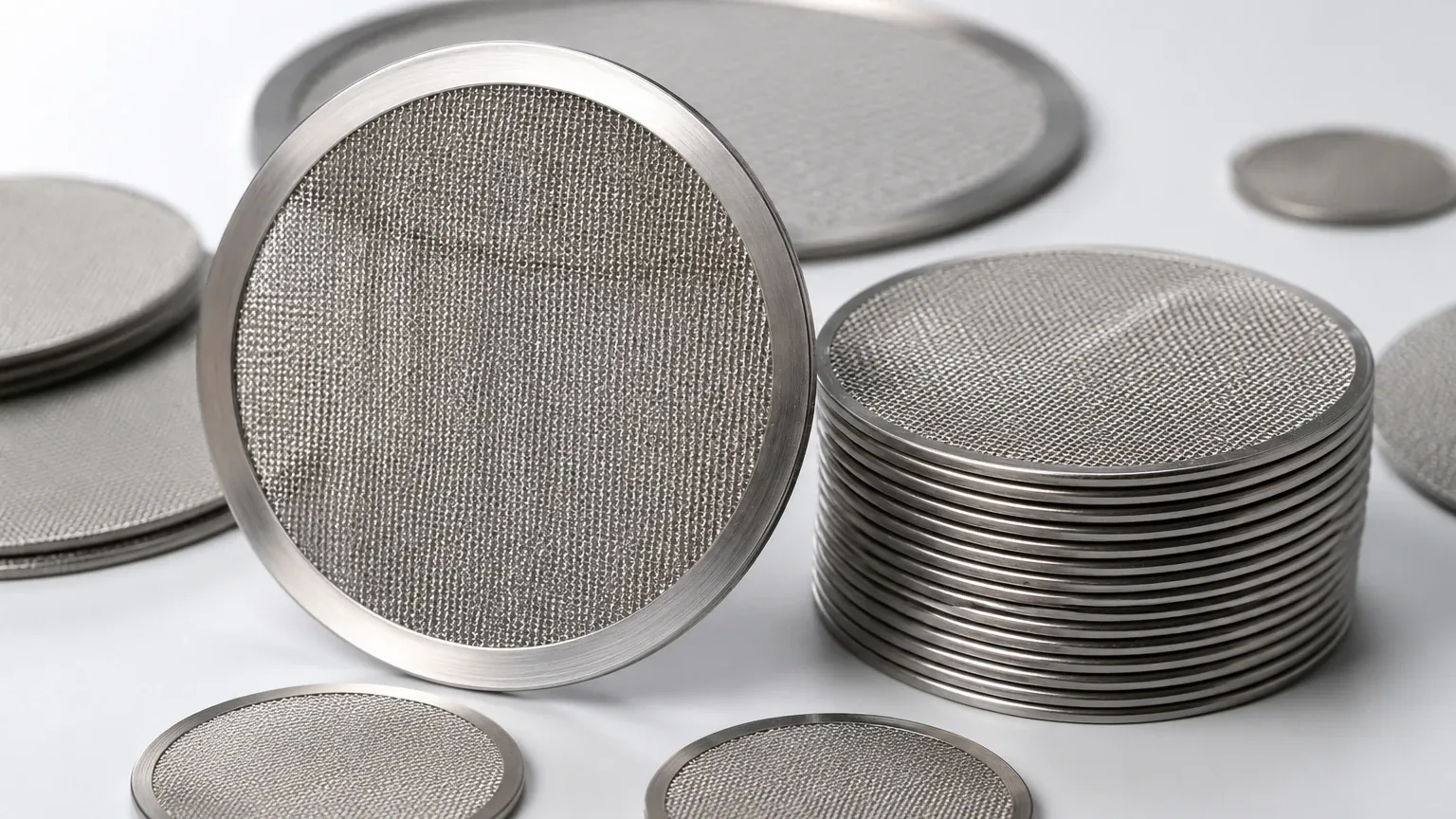
* Rimmed Discs: The edges of the disc are enclosed in a metal binding (typically aluminum, stainless steel, or copper). This rim serves two purposes: it prevents bypass by providing a better sealing surface within the filter housing, and it protects the integrity of the mesh edges, ensuring no loose wires enter the air stream.
Application-Specific Engineering for Gas and Air Streams
The versatility of disc filter air solutions allows them to be deployed across a wide range of specialized industrial sectors. Each application presents unique challenges that influence the design of the filtration component.
1. Pneumatic Power and Control: In automated manufacturing lines, disc filters protect solenoid valves and actuators from pipe scale. The focus here is on durability and long service life.
2. Food and Beverage Carbonation: When CO2 or nitrogen is injected into beverages, the gas must be free of oil aerosols and particulates. Stainless steel discs are preferred here for their ease of sterilization and compliance with food safety standards.
3. Aeration and Sparging: In wastewater treatment or chemical reactors, disc filters are used to create fine bubbles in gas streams. The uniformity of the mesh pore size is critical to achieving consistent bubble distribution.
4. Aerospace and Defense: Filtration of high-pressure gases in propulsion or cooling systems requires discs that can withstand extreme vibration and thermal cycling without failure.
In each of these cases, the Filter Discs & Packs must be sized correctly to the housing to prevent "bypass," where air takes the path of least resistance around the filter rather than through it. Precision in the outer diameter (OD) of the disc is therefore non-negotiable during the manufacturing process.
Maintenance Protocols and Economic Longevity
One of the primary B2B advantages of stainless steel disc filter air components is their cleanability. Unlike polymer filters that must be discarded once clogged, metal discs can often be restored to near-original performance levels through various cleaning methods.
* Ultrasonic Cleaning: High-frequency sound waves create cavitation bubbles that dislodge deeply embedded particles from the mesh pores. This is the most effective method for fine Dutch weave discs.
* Backwashing: Reversing the flow of air or gas can blow off surface-level dust and debris, extending the interval between deep cleanings.
* Chemical Cleaning: For discs exposed to oily residues or chemical vapors, compatible solvents can be used to dissolve contaminants without damaging the stainless steel substrate.
Total Cost of Ownership (TCO)
While the initial purchase price of a stainless steel disc filter air solution is higher than a disposable alternative, the TCO is significantly lower in many industrial contexts. The reduction in waste disposal costs, the elimination of frequent downtime for filter changes, and the protection of expensive downstream machinery provide a clear return on investment. Furthermore, the sustainability aspect of using reusable components aligns with modern corporate environmental goals.
Conclusion: Selection Criteria for Engineers
Before finalizing a purchase for disc filter air components, technical teams should confirm several key variables with the manufacturer. These include the exact operating pressure (both steady-state and peak), the chemical composition of the air or gas stream, and the specific particle size that must be excluded to protect the process.
Kaifil provides the engineering expertise required to navigate these choices, offering customized Filter Discs & Packs tailored to the rigorous demands of industrial filtration. By focusing on material integrity, precise micron ratings, and robust structural design, engineers can ensure their air systems operate at peak efficiency with minimal maintenance intervention.
