


Air Filter Discs
In industrial gas and air filtration, the selection of media is a critical engineering decision that impacts system efficiency, equipment longevity, and operational safety. While polymer-based filters are common in light-duty HVAC applications, demanding industrial environments—characterized by high temperatures, corrosive gases, and high differential pressures—require the mechanical robustness of stainless steel. Industrial air filter discs, often constructed from precision-woven wire mesh or sintered metal, provide the necessary structural integrity and filtration accuracy for these rigorous applications.
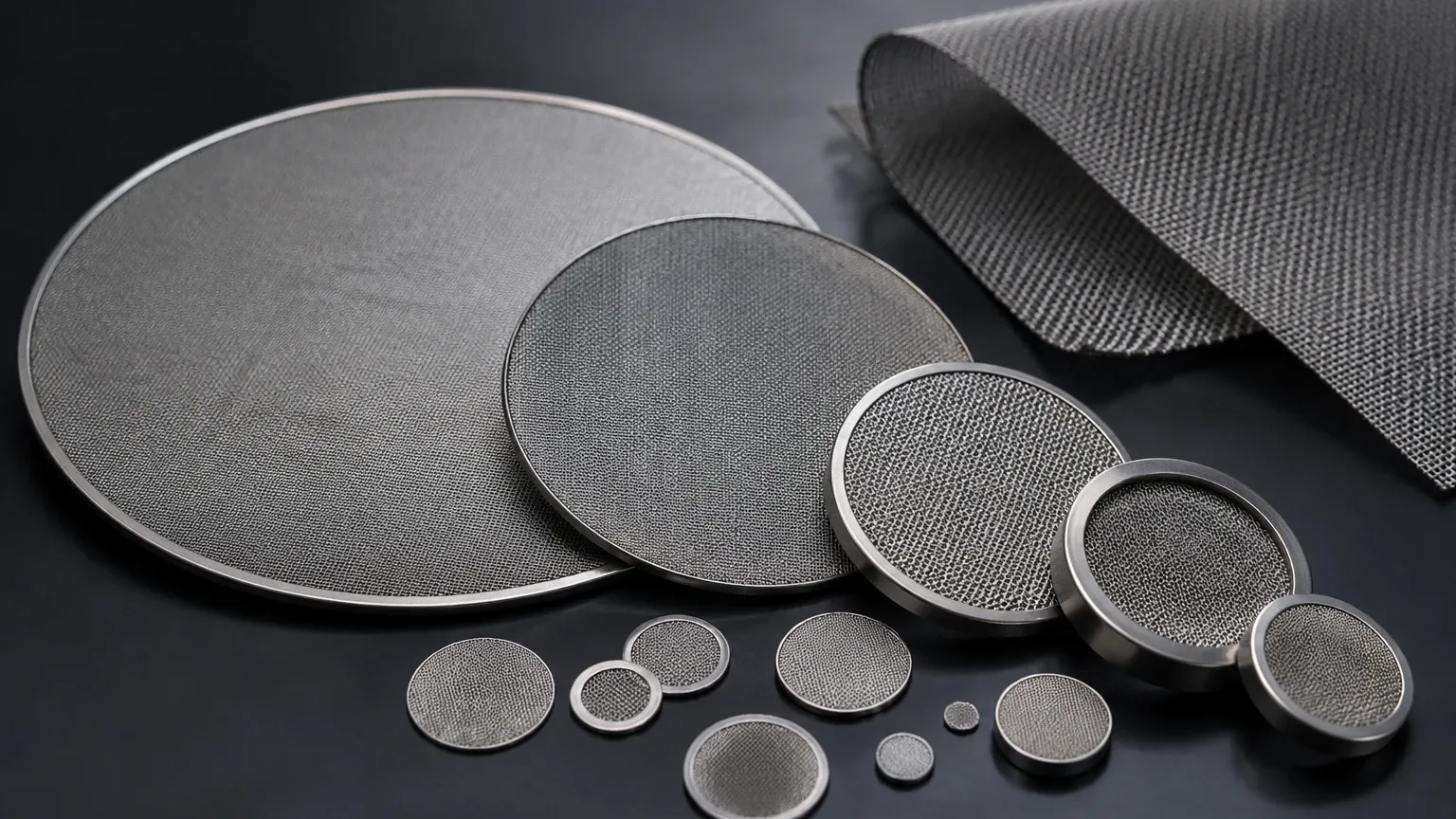
For engineers and procurement specialists, understanding the technical nuances of Filter Discs & Packs is essential for optimizing pneumatic systems, protecting sensitive instrumentation, and ensuring the purity of process air. This guide examines the engineering considerations, material properties, and selection criteria for high-performance metal air filter discs.
Understanding the Role of Stainless Steel Air Filter Discs in Industrial Systems
Industrial air filter discs serve as primary or secondary barriers in gas streams to remove particulate matter, prevent cross-contamination, and protect downstream components such as compressors, valves, and sensors. Unlike disposable fiber filters, stainless steel discs offer a permanent or semi-permanent solution that can withstand environmental stressors that would cause synthetic media to fail.
In B2B industrial contexts, these components are frequently utilized in pneumatic conveying, gas analysis equipment, and venting systems. Their primary advantage lies in their predictable pore size and high mechanical strength. Because the filtration media is metallic, it does not shed fibers into the air stream—a critical requirement in pharmaceutical and semiconductor manufacturing where "cleanliness" refers not just to the absence of external dust, but the absence of media migration from the filter itself.
Material Selection and Engineering Specifications
The performance of air filter discs is fundamentally dictated by the alloy and the weave pattern of the wire mesh. At Kaifil, material selection is the first step in aligning a filter's capabilities with the application's demands.
Stainless Steel Grades
* AISI 304: The standard grade for general industrial air filtration. It offers excellent mechanical properties and good corrosion resistance in non-acidic environments.
* AISI 316L: Preferred for applications involving corrosive gases, high humidity, or chemical vapors. The addition of molybdenum and lower carbon content enhances resistance to pitting and intergranular corrosion.
* Specialty Alloys: For extreme environments, alloys like Monel or Inconel may be used, though 316L remains the industry standard for the majority of high-end B2B filtration needs.
Weave Patterns and Filtration Accuracy
The geometry of the mesh determines the effective micron rating and the flow characteristics:
* Plain Weave: Offers a straightforward aperture and high open area, ideal for high-flow gas streams where low pressure drop is a priority.
* Twill Weave: Allows for a heavier wire diameter in a given mesh count, providing increased strength for high-pressure air lines.
* Dutch Weave (Plain and Twill): Features a dense, compact structure with smaller triangular openings. This is the preferred choice for fine gas filtration where high precision (down to 5-10 microns) is required.
Multi-Layer Filter Discs & Packs for Gas Filtration
In many industrial scenarios, a single layer of wire mesh is insufficient to meet both the filtration fineness and the structural requirements of the system. This leads to the use of multi-layer Filter Discs & Packs. By combining different mesh specifications, engineers can create a gradient filtration effect or a reinforced structure.
The Layering Strategy
A typical multi-layer pack might consist of:
1. A Filtration Layer: A fine Dutch weave mesh that determines the micron rating.
2. Support Layers: Coarser mesh layers on either side of the filtration layer to provide mechanical rigidity and prevent the fine mesh from deforming under pressure.
3. Drainage Layers: In some gas-liquid separation applications (coalescing), additional layers help manage the flow of captured droplets.
These layers can be spot-welded at the perimeter or bound with a metal rim (aluminum, copper, or stainless steel) to ensure they act as a single, cohesive unit. This prevents bypass and simplifies installation in recessed housings.
Performance Metrics: Flow Rate, Pressure Drop, and Efficiency
When specifying air filter discs, engineers must balance three competing factors: filtration efficiency (micron rating), flow rate (permeability), and pressure drop (Delta P).
Differential Pressure (ΔP)
In compressed air systems, a high pressure drop across a filter translates directly to increased energy costs for the compressor. Metal wire mesh is advantageous here because it provides a high percentage of open area compared to depth-style ceramic or felt filters. Engineers must calculate the "clean pressure drop" to ensure the system operates within its design envelope and establish a "terminal pressure drop" at which the disc must be cleaned or replaced.
Gas Velocity and Turbulence
Unlike liquid filtration, gas filtration must account for the compressibility of the medium. High-velocity air can cause vibration in unsupported mesh layers. Therefore, for high-flow air filter discs, the structural support provided by the disc's frame or secondary coarse mesh layers is vital to prevent fatigue failure of the wires.
Porosity and Dirt Holding Capacity
While surface-type wire mesh filters have lower dirt-holding capacity than thick depth filters, they offer superior "cleanability." In air systems where the particulate load is consistent but the gas is hot or chemically aggressive, the surface-loading nature of a stainless steel disc allows for predictable performance and easy maintenance via back-pulsing or ultrasonic cleaning.
Industrial Applications and Environment Compatibility
The versatility of stainless steel filtration components allows them to be integrated into diverse B2B sectors:
* Chemical and Petrochemical: Used in the filtration of process gases and the protection of catalyst beds. The ability of 316L stainless steel to withstand aggressive chemical vapors makes it indispensable.
* Pharmaceutical and Biotechnology: In these sectors, air filter discs are used for sterile venting of tanks. The media must be capable of withstanding SIP (Steam-In-Place) and CIP (Clean-In-Place) cycles without losing structural integrity.
* Food and Beverage: Used in nitrogen purging and CO2 filtration. The non-toxic, non-shedding nature of stainless steel ensures compliance with food safety standards.
* Hydraulic and Pneumatic Power: Protecting precision valves from airborne contaminants that could enter the system through breathers or intake ports.
Customization Options and Manufacturing Techniques
One of the primary strengths of a professional manufacturer like Kaifil is the ability to provide customized filtration solutions tailored to specific equipment housings. Standard catalog items often fail to meet the exact tolerances required for specialized industrial machinery.
Edge Treatment and Framing
To ensure a proper seal and prevent fraying, air filter discs can be finished in several ways:
* Spot Welding: Secures multi-layer packs at strategic points.
* Rim Binding: An aluminum or stainless steel U-shaped channel is pressed around the edge. This provides a robust sealing surface for gaskets.
* Sintering: In high-performance applications, the layers of mesh are diffusion-bonded (sintered) together. This creates a monolithic structure where the wires cannot move, ensuring a permanent pore size even under extreme vibration.
Geometry and Dimensions
While circular discs are the most common, manufacturing capabilities allow for the production of oval, rectangular, or ring-shaped filters. Precision laser cutting or die-stamping ensures that every disc fits perfectly into the designated filter housing, eliminating the risk of bypass.
Maintenance and Longevity: The Economic Case for Reusable Metal Filters
When evaluating the total cost of ownership (TCO), B2B buyers must look beyond the initial purchase price. Disposable air filters represent a recurring cost, both in terms of procurement and disposal of contaminated waste.
Stainless steel air filter discs offer a sustainable alternative. Because they are manufactured from durable alloys, they can be cleaned and returned to service multiple times. Common cleaning methods include:
* Ultrasonic Cleaning: Highly effective for removing fine particulates trapped within the mesh pores.
* Back-flushing: Using high-pressure air or fluid in the reverse direction of flow to dislodge surface cake.
* Chemical Cleaning: Using compatible solvents to dissolve resins or oils that may have accumulated on the disc.
By extending the replacement cycle, industrial facilities reduce downtime and minimize their environmental footprint. The durability of these components also provides a safety margin; unlike paper or polymer filters, a metal disc will not rupture or collapse during a sudden pressure spike, protecting expensive downstream equipment from catastrophic damage.
Selection Checklist for Engineers
Before finalizing a specification for air filter discs, technical teams should confirm the following parameters with their supplier:
1. Operating Temperature: Will the filter be exposed to cryogenic or high-heat conditions (above 250°C)?
2. Chemical Composition: Are there trace gases or moisture levels that necessitate 316L or higher alloys?
3. Maximum Differential Pressure: What is the highest pressure the disc must withstand before cleaning?
4. Micron Rating: Is the requirement for nominal or absolute filtration?
5. Housing Compatibility: Are the dimensions and edge treatments compatible with existing seals and gaskets?
By addressing these factors, purchasing teams can ensure they receive a filtration solution that delivers reliable performance and long-term value. Kaifil’s expertise in custom manufacturing ensures that every Filter Discs & Packs order is engineered to meet the specific rigors of the intended industrial application, providing peace of mind and operational efficiency.
