


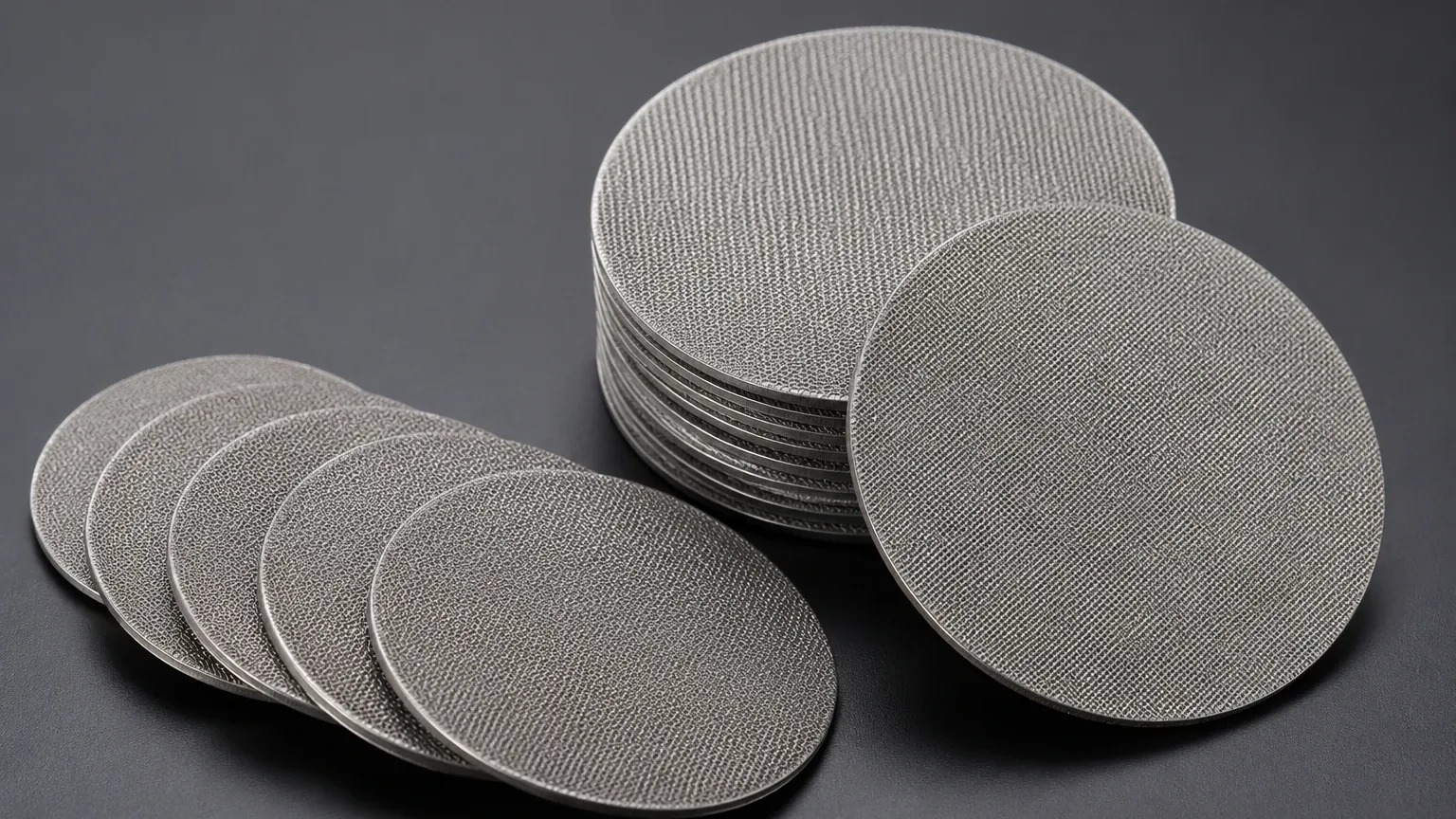
Disc Filter 5 Micron
In industrial filtration, the transition from coarse particle removal to fine precision often centers on the 5-micron threshold. Achieving a reliable 5-micron rating requires a sophisticated balance of material science, weave patterns, and structural reinforcement. For engineers and procurement specialists, selecting a disc filter 5 micron involves more than just identifying a pore size; it requires understanding how the filter media behaves under pressure, its chemical compatibility, and its structural integrity within a larger system.
Industrial filtration components, specifically Filter Discs & Packs, are the primary solution for high-precision applications. These components are typically manufactured from stainless steel wire mesh, which provides the necessary durability and heat resistance that polymer-based filters lack. This guide examines the technical specifications, engineering considerations, and selection criteria for 5-micron disc filters in professional environments.
Technical Foundations of 5-Micron Filtration
A 5-micron rating indicates that the filter is designed to capture particles as small as 5 micrometers. To put this in perspective, a human red blood cell is approximately 7 to 8 microns in diameter. Achieving this level of precision with stainless steel mesh requires specific weaving techniques.
Weave Types for Fine Micron Ratings
While standard square mesh (plain weave) is excellent for coarse filtration, it cannot easily achieve a stable 5-micron opening while maintaining structural strength. For a disc filter 5 micron, manufacturers typically utilize:
1. Plain Dutch Weave (PDW): This weave uses a larger diameter wire in the warp direction and a smaller diameter wire in the shute direction. This creates a dense, strong mesh with fine openings that are measured in a "nominal" micron rating.
2. Twilled Dutch Weave (TDW): In this configuration, each shute wire passes over and under two warp wires. This allows for an even higher density of wires, making it possible to achieve absolute filtration ratings as low as 1 to 5 microns.
3. Sintered Metal Mesh: For the most demanding 5-micron applications, multiple layers of wire mesh are sintered (diffusion bonded) together. This process fuses the contact points of the wires, ensuring the 5-micron pores remain dimensionally stable even under high differential pressure.
Material Selection: SS304 vs. SS316L
Material selection is critical for the longevity of the filter. Stainless steel 304 is the standard for general industrial use, offering good corrosion resistance and cost-effectiveness. However, in chemical processing or pharmaceutical applications, SS316L is preferred. The addition of molybdenum in 316L provides superior resistance to chlorides and organic acids, preventing pitting and ensuring the purity of the filtered medium.
Engineering Considerations for Filter Discs & Packs
When integrating a disc filter 5 micron into an industrial system, engineers must evaluate several performance metrics to ensure the component does not become a bottleneck or a failure point.
Pressure Drop and Flow Rate
As the micron rating decreases, the resistance to flow increases. A 5-micron filter has significantly higher flow resistance than a 40-micron filter. Engineers must calculate the "Clean Pressure Drop" to ensure the system’s pump capacity is sufficient. Factors influencing this include:
* Effective Filtration Area (EFA): The actual surface area available for fluid passage.
* Viscosity of the Fluid: Thicker fluids require more pressure to pass through 5-micron openings.
* Contaminant Loading: How quickly the 5-micron pores will clog based on the concentration of solids in the influent.
Structural Integrity and Layering
A single layer of 5-micron mesh is often too thin to withstand high-pressure differentials. To solve this, Filter Discs & Packs are often constructed as multi-layer components. A typical 5-layer sintered disc might include:
* Filtration Layer: The 5-micron mesh.
* Protective Layers: Finer mesh on either side of the filtration layer to protect it from mechanical damage.
* Support Layers: Coarser, heavy-duty mesh that provides the structural rigidity needed to prevent the disc from deforming under flow.
Edge Treatment and Sealing
Bypass is the primary failure mode in precision filtration. If the edges of the disc are not properly sealed, fluid will take the path of least resistance around the filter rather than through it. Common edge treatments include:
* Spot Welding: Multiple layers are welded at the perimeter to keep them aligned.
* Aluminum or Stainless Steel Rims: The mesh is encased in a metal U-binding or rim. This provides a flat, solid surface for gaskets to seal against, ensuring 100% of the fluid passes through the 5-micron media.
Performance Evaluation: Absolute vs. Nominal
One of the most common points of confusion in purchasing a disc filter 5 micron is the distinction between absolute and nominal ratings.
* Nominal Rating: This is an efficiency figure, often indicating that the filter will trap 60% to 90% of particles at 5 microns. Nominal filters are generally used for non-critical applications where some particle passage is acceptable.
* Absolute Rating: This indicates that 99.9% (or higher) of particles at the specified micron size will be captured. For critical hydraulic systems or pharmaceutical batch processing, an absolute rating is usually required.
To verify these ratings, manufacturers use the Bubble Point Test. This test involves submerging the filter in a liquid and increasing air pressure until the first bubble appears. The pressure required to force the bubble through the pore is inversely proportional to the pore size, allowing for an accurate measurement of the largest opening in the mesh.
Customization Options for Industrial Applications
Standard sizes exist, but most industrial systems require customized Filter Discs & Packs to fit specific housing geometries. Customization options typically include:
1. Geometry: Beyond standard circular discs, filters can be manufactured in ring shapes (with a center hole), ovals, or rectangular strips.
2. Layer Configuration: Depending on the pressure and the nature of the debris, a pack can be designed with varying numbers of layers, ranging from a single layer to complex 7-layer stacks.
3. Rim Materials: While aluminum is common for its malleability and cost, copper or stainless steel rims are used for high-temperature or high-corrosion environments where aluminum might react with the process fluid.
Common Applications for 5-Micron Disc Filters
The 5-micron threshold is a standard requirement across several high-stakes industries:
Chemical and Petrochemical Processing
In the production of specialty chemicals, 5-micron filters are used to remove catalysts or fine particulates that could interfere with downstream reactions. The high temperature and corrosive nature of these fluids make stainless steel the only viable material.
Pharmaceutical and Biotechnology
Filtration in pharma requires extreme precision. 5-micron discs often serve as pre-filters for membrane systems, removing larger biological aggregates or precipitates to extend the life of more expensive, sub-micron sterile filters.
Hydraulic and Lubrication Systems
Modern hydraulic components have extremely tight tolerances. Particles larger than 5 microns can cause abrasive wear on valves and pumps. Using a disc filter 5 micron in the return line or as a suction strainer helps maintain ISO fluid cleanliness codes.
Food and Beverage Production
From filtering fine sediments in wine to ensuring the purity of carbonated water, 5-micron stainless steel discs provide a hygienic, cleanable solution that meets FDA requirements for food contact.
Maintenance, Cleaning, and Replacement Cycles
Unlike disposable polymer filters, stainless steel Filter Discs & Packs are designed for reuse, which significantly lowers the total cost of ownership (TCO).
Cleaning Methods
* Ultrasonic Cleaning: This is the most effective method for 5-micron filters. High-frequency sound waves create cavitation bubbles that dislodge particles trapped deep within the weave.
* Backwashing: Reversing the flow of the fluid can clear surface-loaded contaminants, though it is less effective for depth-loading Dutch weaves.
* Chemical Cleaning: Soaking the discs in compatible solvents or acids can dissolve organic or mineral buildup without damaging the stainless steel structure.
When to Replace
While cleanable, these filters do have a finite lifespan. Replacement is necessary if:
* The pressure drop remains high even after cleaning (indicating permanent pore plugging).
* There is visible mechanical damage to the mesh or the rim.
* The bubble point test indicates that the pore size has enlarged due to erosion or corrosion.
Procurement Checklist for Engineers
Before ordering a disc filter 5 micron, technical teams should confirm the following data points with their manufacturer:
1. Operating Temperature: Will the filter be exposed to extreme heat or cryogenic temperatures?
2. Differential Pressure (ΔP): What is the maximum pressure the disc must withstand before it risks collapsing?
3. Fluid Compatibility: Is SS304 sufficient, or does the chemistry require SS316L or a specialty alloy like Hastelloy?
4. Sealing Requirements: Does the housing require a specific rim thickness or material to achieve a leak-proof seal?
5. Quantity and Lead Time: For OEM applications, ensuring a consistent supply of precision-matched discs is vital for production continuity.
By focusing on these technical parameters, engineers can ensure that their choice of Filter Discs & Packs provides the necessary filtration efficiency while maximizing the operational life of the equipment. Whether for protecting sensitive hydraulic valves or ensuring the purity of a chemical batch, the 5-micron disc filter remains a cornerstone of precision industrial engineering.
