


Bag Filter Unit
In the landscape of industrial liquid filtration, the bag filter unit stands as one of the most versatile and cost-effective solutions for removing particulate matter from process streams. Designed as a pressure vessel containing a replaceable filter bag supported by an internal strainer basket, this system is widely utilized across the chemical processing, food and beverage, pharmaceutical, and water treatment sectors. For engineers and procurement professionals, selecting the right bag filter unit requires a deep understanding of fluid dynamics, material compatibility, and the specific mechanical requirements of the application.
A bag filter unit operates on a relatively simple yet highly effective principle: the liquid to be filtered enters the top or side of the housing, passes through the filter bag from the inside out, and exits through the bottom or side outlet. The contaminants are trapped within the bag, making disposal and replacement straightforward. However, the engineering nuances—ranging from seal integrity to the structural design of the support basket—determine the long-term efficiency and reliability of the filtration process.
Understanding the Mechanics of a Bag Filter Unit
The fundamental design of a bag filter unit revolves around the pressure vessel housing. Unlike cartridge filters, which often utilize a larger number of smaller elements, a bag filter unit relies on the surface area and depth of the bag media to capture solids. The fluid enters the housing and is directed into the open mouth of the filter bag.
One of the most critical mechanical components within the unit is the internal support basket. Because the filter bag is made of flexible media—such as felt, monofilament mesh, or multi-filament mesh—it cannot withstand high differential pressures on its own. The support basket, typically manufactured from perforated stainless steel or high-precision wire mesh, provides the necessary structural integrity. At Kaifil, the focus is on ensuring these internal components are engineered to minimize flow resistance while providing maximum support, preventing bag rupture under heavy particulate loading.
The flow pattern in a bag filter unit is designed to ensure that all liquid passes through the media. Any bypass, where unfiltered liquid escapes around the seal of the bag, compromises the entire system. Therefore, the sealing mechanism—whether it is a snap-fit ring, a plastic flange, or a compression-style lid—is a primary engineering consideration during the selection process.
Critical Components and Material Selection
Material selection is the cornerstone of industrial filtration performance. A bag filter unit must be compatible with the chemical properties of the fluid, the operating temperature, and the required pressure rating.
Housing Materials
For most industrial applications, stainless steel is the preferred material for the housing. Type 304 stainless steel offers excellent general corrosion resistance, making it suitable for water treatment and many food-grade applications. For more aggressive environments, such as chemical processing or pharmaceutical manufacturing, Type 316L stainless steel is often specified due to its superior resistance to chlorides and organic acids. The internal surfaces of the housing may also be polished to specific Ra (Roughness Average) values to prevent bacterial growth or facilitate easier cleaning in sanitary applications.
Filter Bag Media
The media inside the bag filter unit is chosen based on the target particle size and the chemical nature of the fluid. Common materials include:
- Polypropylene (PP): Widely used for its broad chemical compatibility and low cost. It is ideal for aqueous solutions and many acids.
- Polyester (PE): Preferred for higher temperature applications where polypropylene might lose structural integrity.
- Nylon Monofilament: Excellent for precise straining applications where a consistent pore size is required, such as in paints or coatings.
Gaskets and O-Rings
The integrity of the bag filter unit also depends on the elastomeric seals. Engineers must confirm that the O-rings (typically Viton, EPDM, or Nitrile) can withstand the process temperature and chemical exposure without swelling or degrading, which could lead to leaks or bypass.
Performance Metrics: Filtration Accuracy and Flow Dynamics
When evaluating a bag filter unit, engineers must look beyond the physical dimensions and focus on performance metrics. The two most important factors are the micron rating and the flow rate capacity.
Micron Ratings and Efficiency
Filter bags are typically available in ratings from 1 micron to over 1000 microns. It is essential to distinguish between nominal and absolute ratings. Most standard filter bags are nominally rated, meaning they will trap a high percentage of particles at the specified size, but not 100%. If an application requires high-precision removal of specific contaminants, a multi-layered high-efficiency bag or a specialized metal filter component may be necessary. For those seeking advanced technical guidance on these specifications, visiting the Main Page of a professional manufacturer can provide deeper insights into custom metal filtration options.
Flow Rate and Pressure Drop
The flow rate of a bag filter unit is influenced by the viscosity of the fluid, the surface area of the bag, and the pore size of the media. A common mistake in procurement is sizing a unit based solely on the pipe size. Instead, sizing should be based on the "clean pressure drop." Ideally, a system should be designed with an initial pressure drop of less than 0.15 bar (2 psi). As the bag collects solids, the pressure drop (Delta P) will increase. Engineers typically schedule a bag change-out when the differential pressure reaches 1.0 to 1.5 bar (15-22 psi).
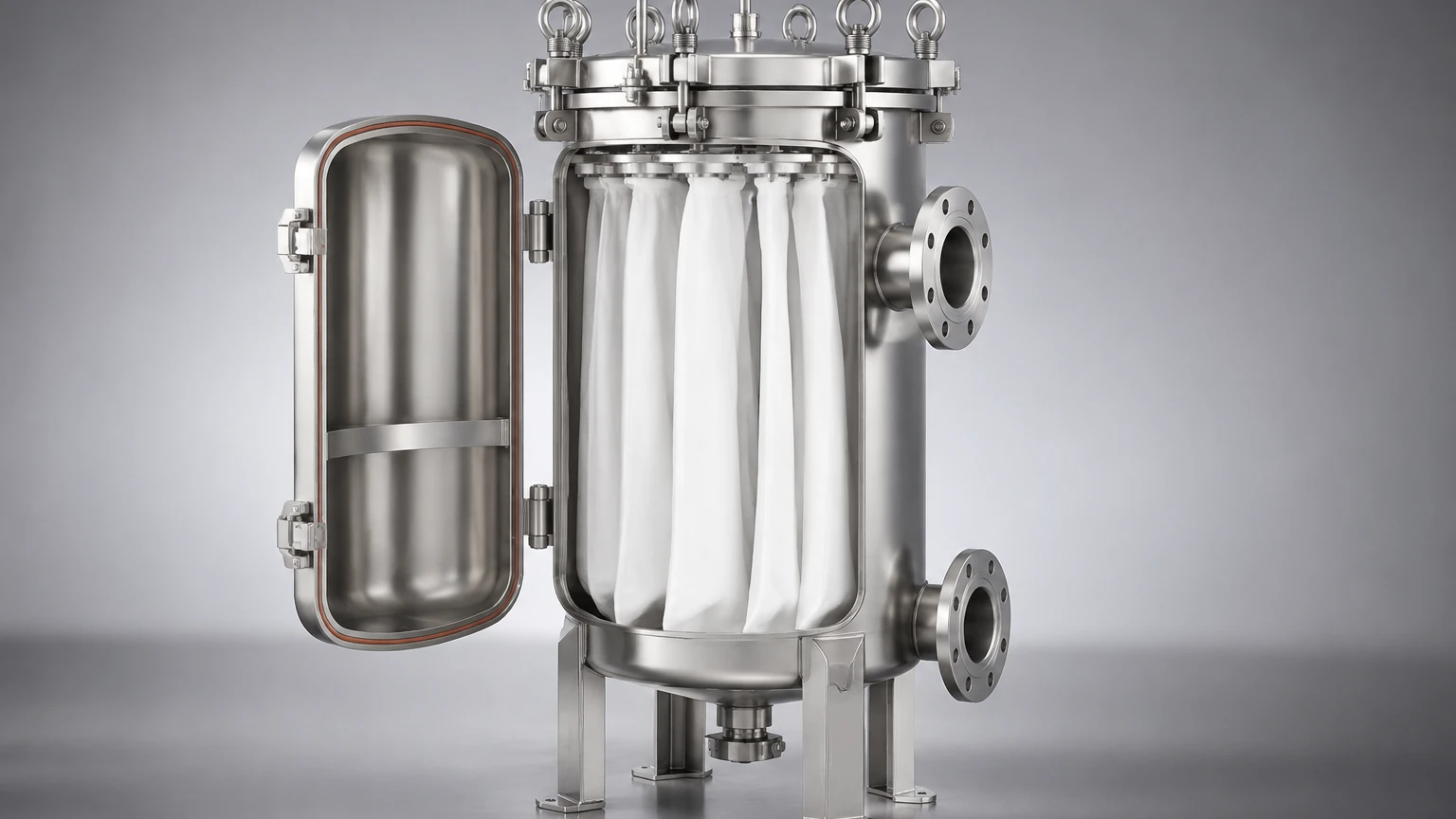
Evaluating Housing Designs for Industrial Applications
Bag filter units are categorized into several design types based on the volume of fluid and the continuity of the process. Selecting the correct configuration is vital for operational efficiency.
Single Bag vs. Multi-Bag Units
For low to medium flow rates, a single bag filter unit is usually sufficient. These are compact and easy to maintain. However, for high-flow industrial applications—such as large-scale water treatment or bulk chemical production—multi-bag housings are used. These units can contain anywhere from 2 to 24 bags (or more) within a single vessel, allowing for significantly higher flow rates and longer intervals between maintenance cycles.
Side-Entry vs. Top-Entry
- Side-Entry: The fluid enters through the side of the housing. This design is often more economical but may result in a small amount of unfiltered liquid remaining in the head of the unit during bag changes.
- Top-Entry: The fluid enters through the top cover, ensuring a more uniform distribution of flow and reducing the risk of bypass. Top-entry designs are often preferred in high-purity applications because they allow for a more secure seating of the filter bag flange.
Duplex Filtration Systems
In processes that cannot be shut down for maintenance, a duplex bag filter unit configuration is employed. This consists of two separate housings connected by a diverter valve. When the bag in one housing reaches its maximum pressure drop, the flow is diverted to the second housing, allowing the first bag to be replaced without interrupting the process flow.
Maintenance, Replacement Cycles, and Lifecycle Costs
The total cost of ownership (TCO) of a bag filter unit is not just the initial purchase price, but the ongoing cost of replacement bags, labor, and potential downtime.
Monitoring Differential Pressure
To maximize the life of the filter media, the bag filter unit should be equipped with differential pressure gauges. Changing bags too early leads to unnecessary consumable costs, while changing them too late can cause the media to stretch or the support basket to experience excessive stress. In some cases, high pressure can even force contaminants through the media, a phenomenon known as "unloading."
Replacement Best Practices
When replacing a bag, it is crucial to ensure the housing is properly vented and drained. The new bag must be seated correctly within the support basket, and the sealing ring must be flush against the housing seat. Any misalignment during installation is a primary cause of bypass in industrial filtration systems.
Durability of Internal Components
While the bags are consumables, the bag filter unit housing and the support basket should last for many years. Choosing high-quality stainless steel components ensures that the unit can withstand the mechanical stresses of repeated opening and closing, as well as the hydraulic shocks that can occur in industrial piping systems.
Engineering Custom Filtration Solutions
In many demanding industrial environments, a standard off-the-shelf bag filter unit may not meet all the technical requirements. Customization often becomes necessary to address specific challenges such as unusual piping configurations, extreme temperatures, or the need for specialized filtration media.
Customization options often include:
- Specialized Inlet/Outlet Configurations: Flanged, threaded, or sanitary tri-clamp connections to match existing infrastructure.
- Heating Jackets: For fluids that are highly viscous at room temperature (like resins or food oils), a steam or electric heating jacket can be added to the housing to maintain flowability.
- Advanced Materials: Using exotic alloys or specialized coatings for highly corrosive chemical streams.
- Integrated Precision Components: Incorporating stainless steel wire mesh or sintered metal components for pre-filtration or final polishing stages.
By working with a manufacturer that specializes in custom stainless steel filtration, such as Kaifil, engineers can ensure that the bag filter unit is not just a generic vessel, but a precision-engineered component of their process. From material selection to the final pressure testing of the vessel, every detail is tailored to ensure reliable performance in the field.
In conclusion, the bag filter unit remains a cornerstone of industrial liquid-solid separation. By focusing on the technical details of housing design, material compatibility, and flow dynamics, technical professionals can select a system that provides efficient, durable, and cost-effective filtration for their specific application. Whether for a simple water filtration task or a complex chemical process, the right engineering approach to bag filtration ensures process integrity and protects downstream equipment.
