


5 Micron Disc Filter
In industrial filtration, the precision of particle separation is often the determining factor in product quality and equipment longevity. A 5 micron disc filter represents a high-efficiency solution designed to capture fine particulate matter that could otherwise compromise downstream processes. These components are essential in environments where fluid purity is non-negotiable, such as in chemical processing, pharmaceutical manufacturing, and high-pressure hydraulic systems.
Selecting the correct Filter Discs & Packs requires a deep understanding of material science, fluid dynamics, and the mechanical stresses of the specific application. This guide examines the technical specifications, engineering considerations, and industrial applications of 5 micron filtration components to assist engineers and procurement teams in making informed decisions.
Engineering Principles of 5 Micron Filtration
A 5 micron rating indicates that the filter is designed to remove particles as small as 5 micrometers. To put this in perspective, a human red blood cell is approximately 7 microns in diameter. Achieving this level of precision in a metallic filter requires advanced weaving techniques or sintering processes.
Nominal vs. Absolute Ratings
When specifying a 5 micron disc filter, it is critical to distinguish between nominal and absolute ratings. A nominal rating refers to the ability of the filter to retain a certain percentage (often 60% to 90%) of particles of the specified size. An absolute rating, typically achieved through high-precision Dutch weave mesh or sintered metal, implies that 99.9% or more of particles larger than 5 microns will be captured. For critical applications like catalyst recovery or pharmaceutical sterile filtration, absolute ratings are usually required.
Filtration Mechanisms
At the 5-micron level, filtration occurs through several mechanisms:
* Surface Filtration: Particles larger than the mesh openings are trapped on the upstream surface of the disc. This is common in single-layer wire mesh discs.
* Depth Filtration: Particles are trapped within the tortuous paths of a multi-layer sintered or compressed mesh structure. This significantly increases the dirt-holding capacity of the filter.
* Inertial Impaction: Smaller particles that might otherwise pass through are forced against the wire surfaces due to fluid velocity and momentum.
Material Selection for Precision Filter Discs
The performance of a 5 micron disc filter is heavily dependent on the alloy used in its construction. Stainless steel is the industry standard due to its balance of mechanical strength and chemical resistance.
Stainless Steel 304 and 316L
* SS 304: Suitable for general industrial use, water treatment, and food-grade applications where moderate corrosion resistance is required.
* SS 316L: The "L" stands for low carbon, which improves weldability and resistance to intergranular corrosion. This alloy is preferred in chemical processing and marine environments where exposure to chlorides or acids is common. It is also the standard for pharmaceutical applications due to its high level of biological inertness.
Specialty Alloys
In extreme environments, standard stainless steel may be insufficient. Engineers may specify Hastelloy, Monel, or Inconel for applications involving high temperatures (above 500°C) or highly aggressive chemical solvents. These materials ensure that the 5 micron pore structure remains stable even under thermal expansion or chemical attack.
Structural Configurations: Single Layer vs. Multi-Layer Packs
The physical architecture of Filter Discs & Packs determines how they handle pressure and how often they must be cleaned or replaced.
Single-Layer Discs
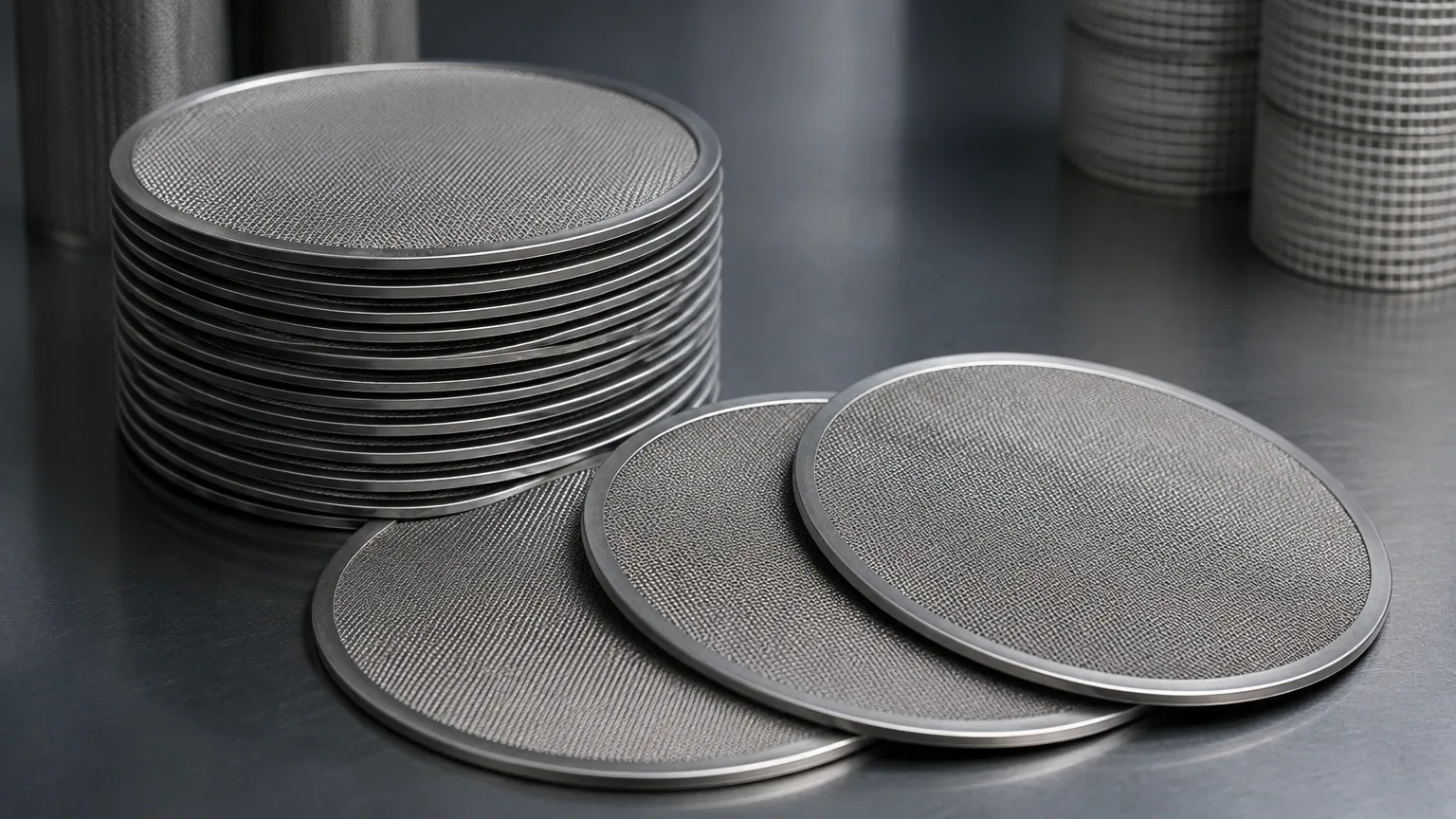
Single-layer 5 micron discs are typically made from a fine Dutch weave wire mesh. These are used in applications with low pressure differentials and where the fluid has a low concentration of solids. They are cost-effective and easy to clean but lack the structural rigidity of multi-layer designs.
Multi-Layer Filter Packs
To handle higher pressures and provide longer service life, multiple layers of mesh are combined. A typical 5-layer sintered disc might include:
1. Drainage Layer: A coarse mesh that provides structural support and allows fluid to exit the filter housing efficiently.
2. Support Layer: A medium mesh that prevents the fine filtration layer from deforming under pressure.
3. Filtration Layer: The 5 micron precision mesh that performs the actual separation.
4. Second Support Layer: Provides additional stability.
5. Protection Layer: A coarse mesh on the upstream side that protects the fine filtration layer from physical damage or large debris.
Sintering these layers together creates a monolithic structure that will not migrate or delaminate, even under high-pressure pulses or backwashing cycles.
Manufacturing Processes and Quality Control
Precision manufacturing is vital for ensuring that a 5 micron disc filter actually performs at its rated specification. Small defects in the weave or the welding process can create bypass routes for contaminants.
Weaving Techniques
For 5 micron filtration, standard square mesh is rarely sufficient because the wires would be too thin to maintain structural integrity. Instead, manufacturers use Plain Dutch Weave (PDW) or Twilled Dutch Weave (TDW). These weaves use larger diameter warp wires and smaller diameter shute wires driven closely together, creating a dense, strong mesh with very fine, triangular openings.
Edging and Rim Options
To prevent fraying and ensure a proper seal within the filter housing, discs are often finished with a rim or frame. Common options include:
* Spot Welding: Multiple layers are welded at the edges. This is economical but may leave exposed wire ends.
* Aluminum or Stainless Steel Rims: The edges are encased in a metal U-channel. This provides a superior seal and makes the disc easier to handle during installation.
* Copper or Rubber Gaskets: Used in specialized hydraulic or pneumatic systems where a gas-tight seal is required.
Testing and Validation
Reliable manufacturers subject their 5 micron disc filters to rigorous testing, including bubble point tests to verify pore size, air permeability tests to check flow resistance, and ultrasonic cleaning to remove any residual manufacturing debris.
Industrial Applications for 5 Micron Disc Filters
The versatility of the 5 micron disc filter makes it a staple in several high-tech industries.
Polymer and Fiber Production
In the extrusion of plastics, polymers, and synthetic fibers (like nylon or polyester), even tiny impurities can cause fiber breakage or surface defects. Filter discs are used in screen changers to remove degraded polymer gels and carbonized particles from the melt before it passes through the spinneret.
Pharmaceutical and Biotechnology
5 micron filters are used as pre-filters for sterile filtration stages. They remove bulk contaminants and bioburden, protecting more expensive 0.22 micron membrane filters from premature clogging. Because they are made of stainless steel, they can be repeatedly sterilized via autoclaving or Steam-in-Place (SIP) processes.
Chemical and Petrochemical Processing
In catalyst recovery, 5 micron discs are used to capture expensive catalyst particles from a liquid stream. Their ability to withstand high temperatures and aggressive solvents makes them superior to polymer-based filters in these environments.
Hydraulic and Aerospace Systems
High-precision hydraulic systems rely on 5 micron filtration to protect sensitive valves and actuators. Particulate contamination in these systems can lead to "stiction" or catastrophic component failure. Stainless steel discs are preferred here because they can withstand the high-pressure spikes inherent in hydraulic circuits.
Technical Selection Criteria for Engineers
When specifying a 5 micron disc filter for a new or existing system, engineers should evaluate the following parameters:
1. Clean Pressure Drop (ΔP): The initial resistance to flow. A lower ΔP allows for higher flow rates or the use of smaller pumps.
2. Dirt Holding Capacity: The volume of contaminants the disc can hold before the pressure drop reaches a critical level. Multi-layer sintered discs offer significantly higher capacity than single-layer discs.
3. Mechanical Strength: The maximum allowable pressure differential across the disc before it deforms or ruptures. This is especially important in high-viscosity fluid filtration.
4. Chemical Compatibility: Ensuring the alloy and rim material will not react with the process fluid.
5. Cleanability: Can the disc be cleaned and reused, or is it a disposable component? Stainless steel discs are generally cleanable via ultrasonic baths, chemical cleaning, or backflushing.
Maintenance and Operational Longevity
The total cost of ownership for a 5 micron disc filter is determined not just by the purchase price, but by its service life and maintenance requirements.
Monitoring Performance
Industrial systems should be equipped with differential pressure gauges. A sudden spike in ΔP indicates that the filter is reaching its loading capacity. Operating a filter beyond its rated capacity can lead to "breakthrough," where particles are forced through the mesh, or physical damage to the filter structure.
Cleaning Procedures
One of the primary advantages of stainless steel Filter Discs & Packs is their reusability. Cleaning methods include:
* Ultrasonic Cleaning: Using high-frequency sound waves in a cleaning solution to dislodge particles from deep within the mesh pores.
* Chemical Cleaning: Using acids, alkalis, or solvents to dissolve organic or inorganic deposits.
* Burn-off / Pyrolysis: For polymer applications, the discs can be heated in a controlled environment to carbonize and remove plastic residues.
It is important to note that repeated cleaning can eventually wear down the wire mesh or alter the pore size. Regular inspection under magnification is recommended to ensure the 5 micron rating is maintained over time.
Conclusion
The 5 micron disc filter is a precision-engineered component that plays a vital role in modern industrial processes. Whether it is protecting sensitive hydraulic valves, ensuring the purity of a pharmaceutical batch, or maintaining the quality of a polymer melt, the choice of filter disc has a direct impact on operational efficiency. By selecting the appropriate material, weave, and structural configuration, and by following rigorous maintenance protocols, engineers can achieve reliable, cost-effective filtration performance in even the most demanding environments.
