


4 Wire Wedge
In the field of industrial separation and filtration, the geometry of the filter media is as critical as the material itself. Among the various configurations available, the 4 wire wedge profile represents a specific engineering standard designed for high-load applications and precision slot control. As a specialized component of Wedge Wire Screens, this profile is widely utilized in sectors where structural rigidity must be balanced with efficient flow rates and resistance to blinding.
Understanding the technical nuances of the 4 wire wedge—including its dimensions, mechanical properties, and application limits—is essential for engineers and procurement teams tasked with optimizing filtration systems for chemical processing, mining, and large-scale water treatment.
Understanding the 4 Wire Wedge Profile in Industrial Screening
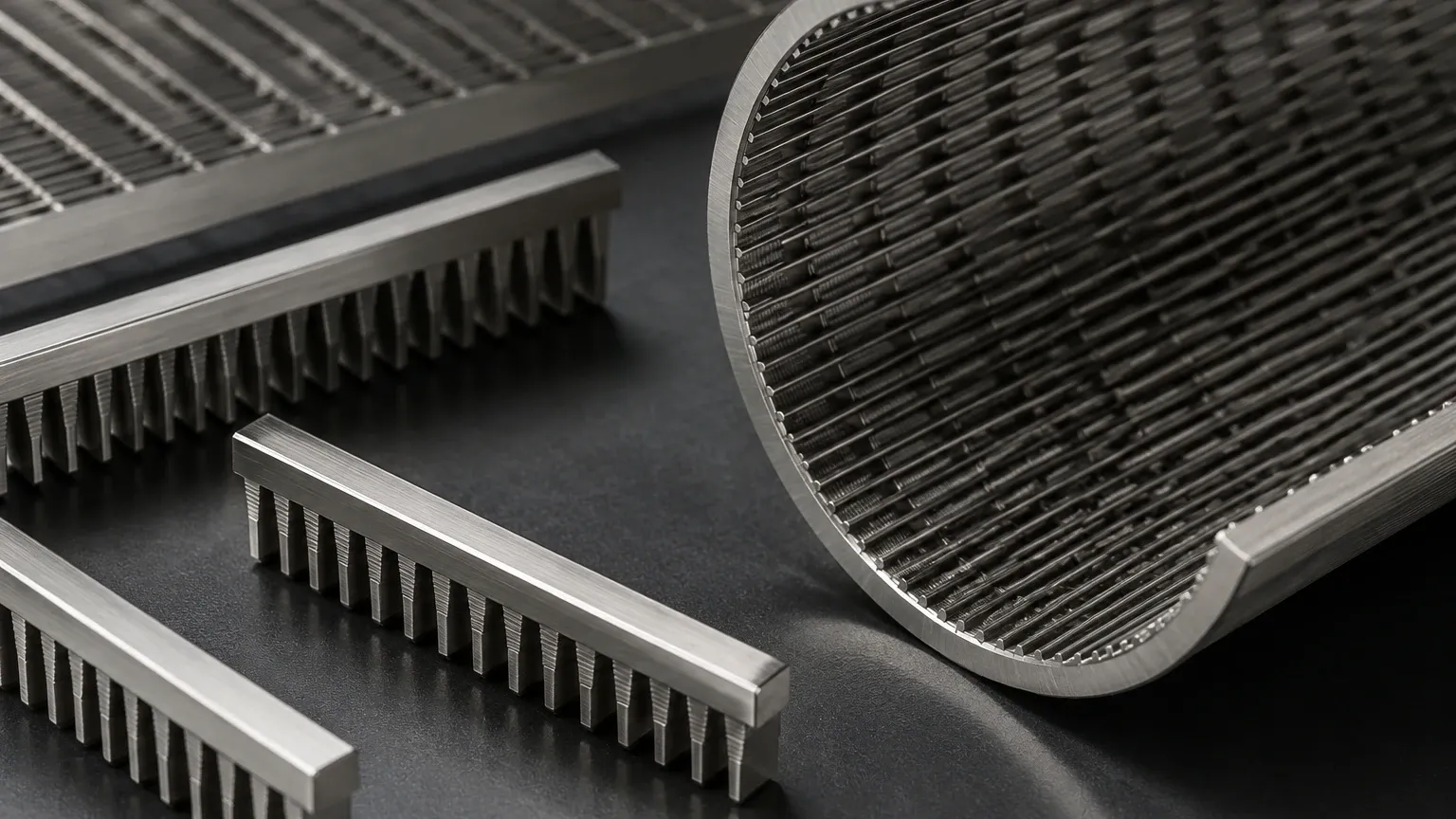
The term "4 wire wedge" typically refers to a wedge-shaped profile wire with a specific width, often standardized around 4.0mm at the widest point of the surface. This profile is part of a broader family of V-shaped wires used to construct continuous-slot screens. Unlike woven wire mesh, which can shift under pressure, wedge wire is resistance-welded at every intersection with a support rod, creating a rigid, three-dimensional structure.
The V-Shape Principle
The defining characteristic of the 4 wire wedge is its tapered cross-section. The wire is widest at the surface (the side facing the incoming flow) and narrows toward the interior. This design creates a "two-point" contact for particles. If a particle is small enough to pass through the initial slot opening, it will continue to fall through the widening gap without becoming wedged or "blinded." This self-cleaning property is the primary reason why wedge wire is preferred over traditional perforated plates or mesh in high-solids applications.
Dimensional Significance
A 4mm profile width provides a significant surface area for wear resistance. In abrasive environments, such as coal washing or aggregate processing, the thickness of the wire determines the service life of the screen. A 4 wire wedge offers a robust wear life while still allowing for a high percentage of open area, provided the slot size is calculated correctly relative to the wire width.
Key Performance Advantages of Wedge Wire Screens
When evaluating the 4 wire wedge within the broader category of Wedge Wire Screens, several performance metrics stand out that directly impact the total cost of ownership and process efficiency.
1. Superior Structural Integrity
Because the 4 wire profile is relatively heavy compared to fine-gauge wires, it provides exceptional mechanical strength. This allows the screen to withstand high differential pressures and heavy static loads without deforming. In vibrating screen applications, the mass and weld-strength of the 4 wire profile help resist fatigue failure caused by constant harmonic stress.
2. Precision Slot Control
Manufacturing a 4 wire wedge requires advanced CNC-controlled resistance welding. This ensures that the slot width—the gap between adjacent wires—remains consistent across the entire surface of the screen. Precision slot control is vital for applications requiring strict particle size distribution, such as catalyst recovery or resin retention in ion exchange columns.
3. Optimized Flow Dynamics
The relief angle provided by the wedge shape reduces the pressure drop across the filter media. By minimizing turbulence and providing a clear path for the filtrate, systems utilizing 4 wire wedge profiles can often operate at higher flow velocities than those using conventional media, leading to increased throughput in the same physical footprint.
Material Selection and Chemical Compatibility
The performance of a 4 wire wedge is intrinsically linked to the alloy from which it is fabricated. Industrial filtration environments often involve corrosive fluids, extreme temperatures, or abrasive slurries. Selecting the correct material is the first step in preventing premature failure.
* AISI 304 Stainless Steel: The standard choice for general industrial use. It offers good corrosion resistance and mechanical strength at a cost-effective price point. Suitable for food and beverage applications and basic water treatment.
* AISI 316L Stainless Steel: Contains molybdenum, which provides superior resistance to pitting and crevice corrosion in chloride-rich environments. This is the preferred material for pharmaceutical and chemical processing.
* Duplex Stainless Steels (e.g., 2205): Used in highly aggressive environments where both high strength and extreme corrosion resistance are required, such as offshore oil and gas or desalination plants.
* Specialty Alloys: For high-temperature applications or specific chemical resistances, alloys like Monel or Hastelloy can be used to manufacture the 4 wire wedge profile, though these are typically reserved for specialized OEM requirements.
Engineering Evaluation: Load Capacity and Pressure Drop
When designing a system around a 4 wire wedge screen, engineers must perform several critical calculations to ensure the component meets the application's demands.
Open Area Calculation
The percentage of open area is a function of the slot width (S) and the wire width (W). For a 4 wire wedge (where W = 4.0mm), the formula is:
Open Area % = [S / (S + W)] x 100
For example, a 1mm slot with a 4mm wire results in a 20% open area. While a wider wire increases the strength and wear life, it decreases the open area for a given slot size. Engineers must find the "sweet spot" where the screen is strong enough to handle the load but open enough to meet flow requirements.
Support Rod Spacing
The 4 wire wedge is supported by perpendicular rods. The distance between these rods (the pitch) determines the beam strength of the surface wires. If the support rods are too far apart, the 4 wire profile may bow under pressure, causing the slot widths to change. In high-pressure hydraulic applications or heavy-duty mining screens, support rod spacing is typically tightened to maintain the integrity of the filtration surface.
Common Risks and Mitigation in Filtration Systems
Despite the inherent durability of the 4 wire wedge, certain operational risks can lead to failure if not properly addressed during the selection and installation phases.
Abrasive Erosion
In slurry transport or mineral processing, high-velocity particles can erode the edges of the wedge wire. Once the sharp edge of the V-profile is rounded, the non-blinding characteristics of the screen are diminished. Mitigating this risk involves selecting harder alloys or increasing the wire profile width to provide more sacrificial material.
Stress Corrosion Cracking (SCC)
In environments with high tensile stress and corrosive agents (like chlorides), stainless steel can suffer from SCC. This is particularly dangerous in welded structures like Wedge Wire Screens. Using L-grade (low carbon) steels or duplex alloys helps mitigate this risk by improving the metallurgical stability of the weld zones.
Vibration Fatigue
In vibrating separators, the screen is subjected to millions of cycles. If the 4 wire wedge is not perfectly welded to the support rods, or if the screen is not tensioned correctly within the machine, harmonic vibration can lead to weld fractures. Ensuring high-quality OEM manufacturing standards is the best defense against fatigue-related downtime.
Customization and OEM Integration
One of the primary benefits of working with a professional manufacturer like Kaifil is the ability to customize the 4 wire wedge configuration to fit specific equipment. Industrial filtration is rarely a one-size-fits-all solution.
* Flat Panels: Used in vibrating screens, sluices, and intake diversions.
* Cylindrical Cartridges: Created by wrapping the 4 wire wedge around support rods in a spiral fashion. These are used in automatic backwashing filters, screw presses, and rotary strainers.
* Internal or External Flow: Depending on the application, the "flat" side of the wedge wire can be on the inside or the outside of a cylinder. For example, in a trommel screen, the flat side faces inward to facilitate the movement of solids.
Kaifil’s advanced manufacturing capabilities allow for precise control over the tilt angle of the wire and the frequency of the support rods, ensuring that the final product integrates seamlessly into existing industrial housings or new OEM designs.
Pre-Purchase Checklist for Engineers and Procurement
Before finalizing a specification for a 4 wire wedge screen, technical teams should confirm the following parameters to ensure performance and longevity:
1. Slot Opening (Aperture): What is the exact particle size that must be retained? Ensure the slot is sized for the minimum particle dimension.
2. Direction of Flow: Will the fluid move from the inside out or outside in? This determines the orientation of the wedge profile.
3. Maximum Differential Pressure: What is the highest pressure the screen will face during a surge or when partially fouled?
4. Chemical Composition: Are there trace elements (like H2S or high chlorides) that require an upgrade from 304 to 316L or Duplex?
5. Mechanical Interface: How will the screen be mounted? Confirm flange dimensions, reinforcement ring requirements, or tensioning hook specifications.
6. Cleaning Method: Will the screen be cleaned via backpulsing, mechanical scraping, or manual wash-down? This may influence the required surface smoothness.
By addressing these technical details early in the procurement process, companies can avoid costly field failures and ensure that their Wedge Wire Screens provide reliable service in demanding industrial environments. The 4 wire wedge remains a cornerstone of heavy-duty filtration, offering a proven balance of strength, precision, and efficiency.
