


Superfish Aqua Flow 50 Filter Cartridges
In the realm of specialized filtration, understanding the specific mechanics of small-scale systems like the Superfish Aqua Flow 50 filter cartridges provides a foundational look at dual-action filtration principles. While these components are often associated with hobbyist aquarium setups, the engineering logic behind their design—combining mechanical entrapment with chemical adsorption—parallels many of the complex challenges faced in industrial fluid processing. For engineers and procurement specialists, analyzing these entry-level systems offers a comparative baseline for evaluating more robust industrial Filter Cartridges used in chemical, pharmaceutical, and food-grade applications.
Understanding the Role of Superfish Aqua Flow 50 Filter Cartridges in Small-Scale Filtration
The Superfish Aqua Flow 50 filter cartridges are designed as the primary consumable component for internal filter units typically rated for volumes up to 50 liters. In any filtration system, the cartridge serves as the functional heart, responsible for maintaining fluid clarity and chemical balance. These specific cartridges utilize a modular design that allows for rapid replacement, a feature that prioritizes ease of maintenance over long-term structural durability.
From a technical perspective, these cartridges are engineered to handle low-flow environments where the primary goal is the removal of organic particulates and dissolved waste. The housing is generally constructed from lightweight polymers, containing a specialized media bed. For industrial professionals, the Aqua Flow 50 represents the "disposable" end of the filtration spectrum, highlighting the trade-offs between initial cost and the total cost of ownership (TCO) that must be calculated when scaling up to industrial-grade stainless steel alternatives.
The Mechanics of Dual-Action Filtration: Mechanical vs. Chemical
The effectiveness of superfish aqua flow 50 filter cartridges stems from their dual-action approach. This is a common strategy in fluid purification, where a single pass through the media must address multiple types of contaminants.
Mechanical Filtration via Open-Cell Foam
The first stage of the cartridge consists of a high-porosity polyurethane foam. This foam acts as a mechanical sieve. As fluid is forced through the tortuous path of the foam's cellular structure, suspended solids are trapped via interceptive and diffusional mechanisms. In industrial contexts, this is analogous to the function of stainless steel wire mesh or depth filters, though the latter offer significantly higher temperature resistance and chemical compatibility.
Chemical Filtration via Activated Carbon
The core of the Aqua Flow 50 cartridge contains activated carbon. This media operates on the principle of adsorption, where dissolved impurities—such as chlorine, organic dyes, and certain heavy metals—are chemically bonded to the vast internal surface area of the carbon granules. In industrial B2B applications, while activated carbon is frequently used, it is often housed within high-pressure stainless steel vessels to ensure the integrity of the process under varying thermal and hydraulic loads.
Evaluating Performance Metrics for Filter Cartridges
When selecting any filtration component, whether for a small-scale system or a high-capacity industrial line, engineers must evaluate several key performance indicators (KPIs). For the superfish aqua flow 50 filter cartridges, these metrics are simplified for the end-user, but the underlying engineering remains relevant.
1. Flow Rate and Flux: The Aqua Flow 50 is typically rated for approximately 0-100 liters per hour. In industrial settings, flux (flow per unit area) is a critical calculation to prevent premature clogging and to ensure that the pressure drop (ΔP) remains within the pump's operating curve.
2. Micron Rating: While consumer-grade cartridges rarely provide a certified micron rating, they generally operate in the 50-100 micron range for mechanical filtration. Industrial precision filters, such as those manufactured from sintered metal or fine wire mesh, allow for much tighter tolerances, often reaching down to 1-5 microns with high repeatability.
3. Bypass Risk: A common failure point in modular cartridges is the seal between the cartridge and the pump housing. If the fit is not precise, fluid will take the path of least resistance, bypassing the media entirely. This is why industrial filter housings utilize precision-machined O-ring seats and mechanical seals.
Maintenance Cycles and the Impact of Cartridge Degradation
The lifecycle of superfish aqua flow 50 filter cartridges is relatively short, typically requiring replacement every 4 to 6 weeks. This frequency is dictated by two primary factors: mechanical loading and chemical saturation.
* Mechanical Loading: As the foam pores fill with debris, the resistance to flow increases. In a small internal filter, this simply reduces the turnover rate. In an industrial hydraulic or chemical system, an increase in differential pressure can lead to filter collapse or system-wide shutdown.
* Chemical Saturation: Activated carbon has a finite number of adsorption sites. Once these sites are occupied, the cartridge no longer removes dissolved toxins. Unlike industrial stainless steel filters, which can often be cleaned via backwashing or ultrasonic treatment, these composite cartridges must be discarded, contributing to a higher long-term waste profile.
For purchasing teams, the frequent replacement cycle of disposable cartridges serves as a reminder of the benefits of permanent, cleanable filtration solutions. While the initial capital expenditure (CAPEX) for a stainless steel filter system is higher, the reduction in operational expenditure (OPEX) over several years is substantial.
Transitioning from Consumer to Industrial Filtration Solutions
While the superfish aqua flow 50 filter cartridges are suitable for their intended niche, industrial environments demand a different level of material science. When moving from small-scale fluid management to industrial processing, several upgrades become mandatory.
Material Compatibility
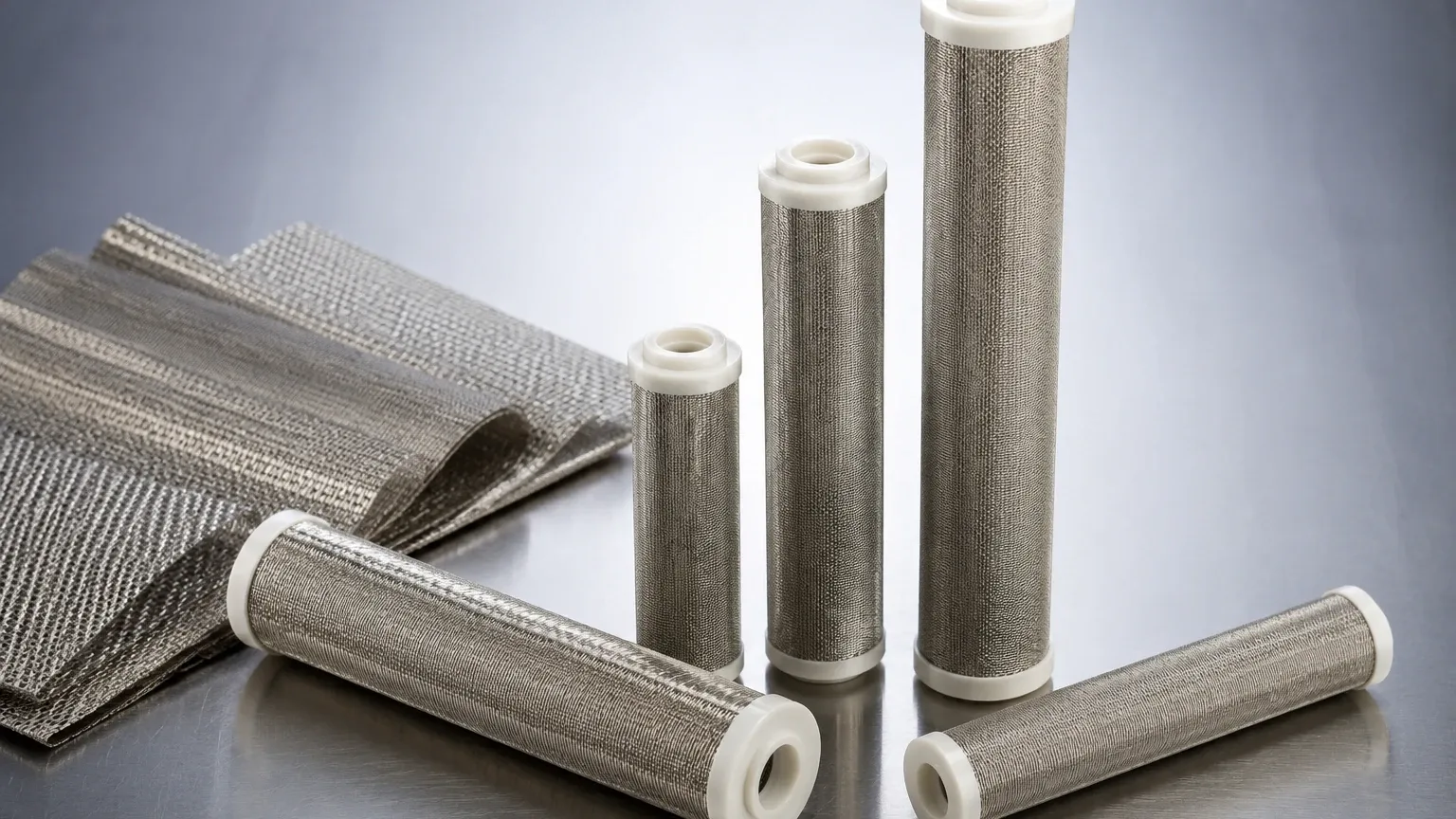
Plastic cartridges are susceptible to degradation when exposed to solvents, high temperatures, or extreme pH levels. Industrial Filter Cartridges are typically fabricated from 304 or 316L stainless steel. This ensures that the filter does not leach contaminants into the process stream and can withstand aggressive Cleaning-in-Place (CIP) protocols.
Structural Integrity
In high-pressure systems, the internal framework of the filter must resist deformation. Industrial cartridges often feature a perforated inner core and an outer support shroud to maintain the pleat geometry of the wire mesh. This prevents the "media migration" that can occur in lower-quality foam or fabric filters.
Precision and Customization
Unlike the standardized dimensions of the Aqua Flow 50, industrial filters are often customized to fit specific housing geometries or to meet unique filtration targets. This includes varying the weave pattern of the wire mesh (e.g., Dutch weave vs. square weave) to balance flow capacity with particle retention accuracy.
Engineering Considerations for Custom Filtration Systems
For engineers looking to optimize their filtration processes, the lessons learned from observing small-scale systems like the superfish aqua flow 50 filter cartridges can be applied to larger system designs. When specifying a custom filtration solution, the following technical factors should be confirmed with the manufacturer:
* Particle Size Distribution (PSD): Understanding the exact size and shape of the contaminants allows for the selection of the ideal mesh count or sintered structure.
* Viscosity and Temperature: Higher viscosity fluids require larger surface areas to maintain flow without excessive pressure build-up. Similarly, temperature fluctuations can affect the expansion and contraction of filter components, necessitating robust metal construction.
* Total Solids Loading: If the fluid has a high concentration of solids, a multi-stage filtration approach—similar to the dual-action concept but scaled up—is often necessary. This might involve a coarse pre-filter followed by a high-precision finish cartridge.
By analyzing the fundamental principles found in products like the superfish aqua flow 50 filter cartridges, it becomes clear that while the scale and materials change, the core objective remains the same: the efficient and reliable removal of unwanted elements from a fluid stream. For industrial applications where failure is not an option, transitioning to high-performance, custom-engineered metal filtration components is the most sustainable path forward. These professional solutions provide the durability, precision, and reusability that disposable cartridges simply cannot match in a B2B environment.
