


In the landscape of industrial filtration and material separation, the specification of components often extends beyond basic mechanical dimensions to include surface treatments and material compositions that meet specific environmental or functional demands. Woven wire mesh black represents a specialized segment of the wire cloth industry, encompassing both carbon steel (often referred to as black wire mesh) and stainless steel substrates treated with various black coatings or finishes. For engineers and procurement teams, understanding the technical distinctions between these variants is essential for ensuring long-term performance, cost-efficiency, and system compatibility.
At its core, Woven Wire Mesh is produced by interlacing metallic wires on a loom, creating a structured grid with precise openings. When the "black" designation is applied, it typically refers to one of three categories: low-carbon steel mesh used for industrial processing, epoxy-coated stainless steel for high-durability filtration, or black-oxide-treated mesh for specialized optical or architectural applications. Each serves a distinct purpose in sectors ranging from plastic extrusion to high-end architectural security.
Understanding the Composition of Woven Wire Mesh Black
The term woven wire mesh black is most frequently associated with two distinct material paths. The first is carbon steel mesh, manufactured from low-carbon or high-carbon iron wire. This material is inherently dark in appearance and is widely utilized in applications where the high cost of stainless steel is not justified, yet high tensile strength and rigidity are required. Carbon steel mesh is a staple in the rubber, plastic, and oil industries, particularly in melt filtration where the mesh is a consumable component.
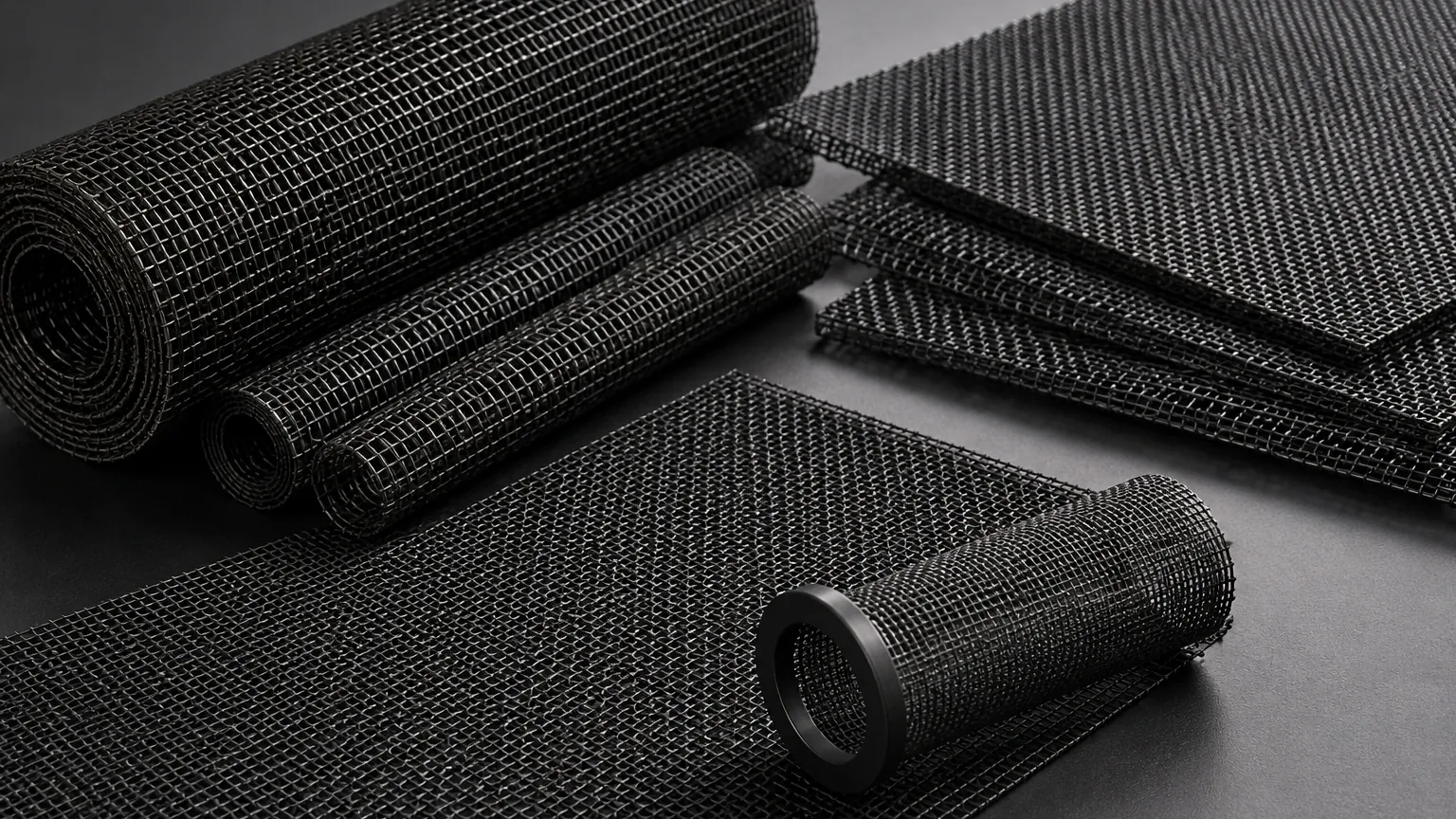
The second category involves surface-treated stainless steel. In this instance, a standard Plain, twill and dutch woven wire mesh in SS304/316L — rolls, cut mesh and framed panels. Send mesh count or micron target for a technical quote. is subjected to a coating process—most commonly epoxy resin or powder coating. This treatment provides a dual benefit: it enhances the corrosion resistance of the underlying metal while providing a non-reflective, aesthetically uniform black finish. For filtration engineers, the choice between raw carbon steel and coated stainless steel depends heavily on the chemical nature of the fluid being processed and the expected lifecycle of the filter element.
Manufacturing Standards and Weave Types
The performance of woven wire mesh black is dictated by the geometry of the weave. Manufacturing these meshes requires precision tensioning to ensure that the aperture size remains consistent across the entire roll or panel.
Plain Weave
This is the most common weave pattern where each warp wire crosses alternately over and under each shute wire. In black wire mesh applications, plain weave is favored for its simplicity and ease of cleaning. It offers a high degree of transparency and predictable flow rates, making it ideal for basic separation tasks.
Twill Weave
In a twill weave, each shute wire passes over and under two warp wires. This allows for the use of heavier wire diameters relative to the mesh count, resulting in a stronger and more durable mesh. This is often specified for heavy-duty industrial sieves where the mesh must withstand significant mechanical stress without deforming.
Dutch Weave
Dutch weaves (including Plain Dutch and Twill Dutch) utilize different wire diameters for the warp and shute. This creates a dense, three-dimensional structure that provides superior filtration accuracy. When produced as woven wire mesh black, Dutch weaves are often used in high-pressure hydraulic systems or fuel filtration where fine particulate removal is critical. The black coating in these instances must be applied with extreme precision to avoid clogging the micron-rated openings.
Industrial Applications for Black Coated and Carbon Steel Mesh
The utility of woven wire mesh black spans across several critical industrial sectors, each leveraging different properties of the material.
Plastic and Rubber Extrusion
In the extrusion process, "black wire mesh" (carbon steel) is used in the form of circular discs or multi-layered packs. These are placed in the breaker plate of the extruder to remove impurities from the molten polymer. The high heat resistance and structural integrity of carbon steel make it suitable for these high-temperature environments, where the mesh is typically replaced frequently as part of routine maintenance.
Security and Architectural Screens
In architectural contexts, epoxy-coated black stainless steel mesh is the industry standard for security screens. The black finish minimizes glare and improves visibility from the inside out, while the stainless steel core provides the necessary shear resistance to prevent forced entry. The epoxy coating is specifically engineered to resist UV degradation and salt spray corrosion, ensuring the mesh retains its structural and aesthetic properties for decades.
Specialized Filtration and Optical Shielding
In electronics and laboratory environments, black oxide-treated mesh is used for EMI (Electromagnetic Interference) shielding. The black finish is non-reflective, which is essential in optical housings or laser systems where stray light must be absorbed rather than reflected. In these applications, the filtration of light or electromagnetic waves is as important as the physical filtration of particles.
Engineering Considerations: Strength, Permeability, and Durability
When specifying woven wire mesh black, engineers must evaluate several technical parameters to ensure the component meets the application's demands.
1. Tensile Strength: Carbon steel variants offer high tensile strength but are susceptible to oxidation. If the application involves high-pressure differentials, the wire diameter and weave type must be calculated to prevent "bursting" or permanent deformation.
2. Corrosion Resistance: For outdoor or chemical environments, a black-coated stainless steel (304 or 316 grade) is mandatory. The integrity of the coating is paramount; any pinholes or scratches can lead to localized galvanic corrosion, especially in marine environments.
3. Aperture and Open Area: The "open area" percentage determines the flow capacity and pressure drop across the mesh. Applying a black coating (like epoxy) slightly increases the wire diameter, which in turn decreases the aperture size and the total open area. Engineers must account for this "coating thickness factor" when calculating flow rates for precision filtration.
4. Thermal Stability: Carbon steel mesh can withstand higher temperatures than epoxy-coated meshes. If the operating environment exceeds 200°C, epoxy coatings may degrade, off-gas, or lose adhesion, making raw carbon steel or specialized high-temperature black finishes necessary.
Selection Criteria for Industrial Procurement
Selecting the correct woven wire mesh black requires a detailed understanding of the operating environment. Procurement teams should confirm the following specifications with the manufacturer:
* Material Grade: Is the base material low-carbon steel, SS304, or SS316? This is the primary driver of cost and corrosion resistance.
* Mesh Count: The number of wires per linear inch. This determines the filtration rating (microns).
* Wire Diameter: Both the pre-coating and post-coating diameters should be specified if using coated mesh.
* Coating Type: Epoxy, PVC, powder coating, or black oxide. Each has different chemical resistance profiles and thicknesses.
* Form Factor: Whether the mesh is required in bulk rolls, cut-to-size pieces, or framed panels. Custom fabrication, such as welding the mesh into a stainless steel frame, is common for industrial filter elements.
For those requiring high-performance materials, Woven Wire Mesh solutions from specialized manufacturers ensure that the tolerances for both the weave and the finish meet international standards like ISO 9044.
Maintenance and Lifecycle Management
The maintenance requirements for woven wire mesh black differ significantly based on the material. Carbon steel mesh used in extrusion is typically treated as a consumable; once the pressure drop across the filter reaches a certain threshold, the mesh is discarded and replaced. This is often more cost-effective than attempting to clean carbon steel, which can rust quickly once exposed to cleaning agents and air.
Conversely, coated stainless steel mesh used in permanent installations or high-end filtration systems can be cleaned. However, the cleaning method must be compatible with the coating. Abrasive cleaning or harsh solvents can strip the black epoxy, exposing the stainless steel and compromising the visual or protective qualities of the mesh. Ultrasonic cleaning or low-pressure water washing with mild detergents is generally recommended for maintaining the integrity of the black finish.
In hydraulic and lubrication systems, the replacement cycle is determined by the contaminant loading. For these applications, monitoring the differential pressure is the most reliable method for determining when the woven wire mesh black element requires service. Regular inspection for "blinding" (permanent clogging of the apertures) is necessary to prevent system failure.
Conclusion
Woven wire mesh black is more than an aesthetic choice; it is a functional specification that addresses specific industrial challenges. Whether it is the cost-effective strength of carbon steel for polymer processing or the durable, non-reflective protection of epoxy-coated stainless steel for security and specialized filtration, the material selection must be evidence-led. By focusing on the intersection of weave precision, material science, and surface technology, engineers can optimize their filtration systems for both performance and longevity. For custom requirements and technical consultation, working with a manufacturer that understands the nuances of wire diameter, mesh count, and coating thickness is the most effective path to a reliable filtration solution.
