


Screening Wwtp
In the context of municipal and industrial wastewater management, the preliminary treatment phase is arguably the most critical for ensuring the longevity and efficiency of the entire facility. Screening wwtp (Wastewater Treatment Plant) operations serve as the first line of defense, physically removing large objects, debris, and suspended solids that could otherwise damage downstream mechanical equipment, clog pipes, or interfere with biological treatment processes. For engineers and plant operators, selecting the correct screening technology is not merely a matter of filtration but a complex decision involving hydraulics, material science, and lifecycle cost analysis.
The Fundamental Role of Screening in Wastewater Treatment
Screening is the initial unit operation in a WWTP. Its primary objective is to remove rags, plastics, wood, metal, and other inorganic materials from the influent stream. Without effective screening, these materials can cause catastrophic failures in grit chambers, primary clarifiers, and particularly in high-precision components like centrifugal pumps and membrane bioreactors (MBR).
From a technical perspective, the screening process is categorized by the size of the aperture and the method of cleaning. The efficiency of a screening system is measured by its Screening Capture Efficiency (SCE), which quantifies the percentage of solids removed relative to the total solids present in the influent. High SCE is essential for modern plants that utilize advanced secondary and tertiary treatments, as even small amounts of fibrous material can lead to "ragging"—the intertwining of fibers around pump impellers and mixers.
Classification of Screening Systems: Coarse vs. Fine
Screening equipment is generally classified into three categories based on the clear opening size: coarse, fine, and micro screens.
Coarse Screens
Coarse screens typically feature openings larger than 6 mm (0.25 inches). These are often referred to as trash racks or bar screens. They are designed to capture large debris such as tree limbs, stones, and large plastic containers. Coarse screens can be manually cleaned in very small installations, but in industrial or municipal settings, they are almost exclusively mechanically cleaned. Common types include multi-rake screens, catenary screens, and reciprocating rake (climber) screens. The design focus here is on structural robustness and the ability to handle high-impact loads during storm events.
Fine Screens
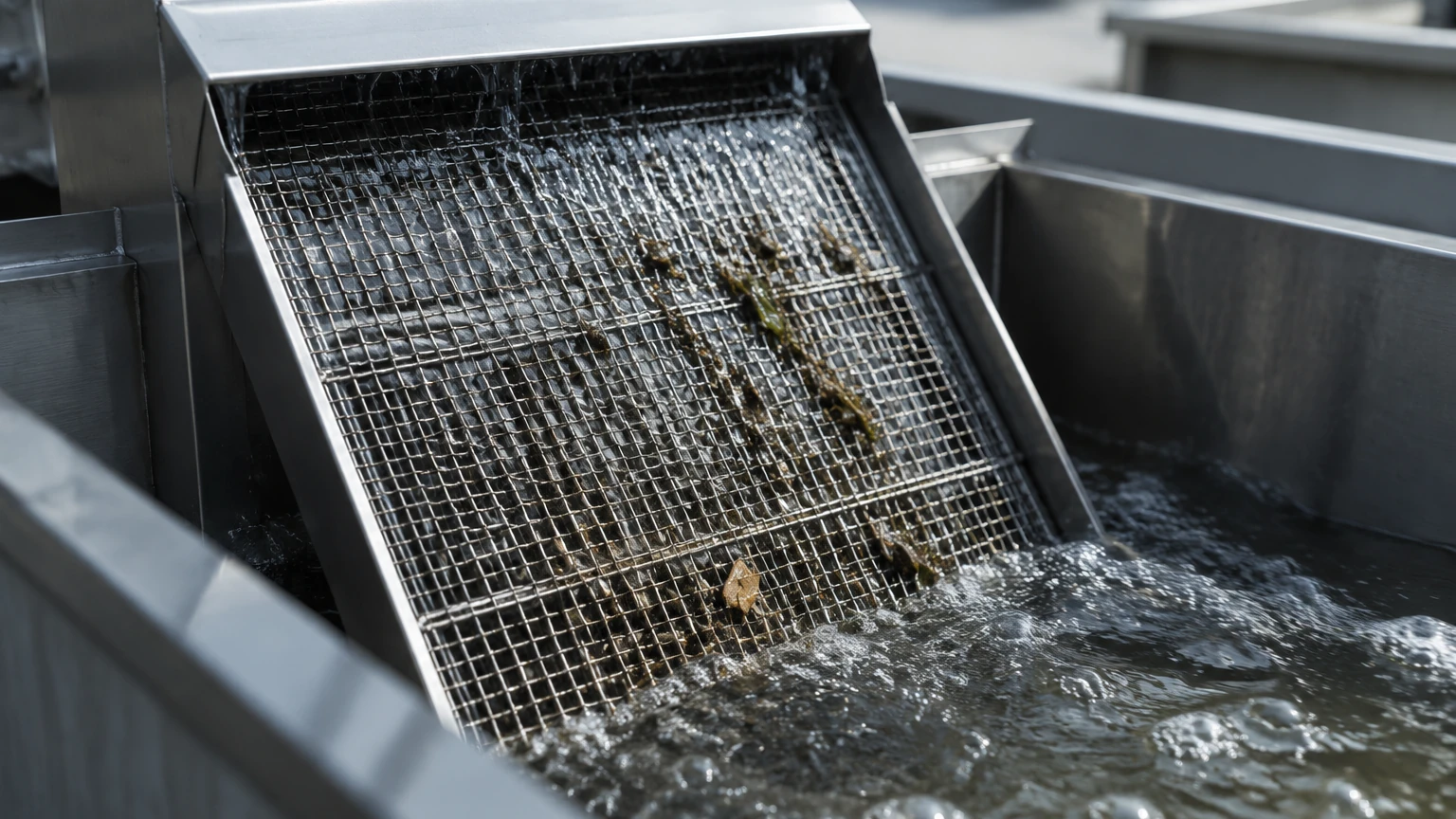
Fine screens have openings ranging from 0.5 mm to 6 mm. These are increasingly common as the primary screening stage in modern facilities. Fine screens utilize various media, including perforated plates, wedge wire, or woven wire mesh. Common configurations include rotary drum screens, step screens, and center-flow band screens. Fine screening is essential for protecting sensitive downstream processes like MBRs, where the presence of hair and fine fibers can significantly reduce membrane flux and increase cleaning frequency.
Micro Screens
Micro screens, with apertures smaller than 0.5 mm, are typically reserved for tertiary treatment or specific industrial applications where high-purity effluent is required. These systems often employ specialized stainless steel mesh to remove residual suspended solids after biological treatment.
Technical Engineering Considerations for Screening Design
When specifying a screening system for a WWTP, engineers must balance several hydraulic and mechanical variables. Failure to account for these can lead to bypass events or equipment failure.
Approach Velocity and Through-Screen Velocity
The approach velocity (the speed of the water in the channel before the screen) must be high enough to prevent the settling of grit and heavy solids (typically > 0.4 m/s) but low enough to prevent the compaction of debris against the screen. The through-screen velocity (the speed of the water passing through the openings) is usually limited to 0.6–0.9 m/s at peak flow to prevent debris from being "extruded" through the apertures.
Head Loss Calculations
Head loss is the pressure drop across the screen. It is a function of the flow rate, the percentage of open area, and the amount of debris currently blinding the screen. Engineers often use the Bernoulli equation or specialized empirical formulas provided by manufacturers to calculate head loss under both clean and partially blinded conditions. Excessive head loss can lead to upstream flooding or the overtopping of the screen channel.
Screening Capture Efficiency (SCE)
SCE is influenced by the shape of the screen media. For example, perforated plates generally offer higher capture rates for hair and fibers compared to bar screens with the same opening size. However, perforated plates also result in higher head loss and require more intensive cleaning mechanisms, such as high-pressure water sprays or specialized brushes.
Material Science: Why Stainless Steel Dominates WWTP Screening
The environment within a wastewater treatment plant is exceptionally harsh. The presence of hydrogen sulfide (H2S), chlorides, and varying pH levels creates a highly corrosive atmosphere. Furthermore, the mechanical abrasion from grit and stones requires materials with high yield strength and wear resistance.
Stainless steel is the industry standard for screening components due to its passive oxide layer, which provides superior corrosion resistance.
1. Grade 304 Stainless Steel: Suitable for standard municipal wastewater with low chloride concentrations. It provides an excellent balance of strength and cost-effectiveness for frames and structural components.
2. Grade 316L Stainless Steel: Specified for industrial wastewater, coastal installations, or plants with high chloride levels. The addition of molybdenum enhances resistance to pitting and crevice corrosion.
3. Duplex Stainless Steels: In extreme cases where high mechanical stress and highly corrosive chemicals are present, duplex alloys may be used for critical components like drive shafts or high-tension wire mesh.
For engineers seeking high-precision components and custom-engineered filtration media, reviewing the technical capabilities available on the Main Page can provide insights into how specialized manufacturing processes, such as precision weaving and welding, contribute to screen durability.
Optimizing Performance: Screening Capture Efficiency and Head Loss
To optimize a screening system, one must consider the "Open Area Ratio." This is the ratio of the total area of the openings to the total area of the screen face. A higher open area reduces head loss and allows for a smaller footprint, but it may compromise the structural integrity of the screen if the "land" (the material between openings) is too thin.
In fine screening, wedge wire (V-wire) is often preferred over standard round wire. The V-shape profile creates a widening gap in the direction of flow, which significantly reduces the risk of "pegging" or "plugging," where particles become wedged in the opening. This design ensures that any particle that passes the initial face of the screen will continue through without getting stuck, maintaining a consistent head loss profile.
Furthermore, the integration of automated control systems is vital. Modern screens are typically controlled by differential level sensors. When the water level upstream of the screen rises to a set point (indicating blinding), the cleaning mechanism is activated. This demand-based cleaning reduces mechanical wear and energy consumption compared to continuous operation.
Maintenance and Operational Longevity in Corrosive Environments
The total cost of ownership (TCO) for screening equipment is heavily weighted toward maintenance and the management of screenings (the captured waste).
Cleaning Mechanisms
Mechanically cleaned screens rely on rakes, brushes, or water jets. In fine screens, high-pressure spray bars are essential to remove grease and fats that can film over the screen media. Engineers must ensure that the wash water system provides sufficient pressure and flow to keep the media clear, especially during high-loading periods.
Screenings Handling
Once removed, the screenings are typically saturated with water and organic matter. Modern installations include a screenings washer-compactor. This equipment washes organic fecal matter back into the flow stream (to be treated biologically) and compacts the remaining inorganic waste. Compaction can reduce the volume and weight of the waste by up to 50–70%, significantly lowering disposal costs.
Replacement Cycles
While the main structure of a screen may last 20 years, the screen media (the mesh or perforated plates) is a wear item. Depending on the grit load and cleaning frequency, media may need replacement every 5 to 10 years. Specifying high-quality, precision-manufactured replacement parts is critical to maintaining the original design's SCE and hydraulic performance.
Conclusion: Selecting the Right Partner for Screening Solutions
Screening in a WWTP is a balance of hydraulic capacity, capture efficiency, and mechanical reliability. For engineering teams, the selection process begins with a thorough analysis of influent characteristics and downstream process requirements. Whether the application calls for a robust coarse bar screen or a high-precision fine mesh filter, the quality of the material and the precision of the manufacturing are the primary determinants of long-term success.
By focusing on stainless steel construction and optimized geometry (such as wedge wire or precision-woven mesh), plants can achieve higher capture rates while minimizing maintenance downtime. As wastewater standards become more stringent and the use of membrane technologies increases, the role of high-performance screening will only continue to grow in importance. For those involved in the procurement and design of these systems, collaborating with manufacturers who understand the nuances of industrial filtration ensures that the preliminary treatment stage remains a reliable asset rather than a bottleneck.
