


Liquid/liquid Coalescers
In industrial process engineering, the separation of two immiscible liquids is a fundamental requirement across various sectors, including petrochemicals, pharmaceuticals, and food processing. Liquid/liquid coalescers are specialized filtration and separation devices designed to merge small droplets of a dispersed phase into larger ones, facilitating their removal from a continuous phase based on density differences. Unlike standard particulate filters, these systems manage the complex fluid dynamics of emulsions, requiring a deep understanding of interfacial tension, surface chemistry, and mechanical design.
For engineers and procurement teams, selecting the right coalescer technology is critical for maintaining product purity, protecting downstream equipment, and ensuring environmental compliance. This guide explores the technical principles, material considerations, and engineering parameters essential for optimizing liquid/liquid separation.
The Fundamentals of Liquid/Liquid Separation
Liquid/liquid separation typically involves a "dispersed phase" (droplets) and a "continuous phase" (the bulk liquid). When these two phases are mixed, they form an emulsion. Depending on the droplet size, these emulsions are categorized as either primary or secondary dispersions. Primary dispersions consist of droplets larger than 50-100 microns and often settle out over time due to gravity. Secondary dispersions, however, contain droplets smaller than 20 microns, which are highly stable and require mechanical intervention to separate.
Liquid/liquid coalescers address these stable secondary dispersions. The process relies on the principle of "coalescence," where the fine droplets are forced to collide and merge within a porous medium. As the droplets grow in size, the buoyancy forces—governed by Stokes' Law—become strong enough to overcome the viscous drag of the continuous phase, allowing the two liquids to separate into distinct layers.
Mechanics of the Coalescence Process
The operation of a liquid/liquid coalescer occurs in three distinct stages: capture, coalescence, and release. Each stage is influenced by the physical properties of the liquids and the structural characteristics of the coalescing media.
1. Droplet Capture
As the emulsion flows through the coalescing media, the dispersed droplets come into contact with the fibers or wires of the mesh. This capture is achieved through several mechanisms, including inertial impaction, interception, and Brownian motion. For effective capture, the media must have a high surface area and a pore structure that encourages contact without creating excessive pressure drop.
2. Coalescence (Droplet Growth)
Once captured, the droplets must merge. This is facilitated by the surface properties of the media. In a typical oil-water separation, a "hydrophilic" (water-attracting) or "oleophilic" (oil-attracting) surface is selected depending on which phase is being coalesced. As more droplets are captured, they film along the surface of the media, eventually merging into larger globules at the junctions of the mesh or fibers.
3. Release and Settling
When the coalesced droplets reach a sufficient size, the flow of the continuous phase strips them from the media. These enlarged droplets then enter a settling zone (often a quiet area of the vessel) where gravity takes over. Because the droplets are now significantly larger, their settling velocity increases exponentially, allowing for rapid and efficient phase separation.
Material Selection and Structural Integrity
The choice of material for liquid/liquid coalescers is paramount, especially in demanding industrial environments. Stainless steel is often the material of choice due to its chemical compatibility, thermal stability, and mechanical strength.
At Kaifil, we specialize in manufacturing high-precision stainless steel filtration components that serve as the core of these separation systems. Using materials like 304, 316L, or specialized alloys ensures that the coalescer can withstand corrosive process fluids and high operating temperatures without degrading.
Wire Mesh vs. Fiber Media
Traditional coalescers may use glass fiber or polymer media, but stainless steel wire mesh offers unique advantages in industrial applications. Wire mesh provides a rigid, uniform structure that can be engineered with specific micron ratings and surface treatments. Unlike fibrous media, which can shed fibers into the process stream or compress under high pressure, stainless steel mesh maintains its structural integrity, ensuring consistent performance over a longer service life. For more information on our manufacturing capabilities, you can visit our Main Page.
Engineering Challenges: Surfactants and Emulsions
One of the most significant challenges in liquid/liquid separation is the presence of surfactants. Surfactants are chemical agents that reduce the interfacial tension (IFT) between two liquids. When IFT is low (typically below 20 dynes/cm), the droplets become extremely stable and resistant to coalescence.
Engineers must also account for the "disengaging velocity"—the speed at which the continuous phase moves through the separator. If the velocity is too high, it can re-entrain the coalesced droplets, defeating the purpose of the device. Consequently, the design of the vessel must provide enough residence time for the droplets to settle or rise to the interface.
Furthermore, particulate contamination can foul the coalescing media. If solid particles are present in the stream, they can coat the surface of the mesh, changing its wetting characteristics and blocking the pores. In such cases, a pre-filtration stage is essential to protect the liquid/liquid coalescers and extend their maintenance intervals.
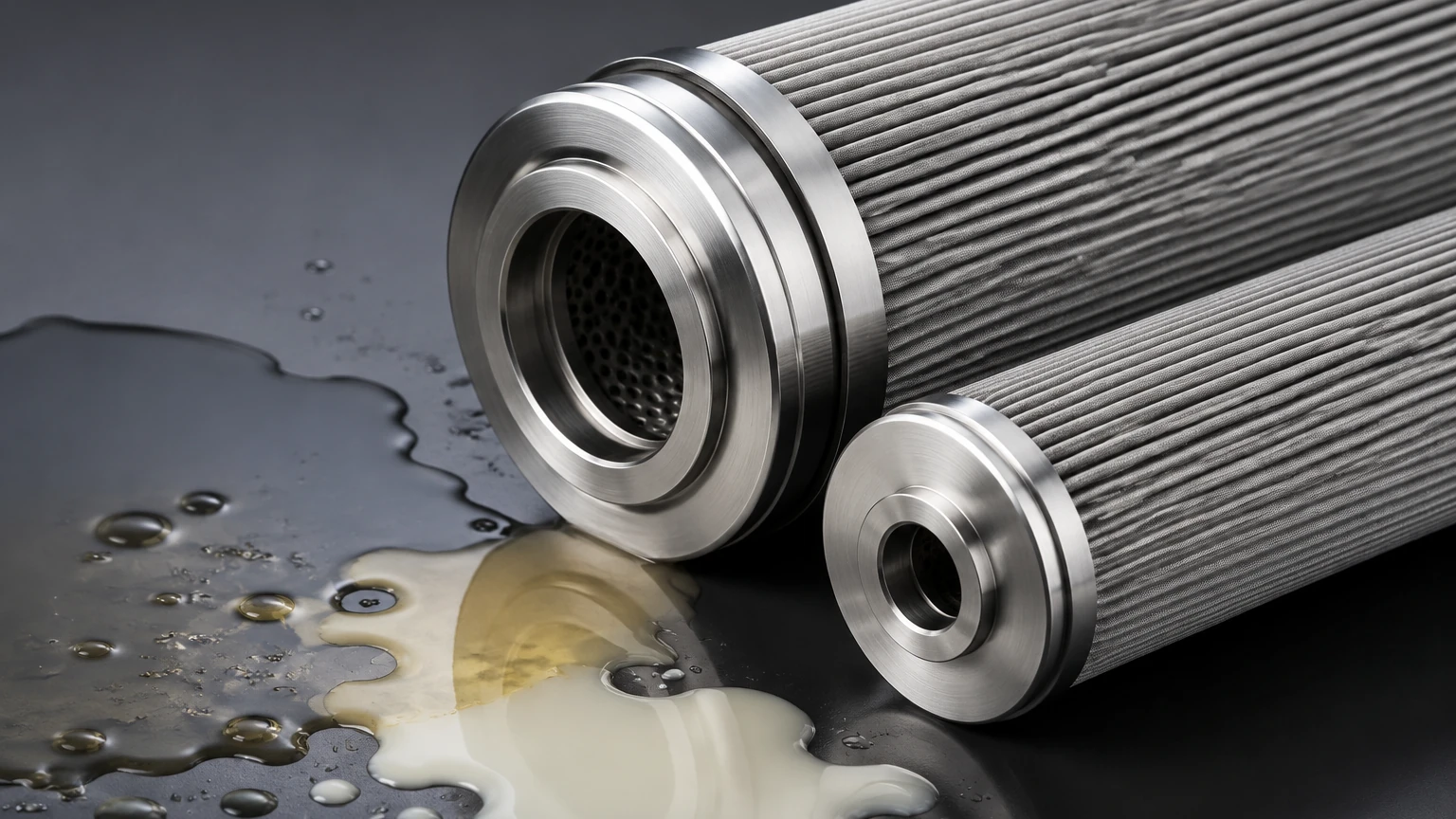
Key Engineering Parameters for Coalescer Design
When specifying liquid/liquid coalescers, several technical parameters must be evaluated to ensure the system meets the required separation efficiency:
* Interfacial Tension (IFT): This is the measure of the force at the boundary between the two liquids. High IFT (e.g., pure oil and water) is easier to separate, while low IFT requires more sophisticated coalescing media.
* Viscosity: The viscosity of the continuous phase affects the rate at which droplets can move through it. Higher viscosity requires larger settling zones or slower flow rates.
* Density Differential: The difference in specific gravity between the two liquids provides the driving force for separation. A larger difference results in faster separation.
* Flow Rate and Flux: The volume of liquid processed per unit area of media. Exceeding the design flux can lead to "breakthrough," where the dispersed phase passes through the media without coalescing.
* Temperature: Temperature changes affect both viscosity and density, often making separation easier at higher temperatures, provided the materials can withstand the heat.
Application Profiles in Industrial Filtration
Liquid/liquid coalescers are utilized in a variety of critical applications where purity is non-negotiable:
* Petrochemical and Refining: Separating water from hydrocarbons (diesel, jet fuel, gasoline) to prevent engine corrosion and microbial growth. They are also used to recover valuable oils from wastewater streams.
* Chemical Processing: Removing catalysts or unreacted aqueous phases from organic products. This is vital for maintaining the quality of specialty chemicals.
* Hydraulic and Lubrication Systems: Removing water from lubricating oils to prevent component wear and oxidation of the oil.
* Pharmaceuticals: In solvent extraction processes, coalescers are used to separate the solvent phase from the aqueous phase after nutrient or API (Active Pharmaceutical Ingredient) recovery.
Selection Criteria and Technical Specifications
For engineers looking to integrate liquid/liquid coalescers into their systems, the following checklist provides a framework for selection:
1. Fluid Compatibility: Ensure the housing and media materials are compatible with both the continuous and dispersed phases, including any trace chemicals or additives.
2. Required Purity Levels: Define the target effluent concentration (e.g., reducing water in oil from 5,000 ppm to less than 10 ppm).
3. Operating Pressure and Temperature: Verify that the mechanical design of the filter cartridge or mesh element can handle the peak operating conditions.
4. Customization Requirements: Standard off-the-shelf solutions may not fit unique vessel geometries. Custom-engineered stainless steel elements can be designed to fit existing housings while optimizing filtration area.
As a professional manufacturer, Kaifil provides reliable OEM and customized filtration solutions. We work closely with global customers to develop high-performance filter products that meet specific application requirements, from material selection to precise filtration accuracy.
Operational Maintenance and Longevity
The total cost of ownership (TCO) for liquid/liquid coalescers is heavily influenced by the replacement cycle of the media. While disposable cartridges may have a lower upfront cost, permanent or cleanable stainless steel elements often provide better long-term value.
Monitoring the pressure drop across the coalescer is the most common method for determining when maintenance is required. A sudden increase in pressure drop usually indicates particulate fouling, whereas a decrease in separation efficiency (detected through downstream sampling) may indicate media saturation or damage.
By selecting high-quality stainless steel components and ensuring proper pre-filtration, industrial facilities can achieve dependable filtration performance even in the most demanding environments. For technical support and to review our full range of filtration components, please visit our Main Page.
In conclusion, liquid/liquid coalescers are sophisticated tools that require careful engineering and high-quality materials. By understanding the underlying physics of coalescence and selecting the appropriate media structure, engineers can significantly improve process efficiency and product quality.
