


Filter Hot
In industrial processing, the requirement to filter hot fluids—whether liquids or gases—presents a unique set of engineering challenges that standard filtration components cannot meet. High-temperature environments, often exceeding 200°C (392°F) and reaching upwards of 800°C (1472°F) in specialized applications, demand a rigorous approach to material science and structural design. For engineers and procurement teams, understanding the variables involved in high-heat filtration is essential for ensuring process continuity, equipment longevity, and safety.
Industrial applications such as chemical synthesis, steam filtration, polymer melt processing, and hot gas emission control rely on the ability to remove contaminants without compromising the structural integrity of the filter media. When a system must filter hot media, the selection of stainless steel and specialized alloys becomes the primary factor in determining the success of the operation. Kaifil specializes in these demanding environments, providing custom stainless steel filtration solutions designed to withstand extreme thermal loads.
Engineering Challenges of High-Temperature Filtration
Operating at elevated temperatures introduces mechanical and chemical stresses that are absent in ambient-temperature applications. The most significant challenge when you filter hot substances is the change in the physical properties of both the filter media and the fluid being processed.
Thermal Expansion and Mechanical Stress
Different materials expand at different rates when heated. In a filter assembly, the housing, the support core, and the filter mesh may all have slightly different coefficients of thermal expansion. If not accounted for in the design phase, this can lead to buckling, warping, or the failure of seals and joints. Engineers must calculate the "thermal growth" of components to ensure that the filter remains seated correctly within its housing during the transition from cold start-up to steady-state high-temperature operation.
Viscosity and Flow Dynamics
For many liquids, such as heavy oils or polymers, the primary reason to filter hot is to reduce viscosity. Lower viscosity allows for higher flow rates and lower differential pressures across the filter media. However, as the temperature rises, the fluid's density and surface tension also change, which can affect the efficiency of particle capture. The filtration system must be sized based on the fluid’s properties at the operating temperature, not at room temperature.
Oxidation and Scaling
At high temperatures, many metals react with oxygen or other chemicals in the process stream. This can lead to the formation of oxide scales on the surface of the filter mesh. These scales can eventually flake off, becoming a source of downstream contamination themselves, or they can plug the pores of the filter, leading to a rapid increase in differential pressure. Selecting the correct alloy is the only way to mitigate this risk.
Material Science: Selecting Alloys for Elevated Temperatures
The choice of material is the foundation of any system designed to filter hot media. While standard carbon steels or plastics fail rapidly under thermal stress, stainless steel and high-nickel alloys provide the necessary oxidation resistance and mechanical strength.
* 304/304L Stainless Steel: Suitable for moderate temperatures (up to approximately 400°C) where corrosion is not a primary concern. It is often used in steam filtration and basic industrial heating applications.
* 316/316L Stainless Steel: The industry standard for high-temperature filtration. The addition of molybdenum provides better resistance to pitting and crevice corrosion, making it ideal for chemical processing and pharmaceutical applications where the media is both hot and corrosive.
* 310S Stainless Steel: This high-chromium, high-nickel alloy is specifically designed for high-temperature service. It offers excellent oxidation resistance and can maintain its strength at temperatures up to 1100°C in continuous service. It is frequently used in furnace components and hot gas filtration.
* Inconel and Hastelloy: In extreme cases where the environment is both exceptionally hot and highly acidic or alkaline, specialized nickel-based superalloys are required. These materials maintain mechanical integrity under conditions that would cause standard stainless steels to undergo "creep" (slow deformation under stress).
Kaifil’s expertise in material selection ensures that every custom filter is matched to the specific thermal and chemical profile of the application. For more information on material compatibility and technical specifications, you can visit the Main Page.
Structural Integrity: Beyond Standard Filter Construction
When a process requires a system to filter hot fluids, the method of construction is just as important as the material itself. Standard filter cartridges often use adhesives, epoxy resins, or potting compounds to secure the filter media to the end caps. In high-temperature applications, these organic binders will melt, off-gas, or degrade, leading to total filter failure and process contamination.
All-Welded Construction
For high-heat environments, an all-welded construction is mandatory. Techniques such as TIG (Tungsten Inert Gas) welding or plasma welding are used to fuse the stainless steel mesh directly to the support cores and end caps. This creates a monolithic metallic structure that can withstand rapid temperature fluctuations and high pressure without the risk of bypass.
Sintered Metal Media
Sintered wire mesh and sintered metal fibers are the preferred media for hot filtration. Sintering is a process where multiple layers of wire mesh or metal fibers are bonded together through heat and pressure without melting. This creates a rigid, porous structure where the individual wires are fused at every contact point. Sintered media provides superior mechanical strength and prevents "media migration," where individual wires might break off and enter the process stream due to thermal fatigue.
Pleated vs. Cylindrical Designs
Pleating the filter media increases the available surface area, which is critical when dealing with high-viscosity fluids or high flow rates. However, in high-temperature applications, the pleat geometry must be carefully engineered to allow for thermal expansion. If the pleats are too tight, the expansion of the metal can cause the pleats to pinch shut, reducing the effective filtration area.
Operational Variables: Viscosity and Flow Control
Managing the operational parameters is essential when you filter hot substances. The relationship between temperature, viscosity, and pressure drop (Delta P) is non-linear and must be modeled accurately during the design phase.
1. Differential Pressure Monitoring: As the filter collects contaminants, the pressure drop increases. In high-temperature systems, the structural strength of the filter media decreases as the temperature rises. Therefore, the maximum allowable differential pressure is lower at 500°C than it is at 20°C. Systems must be equipped with sensors to monitor this carefully.
2. Thermal Shock: Rapidly introducing hot fluid into a cold filter housing (or vice versa) can cause thermal shock. This sudden expansion or contraction can crack welds or deform the filter mesh. Pre-heating protocols are often necessary to bring the filtration system up to temperature gradually.
3. Flow Velocity: High-temperature gases often move at much higher velocities than liquids. This can lead to erosion of the filter media if the system is not sized correctly. Reducing the face velocity at the filter surface extends the life of the component.
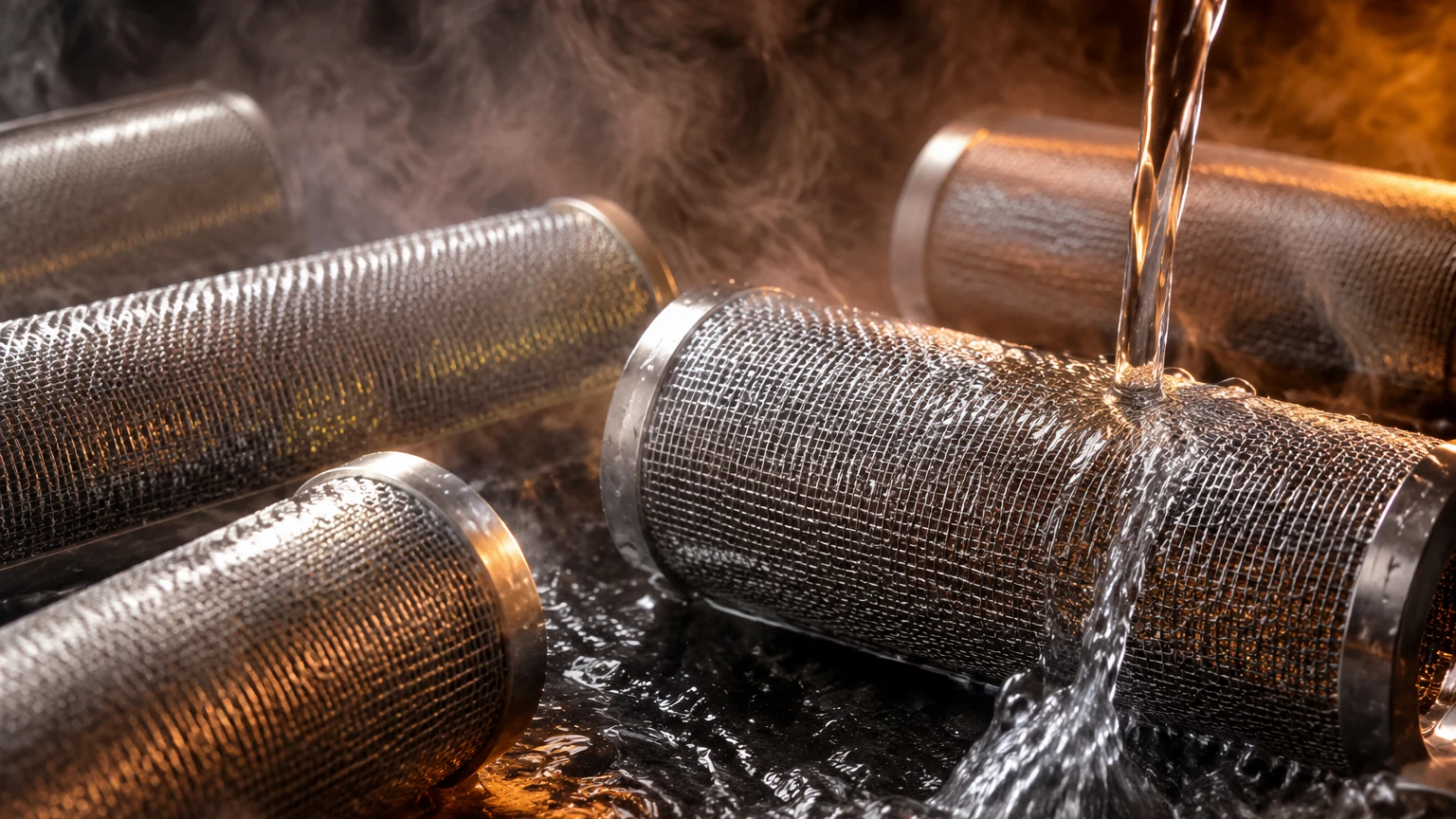
Safety and Maintenance in Thermal Processing
Maintenance protocols for systems that filter hot media require specialized safety procedures. Technicians must be protected from thermal burns, and the equipment must be allowed to reach a safe handling temperature before servicing.
Cleaning and Regeneration
One of the primary advantages of stainless steel filters is their ability to be cleaned and reused. In high-temperature applications, "burn-off" or pyrolysis can be used to remove organic contaminants from the filter. The filter is placed in a controlled oven where the contaminants are carbonized and then removed via ultrasonic cleaning or backpulsing. This significantly reduces the total cost of ownership compared to disposable filters.
Replacement Cycles
Even the most durable stainless steel filter has a finite lifespan in high-heat environments. Over time, repeated thermal cycling leads to metal fatigue. Regular inspections for signs of mesh deformation, thinning of the wire, or weld cracks are essential. Establishing a predictive maintenance schedule based on the number of thermal cycles and the total throughput helps prevent catastrophic failures.
Custom Engineering for Specific Thermal Loads
Because every industrial process has a unique thermal profile, off-the-shelf filtration solutions are rarely sufficient. When an engineer needs to filter hot media, they must consider the specific micron rating, the chemical composition of the fluid, and the peak operating temperature.
Kaifil provides comprehensive OEM and customization services to address these needs. By working closely with engineering teams, Kaifil develops filtration components that are optimized for specific pressure and temperature requirements. This includes custom end-cap configurations, reinforced internal support cores for high-pressure differentials, and specialized mesh weaves for precise particle retention.
To explore the full range of custom filtration solutions and to consult with technical experts on your specific high-temperature application, please refer to the Main Page.
Conclusion
The ability to filter hot fluids effectively is a cornerstone of modern industrial efficiency. By selecting the appropriate stainless steel alloys, employing all-welded construction, and understanding the complex interplay between heat and fluid dynamics, manufacturers can achieve reliable and cost-effective filtration. Whether the application involves steam, hot chemicals, or molten polymers, the engineering focus must remain on durability, thermal stability, and precision. Partnering with a specialized manufacturer like Kaifil ensures that these technical requirements are met with high-performance, customized solutions tailored to the most demanding industrial environments.
