


Slotting Pipe
In the realm of industrial filtration and fluid management, the slotting pipe serves as a fundamental component for sand control, fluid distribution, and structural support. Often utilized as the primary screening element in water wells or as a robust internal core for complex multi-layer filter cartridges, its design directly impacts the efficiency and longevity of a filtration system. For engineers and procurement specialists, selecting the correct slotting pipe involves a technical evaluation of material properties, slot geometry, and mechanical resistance to ensure the component survives the stresses of high-pressure environments while maintaining precise flow characteristics.
As a specialized manufacturer of stainless steel filtration solutions, Kaifil provides precision-engineered components that integrate these pipes into broader industrial systems. Understanding the nuances of slotting pipe design is essential for optimizing performance in sectors ranging from chemical processing to hydraulic systems.
Understanding the Role of Slotting Pipe in Industrial Filtration
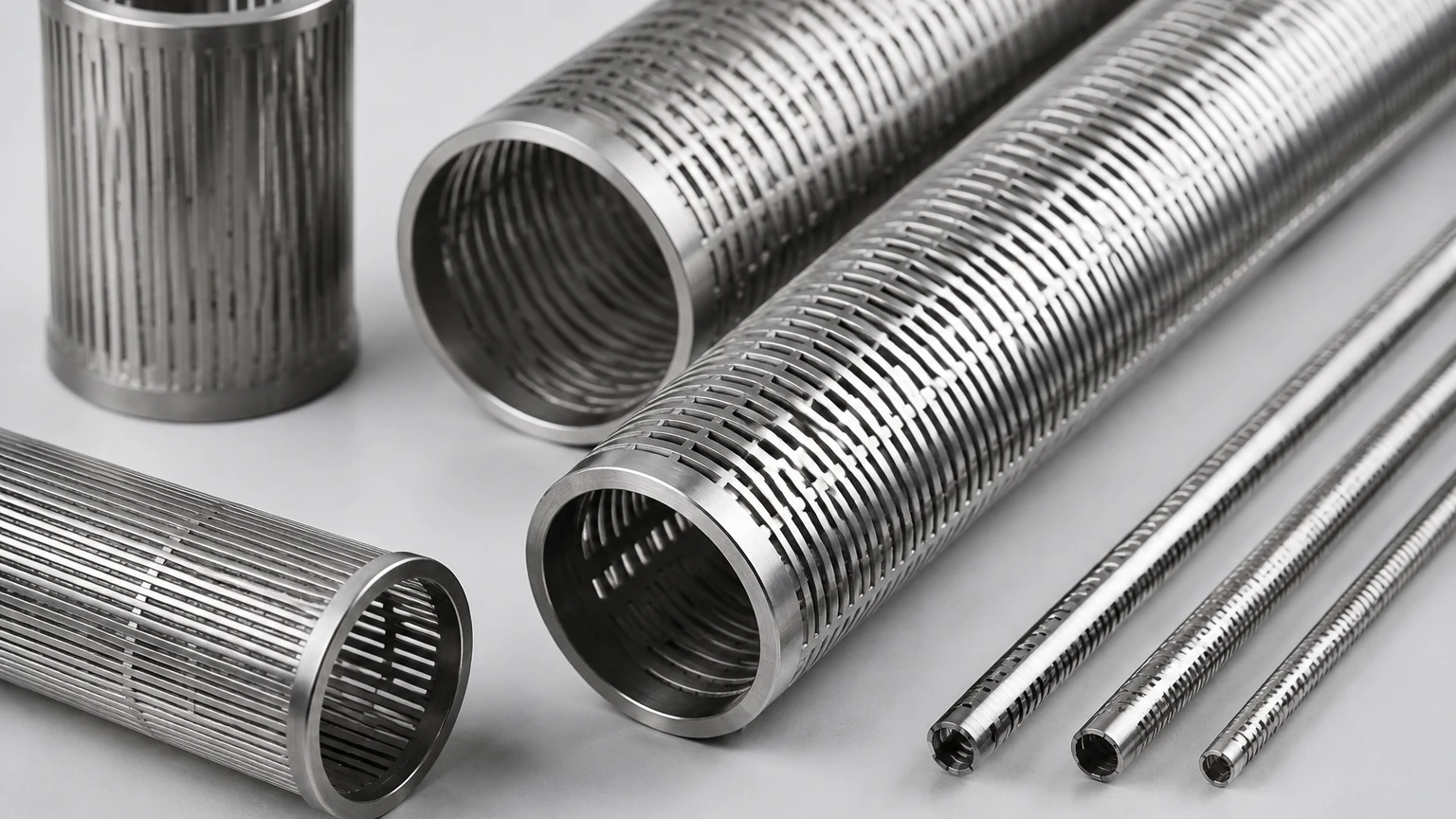
A slotting pipe is essentially a heavy-wall tube or pipe that has been precision-machined with a series of longitudinal or transverse openings. Unlike standard perforated pipes, which feature round holes, the "slots" in a slotting pipe are designed to provide a specific aspect ratio that facilitates better sand control and reduces the likelihood of plugging.
In industrial applications, these pipes fulfill two primary roles. First, they act as a standalone filter in coarse filtration scenarios, such as groundwater extraction or primary oil-water separation. Second, and perhaps more critically in high-precision industries, they serve as the structural backbone for wire mesh filters or pleated filter cartridges. In this capacity, the pipe must withstand significant differential pressures without collapsing, while the outer mesh layers handle the actual micron-rated filtration.
For technical teams, the choice of a slotting pipe is rarely about the pipe in isolation. It is about how the slot dimensions interact with the particulate matter in the process stream and how the pipe’s structural integrity supports the entire filtration assembly under peak load.
Engineering Specifications and Slot Geometry
The performance of a slotting pipe is dictated by the geometry of the slots. There are two primary configurations used in industrial manufacturing: straight slots and keystone (tapered) slots.
Straight Slots
Straight slots maintain a uniform width through the entire wall thickness of the pipe. These are cost-effective to manufacture and are suitable for applications where the particulate size is relatively uniform and the risk of internal scaling is low. However, straight slots are more prone to "bridging," where particles become wedged within the slot, leading to a gradual reduction in flow area.
Keystone Slots
Keystone or tapered slots are wider on the interior of the pipe than on the exterior. This design is engineered to be self-cleaning. Any particle that is small enough to pass through the outer opening will easily clear the rest of the slot due to the increasing width. This geometry is critical in applications involving high-viscosity fluids or varied particle size distributions (PSD), as it significantly extends the interval between maintenance cycles.
Slot Arrangement and Density
Slots can be arranged in staggered or parallel patterns. A staggered pattern is generally preferred in high-stress environments because it maintains higher torsional and longitudinal strength. The "open area"—the percentage of the pipe surface that is slotted—must be carefully calculated. While a higher open area reduces flow resistance (pressure drop), it simultaneously reduces the pipe's collapse strength. Engineering teams must find the equilibrium point where the pipe provides sufficient flow without compromising the structural safety factor.
Material Selection for Demanding Environments
Material durability is a non-negotiable factor in B2B procurement of filtration components. Because slotting pipes are often submerged in corrosive chemicals or high-temperature fluids, the choice of alloy determines the total cost of ownership.
1. Stainless Steel 304: The standard choice for general industrial applications, providing good corrosion resistance and mechanical strength at a moderate price point. It is widely used in food and beverage and standard water treatment.
2. Stainless Steel 316L: Containing molybdenum and a lower carbon content, 316L is the preferred material for chemical processing and pharmaceutical applications. It offers superior resistance to pitting and crevice corrosion, particularly in chloride-rich environments.
3. Duplex Stainless Steels: For extreme environments, such as deep-well oil extraction or high-pressure hydraulic systems, duplex alloys provide nearly double the yield strength of standard austenitic stainless steels, allowing for thinner walls or higher open areas without sacrificing integrity.
At Kaifil, the focus remains on utilizing high-grade stainless steel to ensure that every slotting pipe produced can withstand the chemical and physical rigors of its intended application. For more detailed technical data on material compatibility, professionals can visit the Main Page to explore specific alloy performance metrics.
Manufacturing Methods and Precision Standards
The method used to create slots in a pipe significantly affects the pipe’s mechanical properties and the precision of the filtration. There are three common industrial methods:
* Mechanical Milling: This traditional method uses high-speed saws to cut slots. While effective for larger slots, it can introduce heat-affected zones (HAZ) and burrs that require extensive post-processing. It is generally limited in terms of how narrow the slots can be.
* Laser Cutting: Laser technology allows for extreme precision, with slot widths as narrow as 0.005 inches (0.127 mm). Laser cutting is non-contact, which minimizes mechanical stress on the pipe and allows for complex slot patterns that would be impossible with mechanical milling. It also produces a cleaner edge, reducing the risk of particle entrapment.
* Plasma Cutting: Often used for thicker-walled pipes where high-speed production is prioritized over extreme precision. Plasma cutting is typically reserved for coarse filtration applications in the mining or heavy industrial sectors.
For engineers, the tolerance of the slot width is a key performance indicator (KPI). If the tolerance is too wide, oversized particles will bypass the filter; if too narrow, the pressure drop will exceed design limits. Precision manufacturing ensures that the slotting pipe performs exactly as modeled in fluid dynamics simulations.
Balancing Open Area and Structural Integrity
One of the most complex challenges in specifying a slotting pipe is the trade-off between hydraulic efficiency and mechanical strength. This is particularly relevant in deep-well applications or high-pressure hydraulic circuits where the pipe is subject to external collapse pressure.
Collapse Resistance
The collapse strength of a pipe is a function of its wall thickness, diameter, and the remaining material after slotting. Engineering standards, such as those provided by the API (American Petroleum Institute), offer formulas to calculate the reduction in strength based on the slot pattern. As a general rule, a staggered slot pattern preserves more of the pipe’s original collapse resistance compared to a straight-row pattern.
Flow Dynamics
From a fluid dynamics perspective, the slotting pipe must minimize turbulence and pressure drop ($ΔP$). A low open area forces fluid through fewer openings at higher velocities, which can lead to erosion of the slot edges and increased cavitation risk. Conversely, an optimized slotting pipe design distributes the flow evenly across the surface area, ensuring that the secondary filter media (such as a wire mesh wrap) is utilized uniformly.
Applications Across Key Industrial Sectors
Slotting pipes are versatile components used across a broad spectrum of industries. Their application dictates the specific design requirements:
* Water Treatment and Desalination: Used as intake screens and underdrain laterals. Here, corrosion resistance and slot precision are vital to prevent sand from entering pumps and downstream membranes.
* Chemical and Petrochemical Processing: Often used as internal components in reactor vessels or as support cores for high-temperature catalyst recovery filters. The ability of stainless steel to maintain strength at elevated temperatures is a primary consideration.
* Food and Beverage: In these hygienic environments, the surface finish of the slotting pipe is critical. Electropolishing is often applied to the slotted pipe to ensure there are no microscopic pits where bacteria can proliferate.
* Hydraulic Systems: Acting as a protective core for high-pressure return line filters, the slotting pipe prevents the filter media from collapsing under sudden pressure surges.
Critical Factors for OEM Customization and Procurement
When sourcing slotting pipes for specialized industrial projects, a standard off-the-shelf solution is rarely sufficient. OEM customization allows engineers to tailor the component to the exact needs of the process. Before initiating a procurement request, technical teams should confirm the following data points:
1. Particle Size Distribution (PSD): The slot width should typically be half the size of the smallest particles intended to be retained to prevent blinding.
2. Operating Pressure and Temperature: These factors dictate the required wall thickness and material grade.
3. Fluid Chemistry: Identification of corrosive agents (e.g., H2S, CO2, chlorides) is necessary for alloy selection.
4. Flow Rate Requirements: This determines the minimum required open area.
5. Connection Types: Whether the pipe requires threaded ends, flanged connections, or plain ends for welding into a larger assembly.
By addressing these factors early in the design phase, companies can avoid costly field failures and optimize the maintenance cycles of their filtration systems. Kaifil works closely with global partners to provide these customized solutions, ensuring that every component meets the rigorous demands of modern industrial environments.
For professionals seeking to integrate high-performance filtration components into their systems, reviewing technical specifications and manufacturing capabilities is the first step toward operational efficiency. Detailed information on custom wire mesh and precision metal filter components can be found by visiting the Main Page, where technical resources are available to assist in the selection and design process.
