


Stainless Steel Water Well Screen
In industrial and municipal groundwater extraction, the efficiency and longevity of a well are fundamentally tied to the performance of the intake zone. A stainless steel water well screen serves as the critical interface between the aquifer and the pumping system. Its primary function is to permit the entry of water while excluding sand, silt, and gravel, thereby protecting the pump from abrasion and preventing the borehole from collapsing.
For engineers and procurement teams, selecting the appropriate screen is not merely a matter of sizing; it involves a complex evaluation of hydrogeological conditions, chemical compatibility, and structural requirements. As a specialized manufacturer of precision filtration solutions, Kaifil emphasizes the technical nuances of screen design to ensure optimal drawdown and extended service life in demanding environments.
The Role of Screens in Groundwater Extraction
The performance of a water well is measured by its specific capacity—the yield per unit of drawdown. A high-quality stainless steel water well screen minimizes friction loss as water moves from the formation into the well. If a screen is poorly designed or constructed from inferior materials, it can lead to excessive entrance velocities, which cause turbulent flow, increased energy consumption, and accelerated encrustation or corrosion.
Stainless steel has become the industry standard for high-performance wells because it offers a superior strength-to-weight ratio and exceptional resistance to the corrosive agents often found in deep aquifers, such as hydrogen sulfide (H2S), carbon dioxide (CO2), and high chloride concentrations. Unlike carbon steel, which is prone to scaling and pitting, or PVC, which lacks structural rigidity at depth, stainless steel maintains its slot integrity over decades of operation.
Engineering Advantages of Stainless Steel Construction
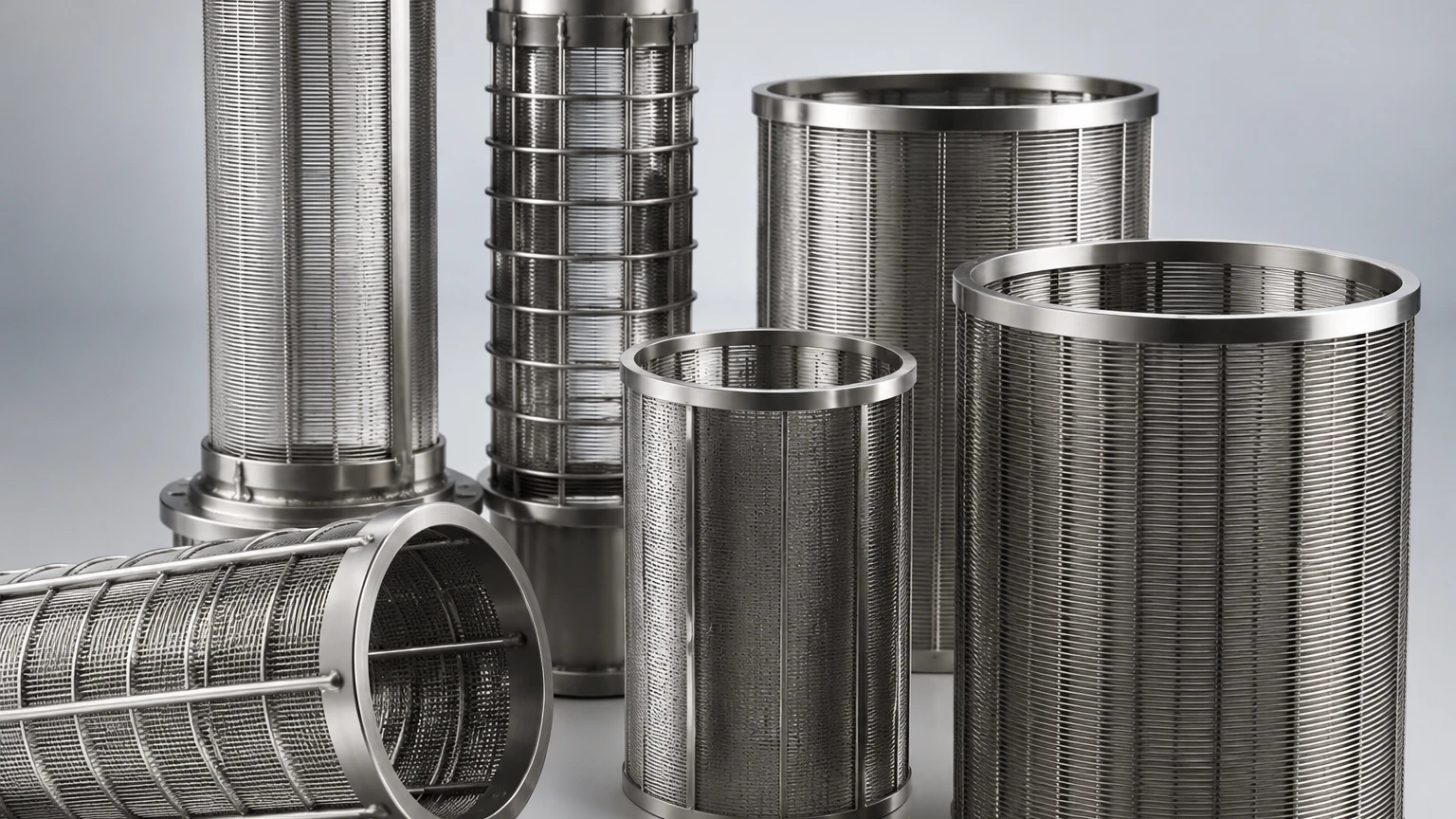
When evaluating a stainless steel water well screen, the engineering focus typically centers on the "wedge wire" or "V-wire" design. This construction method involves wrapping a cold-rolled triangular wire around a circular array of longitudinal support rods. Every intersection is fusion-welded, creating a rigid, one-piece structure.
Non-Clogging Geometry
The V-shaped profile of the wire is oriented so that the narrowest part of the opening is at the exterior. As particles move through the slot, the opening widens inwardly. This geometry ensures that any particle small enough to pass the outer width of the slot will flow through without becoming wedged, a common failure mode in perforated pipe or mesh-wrapped screens.
Maximized Open Area
Compared to slotted pipe or bridge-slot screens, wedge wire screens offer a significantly higher percentage of open area. This allows for lower entrance velocities (typically recommended at less than 0.1 feet per second or 0.03 meters per second). Low entrance velocity is critical because it reduces the transport of fine-grained sand toward the screen and minimizes the rate of mineral precipitation (encrustation).
Technical Design: Wedge Wire vs. Conventional Methods
While various screen types exist, the choice of a stainless steel water well screen often depends on the specific requirements of the aquifer.
1. Continuous Slot Wedge Wire: This is the most efficient design for most industrial applications. The continuous slot allows for uniform water entry across the entire circumference of the screen. This uniformity is essential during the well development phase, where surging and jetting are used to remove fine particles from the gravel pack.
2. Pipe-Based Screens: For extremely deep wells where hydrostatic pressure and formation collapse loads are extreme, a pipe-based screen may be used. This involves a wedge wire jacket shrunk-fit over a perforated base pipe. The base pipe provides the structural backbone, while the outer screen provides the filtration precision.
3. Bridge Slot Screens: These are often used in less demanding applications or where budget constraints are primary. However, they lack the non-clogging characteristics of V-wire and generally offer much lower open area, leading to higher maintenance costs over time.
Critical Selection Criteria: Slot Size and Open Area
The selection of slot size is the most critical technical decision in the procurement of a stainless steel water well screen. This decision must be based on a sieve analysis of the formation material or the filter pack (gravel pack) material.
* Sieve Analysis Integration: Engineers typically select a slot size that retains 90% to 100% of the filter pack material. If the well is "naturally developed" (no artificial gravel pack), the slot size is usually chosen to retain 40% to 60% of the formation material.
* Hydraulic Efficiency: The total open area is a function of the slot width and the wire width. Using a thinner wire increases the open area but reduces the structural collapse strength. Kaifil’s engineering team works with clients to balance these competing requirements, ensuring the screen can withstand installation stresses while maximizing flow.
Structural Integrity and Collapse Resistance
A water well screen must withstand several types of physical stress:
* Tensile Strength: The screen must support its own weight and the weight of the pipe string below it during installation.
* Collapse Strength: This is the most common cause of screen failure. As the well is pumped, the water level inside the screen drops, creating a pressure differential between the outside formation and the inside of the well. The screen must be engineered to resist this external hydrostatic pressure.
* Column Strength: The screen must resist the compressive forces encountered during installation, especially in deviated or horizontal wells.
Collapse resistance is governed by the diameter of the screen, the frequency and size of the support rods, and the material properties of the stainless steel alloy used. For deep-well applications, high-collapse designs are achieved by using heavier support rods or specialized alloy tempering.
Material Grades and Environmental Compatibility
Not all stainless steel is equal. The choice of alloy significantly impacts the total cost of ownership and the expected lifespan of the well.
* Grade 304: The most common choice for freshwater applications. It provides excellent corrosion resistance under standard conditions and is cost-effective.
* Grade 316L: Contains molybdenum, which provides superior resistance to pitting and crevice corrosion, particularly in environments with high chloride content (brackish water or coastal aquifers). The "L" denotes low carbon, which improves weldability and prevents intergranular corrosion in the heat-affected zones of the welds.
* Duplex Stainless Steels: For highly aggressive geothermal or chemical processing wells, duplex alloys offer even higher strength and resistance to stress corrosion cracking, though at a higher initial capital expenditure.
Maintenance and Longevity in Industrial Applications
One of the primary advantages of utilizing a stainless steel water well screen is the ability to perform aggressive chemical rehabilitation. Over time, wells can suffer from biofouling (iron bacteria) or mineral encrustation (calcium carbonate).
Unlike plastic or carbon steel screens, stainless steel can withstand high-concentration acid treatments and chlorine shocks without degrading. The smooth surface of the V-wire also makes mechanical cleaning, such as high-pressure water jetting or wire brushing, more effective. This maintainability ensures that the well can be returned to its original efficiency multiple times over its life cycle, which can exceed 50 years when properly specified.
Procurement and Customization for OEM Projects
For engineers and technical professionals, the procurement process for filtration components requires a partner capable of precise customization. Industrial water treatment and chemical processing often demand non-standard diameters, specific end-fittings (such as NPT threads, weld rings, or flanges), and exact lengths to match existing infrastructure.
Kaifil provides comprehensive OEM capabilities, allowing for the design of filtration components that meet specific pressure ratings and filtration accuracies. Whether the application involves municipal water supply, mine dewatering, or industrial process water, the integration of high-performance metal filtration is essential for system reliability.
When determining the specifications for your next project, it is vital to confirm the aquifer’s chemical profile and the expected mechanical loads. Reviewing technical data sheets and consulting with manufacturing experts can prevent costly field failures and ensure the efficiency of the groundwater system. For more information on customized filtration components and industrial wire mesh solutions, you can visit our Main Page to review product options and application support.
Conclusion
The selection of a stainless steel water well screen is a foundational engineering decision that dictates the long-term viability of a water source. By prioritizing the wedge wire design, selecting the correct material grade, and accurately calculating slot requirements, operators can achieve a well that provides maximum yield with minimal maintenance. As industrial demands for water increase, the role of precision-engineered stainless steel filtration remains more critical than ever.
