


Rotary Drum Screener
In industrial liquid-solid separation and bulk material handling, the rotary drum screener stands as a foundational technology. Often referred to as a trommel screen or a drum filter, this equipment is designed to separate materials based on size through a rotating cylindrical screen. For engineers and procurement professionals in the chemical processing, food and beverage, and water treatment sectors, selecting the right rotary drum screener—and more importantly, the correct filtration media—is critical to maintaining process efficiency and minimizing downtime.
As a specialist in custom stainless steel filtration solutions, Kaifil provides the precision-engineered components that define the performance of these systems. Understanding the mechanical principles, material requirements, and engineering variables of rotary drum screeners allows technical teams to optimize their filtration processes for long-term reliability.
Principles of Operation in Rotary Drum Screening
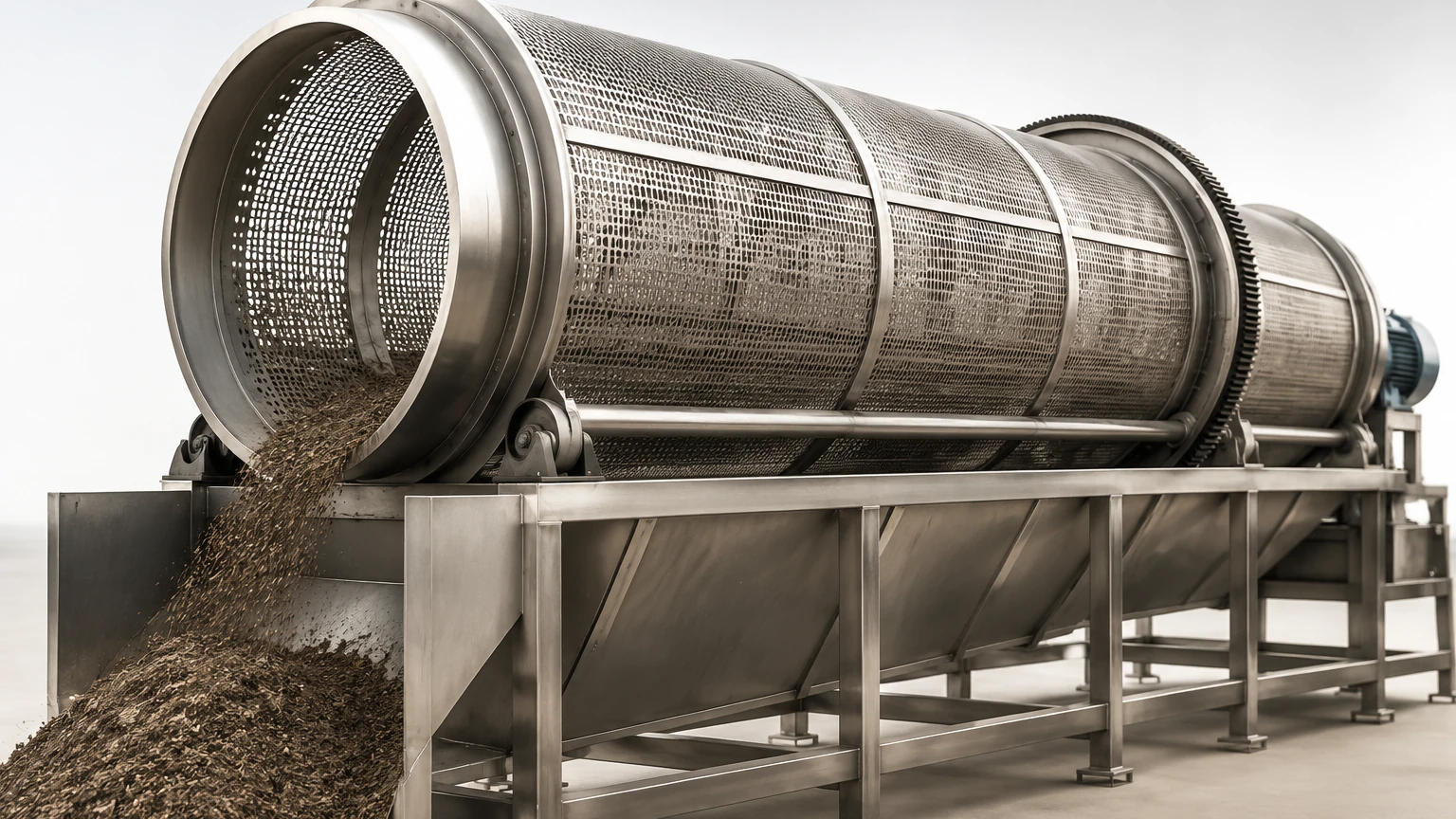
The fundamental operation of a rotary drum screener relies on the combination of centrifugal force, gravity, and mechanical agitation. The system consists of a perforated or mesh-covered cylinder mounted on a horizontal or slightly inclined axis. As the drum rotates, the feed material—which can be a dry solid mixture or a liquid slurry—is introduced into the interior of the drum.
The Separation Process
As the drum turns, the material is lifted by internal flights or simply by the friction against the screen wall. Once the material reaches a certain height, gravity causes it to tumble back down. During this tumbling action, particles smaller than the screen apertures pass through the media (the filtrate or undersize), while larger particles are retained on the surface and eventually discharged at the end of the drum (the retentate or oversize).
For liquid applications, such as wastewater treatment or industrial process water recovery, the liquid passes through the stainless steel mesh while solids are captured. The efficiency of this process is governed by several factors, including the drum’s rotational speed, the angle of inclination, and the total open area of the filtration media.
Key Components and Engineering Considerations
A robust rotary drum screener is more than just a rotating tube. It is a precision assembly where each component must withstand significant mechanical stress and environmental exposure.
1. The Drum Structure
The drum frame provides the structural integrity required to support the weight of the material and the filtration media. In high-capacity industrial environments, the frame must be engineered to prevent sagging or misalignment, which can lead to premature wear of the drive system and uneven screening.
2. Filtration Media (The Screen)
This is the most critical component for performance. Depending on the application, the screen may consist of perforated metal plates, wedge wire, or woven stainless steel wire mesh. For fine filtration requirements, Kaifil specializes in providing high-precision wire mesh that offers a high percentage of open area while maintaining the structural strength needed to resist the pressure of the incoming flow.
3. Drive and Support Systems
Rotary drum screeners typically utilize one of three drive types: chain drives, gear drives, or friction drives (where the drum sits on rubber trunnion wheels). The choice of drive system affects the maintenance cycle and the noise levels of the operation. Engineers must ensure the drive system can handle the starting torque, especially when the drum is fully loaded.
4. Cleaning Mechanisms
To prevent "blinding"—a condition where particles become lodged in the screen apertures—most rotary drum screeners are equipped with a cleaning system. This may include external spray bars that use high-pressure water to backwash the screen or mechanical brushes that physically remove debris from the mesh surface.
Material Selection for Industrial Filtration Media
In B2B industrial environments, material selection is rarely about cost alone; it is about the total cost of ownership (TCO) and chemical compatibility. Stainless steel is the industry standard for rotary drum screener media due to its durability and resistance to various forms of degradation.
304 vs. 316L Stainless Steel
* 304 Stainless Steel: Suitable for general industrial applications, providing excellent strength and basic corrosion resistance. It is commonly used in dry material screening and non-corrosive liquid separation.
* 316L Stainless Steel: Contains molybdenum, which provides superior resistance to chlorides and pitting. This is the preferred choice for pharmaceutical, food and beverage, and marine applications where aggressive cleaning agents or saline environments are present.
Benefits of Stainless Steel Wire Mesh
Using woven wire mesh as the screening medium offers several advantages over perforated plate. Wire mesh provides a significantly higher open area ratio, which translates to higher flow rates and lower pressure drops. Furthermore, stainless steel mesh can be manufactured to much tighter tolerances, allowing for precise micron-rated filtration that is essential in chemical processing and fine particle recovery. For more information on available mesh specifications, you can visit the Main Page to review product options and application support.
Selection Criteria for Rotary Drum Screeners
When specifying a rotary drum screener for a new installation or upgrading an existing process, engineers should evaluate the following technical parameters:
Micron Rating and Aperture Size
The aperture size must be smaller than the smallest particle intended for retention, but large enough to allow the required volume of fluid or undersize material to pass through. Choosing an unnecessarily fine mesh can lead to frequent clogging and reduced throughput.
Hydraulic Loading and Solids Concentration
In liquid applications, the hydraulic loading rate (gallons per minute per square foot of screen area) determines the required size of the drum. High solids concentrations require larger surface areas or more aggressive cleaning systems to maintain a continuous flow.
Drum Speed and Residence Time
The rotational speed (RPM) affects the centrifugal force applied to the material. If the speed is too high, material may "pin" to the drum wall due to centrifugal force, preventing separation. If it is too low, the tumbling action is insufficient. Finding the optimal RPM is essential for maximizing the "effective screening area."
Footprint and Integration
Industrial facilities often have limited space. The orientation of the inlet and outlet, as well as the overall length and diameter of the drum, must be compatible with existing piping and conveyor systems.
Common Challenges and Performance Optimization
Even a well-designed rotary drum screener can encounter operational issues if not properly maintained or if the process conditions change.
Addressing Screen Blinding
Blinding is the most common cause of reduced efficiency. It occurs when near-size particles (particles roughly the same size as the screen opening) become trapped. To optimize performance, engineers should consider the shape of the wire. For example, wedge wire (V-wire) provides a two-point contact that minimizes the chance of particles getting stuck compared to square mesh.
Wear and Abrasion
In mining or heavy industrial applications, the abrasive nature of the material can thin the wire mesh over time. Specifying a heavier wire diameter or using specialized alloys can extend the life of the screen. Kaifil works with clients to balance wire diameter (durability) with open area (performance) to find the optimal configuration for abrasive environments.
Mechanical Misalignment
Over time, the support rollers or trunnions may wear unevenly, causing the drum to shift. This can lead to bypass, where material escapes the drum without being screened. Regular inspection of the seals and support structures is vital.
Customization Options for Specialized Applications
Off-the-shelf filtration solutions often fail to meet the rigorous demands of specialized industrial processes. Customization is frequently required to ensure the rotary drum screener integrates seamlessly into a specific workflow.
OEM and Tailored Mesh Designs
Kaifil provides OEM manufacturing capabilities for filter components, allowing for the creation of custom-sized drum inserts and reinforced mesh structures. This includes:
* Reinforced Edges: To prevent fraying and ensure a secure fit within the drum frame.
* Multi-Layer Sintered Mesh: For applications requiring extreme pressure resistance and fine filtration levels that standard single-layer mesh cannot provide.
* Custom Dimensions: Ensuring that replacement screens fit perfectly into existing equipment from various global manufacturers.
Application-Specific Configurations
In the food industry, the focus is on "clean-in-place" (CIP) capabilities and the elimination of dead zones where bacteria could grow. In the chemical industry, the focus shifts to pH resistance and high-temperature stability. By collaborating with a manufacturer that understands these nuances, engineering teams can procure components that are fit for purpose.
Conclusion: The Importance of Precision Components
The rotary drum screener is a workhorse of industrial separation, but its success is entirely dependent on the integrity of its filtration media. Whether you are managing a municipal wastewater plant or a precision chemical refinery, the choice of stainless steel mesh, the accuracy of the aperture, and the durability of the construction will dictate your operational success.
By focusing on high-quality materials and engineering-led design, facilities can reduce maintenance costs, improve product purity, and ensure a more stable production environment. For technical professionals looking to optimize their filtration systems, understanding these mechanical and material boundaries is the first step toward achieving superior process performance.
