


Auto Backwashing Sediment Filter
In industrial fluid processing, the management of suspended solids is a critical factor in maintaining system efficiency and protecting downstream equipment. An auto backwashing sediment filter represents an advanced solution for continuous filtration, designed to remove particulate matter such as sand, scale, rust, and organic debris without the need for manual intervention or process downtime. For engineers and facility managers, understanding the mechanics, material requirements, and integration strategies of these systems is essential for optimizing operational reliability.
Unlike traditional bag or cartridge filters that require periodic manual replacement, an automatic backwashing system utilizes a self-cleaning mechanism triggered by pressure differentials or set time intervals. This automation is particularly vital in high-volume industrial applications where sediment loading is unpredictable or where process continuity is a primary requirement.
Mechanics of Automatic Self-Cleaning Filtration
The core functionality of an auto backwashing sediment filter relies on the detection of contaminant buildup on the filter element. As fluid passes through the filter media—typically a precision-engineered stainless steel mesh—suspended solids are trapped on the internal surface. Over time, this accumulation creates a flow restriction, resulting in a pressure drop (differential pressure) between the inlet and outlet ports.
When the differential pressure reaches a pre-set threshold (commonly between 0.5 to 1.0 bar), the system initiates a cleaning cycle. During this cycle, a dedicated backwash valve opens, and a cleaning mechanism—such as a rotating suction scanner or a reverse-flow manifold—is activated. The high-velocity flow created by the pressure difference between the internal system and the atmospheric drain effectively dislodges the trapped particles from the mesh.
A key engineering advantage of these systems is the "continuous flow" capability. Many industrial-grade designs allow the main process flow to continue even during the backwash cycle, ensuring that downstream operations are never starved of fluid. This is achieved by cleaning only a small portion of the filter surface area at any given moment.
Engineering Material Selection: The Role of Stainless Steel
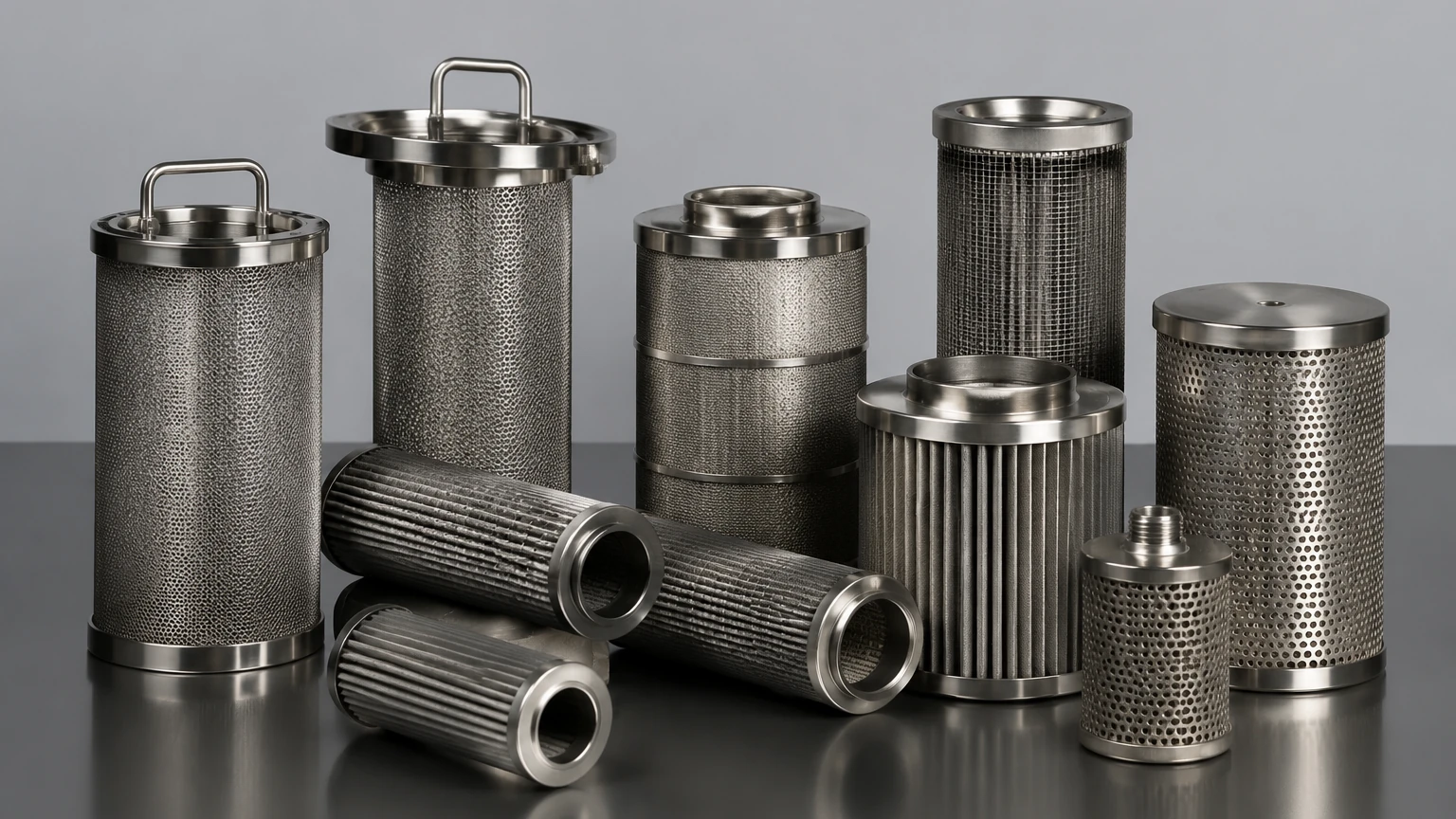
The performance and longevity of an auto backwashing sediment filter are heavily dependent on the quality of the filter media. In demanding industrial environments, stainless steel is the preferred material due to its mechanical strength and resistance to corrosion. As a specialized manufacturer, Kaifil emphasizes the use of high-grade alloys like 304 and 316L to ensure the filter elements can withstand the repetitive mechanical stresses of the backwashing process.
Woven Wire Mesh vs. Wedge Wire
There are two primary types of stainless steel media used in these filters:
1. Woven Wire Mesh: Available in multi-layer sintered configurations, this media provides high porosity and precise filtration ratings. It is ideal for removing fine silt and delicate particulates where a specific micron rating is required.
2. Wedge Wire (V-Wire): Constructed from V-shaped profiles welded onto support ribs, wedge wire is exceptionally robust and resistant to clogging. Its smooth surface and widening gaps make it highly effective for heavy sediment loads and fibrous materials, as the particles are easily released during the backwash stroke.
Selecting the correct media involves analyzing the particle size distribution (PSD) of the sediment and the chemical compatibility of the fluid. For more information on custom media configurations, technical teams can refer to the Main Page for detailed specifications on stainless steel filtration components.
Key Technical Specifications and Selection Criteria
When specifying an auto backwashing sediment filter for an industrial project, engineers must evaluate several technical parameters to ensure the system meets the application's demands. Over-specifying can lead to unnecessary capital expenditure, while under-specifying results in frequent backwash cycles and premature wear.
Micron Rating and Filtration Efficiency
The micron rating defines the size of particles the filter is intended to capture. In sediment filtration, this typically ranges from 10 microns to 2,000 microns. It is important to distinguish between nominal and absolute ratings. For critical protection of high-pressure pumps or spray nozzles, an absolute-rated stainless steel mesh is often required to prevent any bypass of oversized particles.
Flow Rate and Velocity
The filter housing and element must be sized to accommodate the maximum system flow rate without exceeding recommended face velocities. High velocity can force deformable particles through the mesh or cause "impingement" wear on the filter media. Conversely, oversized filters may not maintain sufficient pressure during the backwash cycle to effectively clean the mesh.
Operating Pressure and Temperature
Standard industrial filters are often rated for 10 or 16 bar, but high-pressure hydraulic or process systems may require custom-engineered housings. Similarly, the seals and electronic components must be rated for the operating temperature, especially in chemical processing or steam condensate recovery applications.
Integration into Industrial Process Loops
Auto backwashing sediment filters are versatile components that can be integrated into various stages of a fluid system. Their primary role is often as a "pre-filter" to protect more sensitive equipment downstream.
* Cooling Tower Filtration: In open-loop cooling systems, water is prone to picking up atmospheric dust and debris. An automatic filter prevents these solids from settling in heat exchangers, which would otherwise reduce thermal efficiency and encourage under-deposit corrosion.
* Membrane Protection (RO/UF): Reverse Osmosis (RO) membranes are extremely sensitive to particulate fouling. Installing an auto backwashing sediment filter upstream of the 5-micron cartridge filters can significantly extend the life of the expensive membranes and reduce the frequency of chemical cleanings (CIP).
* Nozzle Protection: In industrial washing, paper manufacturing, or irrigation, fine spray nozzles are easily clogged by sediment. A self-cleaning filter ensures consistent spray patterns and prevents production line stoppages.
Evaluating Total Cost of Ownership (TCO)
While the initial capital investment for an auto backwashing sediment filter is higher than that of a manual strainer or a disposable bag filter, the Total Cost of Ownership (TCO) is generally much lower in B2B industrial contexts. The economic benefits are realized through several channels:
1. Labor Savings: Manual cleaning of large strainers can take hours of technician time. Automatic systems eliminate this recurring labor cost.
2. Zero Consumable Costs: Unlike cartridge filters that must be purchased, stored, and disposed of, a stainless steel backwashing element is a permanent component designed to last for years.
3. Reduced Water Waste: Modern automatic filters use a very small percentage of the total flow for the backwash cycle (often less than 1%), which is significantly more efficient than manual flushing procedures.
4. Uptime Maximization: By preventing unplanned shutdowns due to clogged filters, the system maintains production throughput, which is often the most significant financial factor in industrial operations.
Customization and OEM Considerations
For many original equipment manufacturers (OEMs) and system integrators, a standard off-the-shelf filter may not meet specific spatial or functional requirements. Customization of an auto backwashing sediment filter often involves tailoring the inlet/outlet orientations, selecting specific flange standards (ANSI, DIN, JIS), or integrating specialized control logic into an existing PLC (Programmable Logic Controller) environment.
Kaifil provides engineering support for such requirements, focusing on the precision manufacturing of the internal stainless steel components that drive filtration performance. When consulting with a manufacturer, it is beneficial to provide a water analysis report and a detailed description of the operating cycle to ensure the filter element geometry is optimized for the specific sediment characteristics.
Maintenance and Long-Term Reliability
Although these systems are "automatic," they are not maintenance-free. Long-term reliability depends on periodic inspections of the mechanical seals, the drive motor (if applicable), and the integrity of the stainless steel mesh. In applications involving hard water or scale-forming minerals, the filter element may eventually require an acid soak to remove mineral deposits that backwashing alone cannot dislodge.
To ensure the longevity of the system, engineers should specify filters that allow for easy access to the internal elements. Modular designs that permit the removal of the filter screen without disconnecting the main piping are highly preferred in industrial settings where downtime is strictly controlled.
Conclusion
The implementation of an auto backwashing sediment filter is a strategic decision that enhances the reliability of industrial fluid systems. By automating the removal of particulates and utilizing durable stainless steel media, facilities can achieve consistent filtration performance with minimal operational overhead. Whether protecting a cooling tower, a high-pressure pump, or a delicate membrane system, the selection of the right filtration technology is fundamental to engineering success. For those seeking to explore specific component designs or custom manufacturing capabilities, visiting the Main Page provides a comprehensive overview of available industrial filtration solutions.
