


Vegetable Oil Filtration
In the industrial processing of edible oils, filtration is a critical unit operation that determines the final product's clarity, stability, and shelf life. Vegetable oil filtration involves the removal of suspended solids, gums, waxes, and residual bleaching earth from crude or semi-refined oils. For engineers and production managers, selecting the correct filtration media is not merely a matter of particle retention; it is an exercise in balancing flow rates, pressure differentials, and the chemical compatibility of the filter hardware with various fatty acids and processing temperatures.
Industrial vegetable oil processing typically follows a sequence of extraction, degumming, neutralizing, bleaching, and deodorizing. At each stage, mechanical filtration serves as a primary quality gate. Using high-performance stainless steel filtration components ensures that the process remains efficient while meeting stringent food safety standards.
The Role of Filtration in the Refining Process
Vegetable oil filtration is not a single-step event but a series of targeted interventions throughout the refining cycle. The requirements for a filter used in crude oil clarification differ significantly from those used in the final polishing stages.
Crude Oil Clarification
Initially, crude oil extracted from seeds or fruits contains significant amounts of "foots"—organic debris, seed fragments, and large cellular structures. Coarse filtration at this stage protects downstream equipment, such as centrifuges and heat exchangers, from abrasion and clogging. Stainless steel wire mesh filters are often preferred here due to their high mechanical strength and ability to be cleaned and reused.
Bleaching Earth Removal
During the bleaching process, adsorbent clays (bleaching earth) are added to the oil to remove pigments like chlorophyll and carotenoids. Once the adsorption is complete, this clay must be entirely removed. This stage requires high-precision filtration, often utilizing pressure leaf filters or specialized stainless steel cartridges that can handle high solids loading without premature blinding.
Winterization and Dewaxing
Certain oils, such as sunflower or corn oil, contain waxes that crystallize at lower temperatures, causing turbidity. In the winterization stage, the oil is chilled to precipitate these waxes, which are then removed via fine filtration. This process requires precise micron ratings to ensure that even the smallest wax crystals are captured, ensuring the oil remains clear even when refrigerated.
Engineering Considerations: Material Selection and Compatibility
When specifying components for vegetable oil filtration, material integrity is paramount. The processing environment is often characterized by high temperatures (up to 200°C in some stages) and the presence of free fatty acids, which can be corrosive to inferior metals.
Stainless Steel 304 vs. 316L
For most vegetable oil applications, Stainless Steel 304 provides adequate corrosion resistance. However, in processes involving high-acid oils or intensive Clean-In-Place (CIP) cycles using caustic chemicals, Stainless Steel 316L is the industrial standard. 316L contains molybdenum, which enhances resistance to pitting and chemical degradation, ensuring a longer service life for the filter elements.
Thermal Stability
Unlike polymer-based filters, stainless steel filter cartridges maintain their structural integrity across a wide temperature range. This is essential in vegetable oil refining, where oil viscosity is managed through heating. A filter must withstand thermal expansion and contraction without losing its pore size accuracy or compromising its seals.
Technical Specifications: Micron Ratings and Flow Dynamics
Selecting the appropriate micron rating for vegetable oil filtration requires an understanding of the specific contaminants present at each stage.
1. Coarse Filtration (50–200 microns): Used for crude oil and protecting pumps.
2. Intermediate Filtration (10–40 microns): Used after degumming or for removing larger particles of bleaching earth.
3. Fine Polishing (1–5 microns): Used for the final stage before bottling to ensure absolute clarity and the removal of trace waxes.
Viscosity and Pressure Drop
Vegetable oils are significantly more viscous than water, and their viscosity changes dramatically with temperature. Engineers must calculate the "clean pressure drop" across the filter media based on the specific gravity and viscosity of the oil at processing temperature. A common error is sizing a filter based on water flow rates, which leads to undersized systems and frequent downtime. Increasing the surface area through pleated wire mesh designs can mitigate high pressure drops while maintaining a compact footprint.
Comparing Filter Structures: Mesh, Pleated, and Wedge Wire
The physical architecture of the filter element dictates its performance in vegetable oil applications. Depending on the solids loading and the desired cleaning method, different structures are employed.
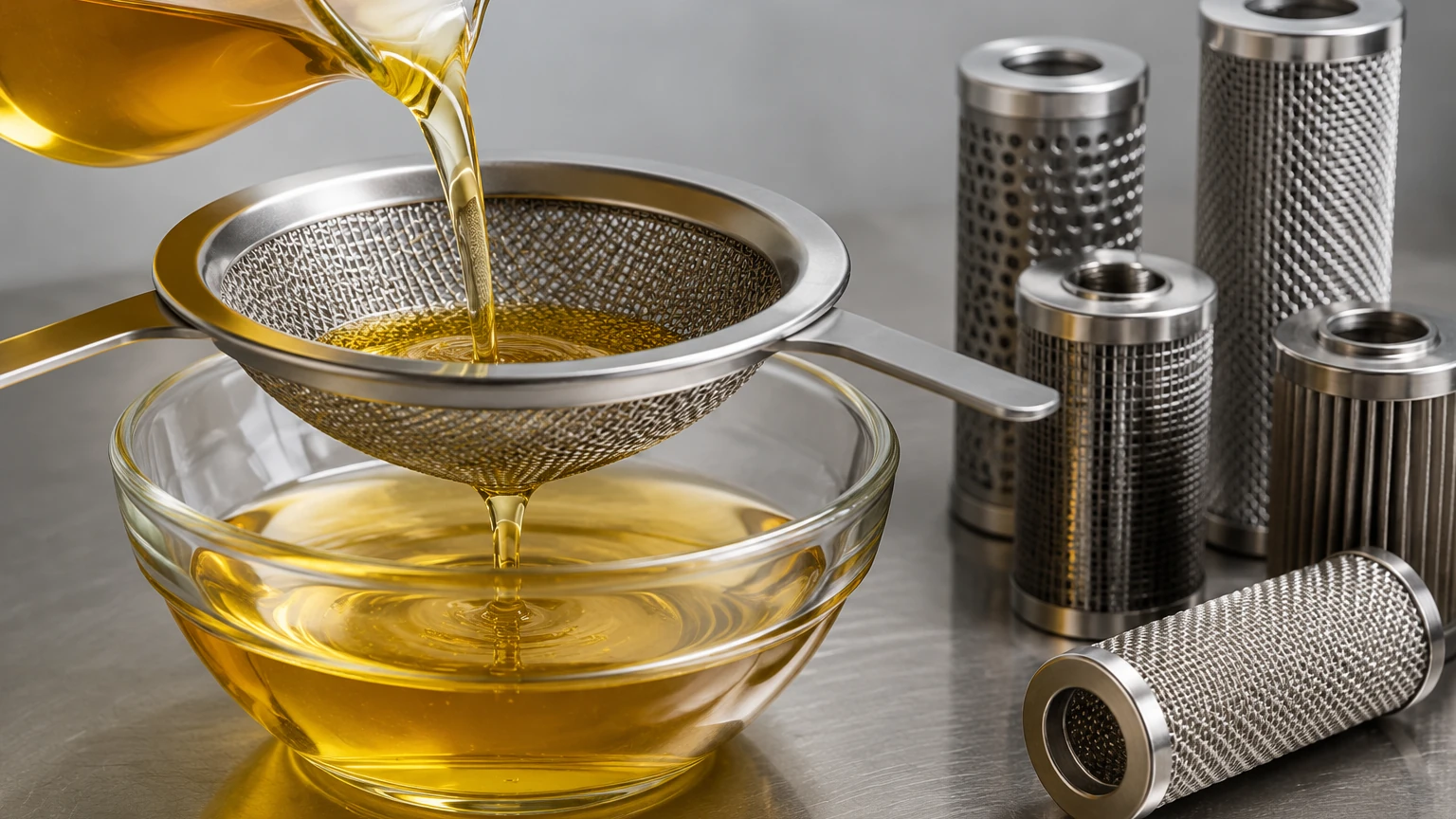
Stainless Steel Wire Mesh Filters
Standard square weave or Dutch weave wire mesh provides a precise, two-dimensional filtration surface. These are ideal for surface filtration where particles are easily dislodged during backwashing or manual cleaning. They are commonly used in strainers and as support structures for finer media.
Pleated Filter Cartridges
For applications requiring high flow rates and fine particle retention, pleated stainless steel cartridges are the preferred choice. By pleating the mesh, the available surface area is increased by 2 to 3 times compared to a cylindrical element of the same size. This results in a lower face velocity, reduced pressure drop, and a longer interval between cleaning cycles.
Wedge Wire Elements
Wedge wire is constructed from V-shaped profiles welded to support rods. This creates a non-clogging surface that is exceptionally strong. Wedge wire is frequently used in automated self-cleaning filters for crude oil, where the robust structure can withstand the mechanical scrapers used to remove heavy solids.
Operational Risks and Maintenance Strategies
The primary operational risk in vegetable oil filtration is "blinding," where sticky gums or fine particles become wedged in the filter pores. If not managed, this leads to a rapid rise in differential pressure and potential collapse of the filter element.
Cleaning and Regeneration
One of the greatest advantages of stainless steel media in vegetable oil processing is its cleanability. Methods include:
* Backpulsing: Reversing the flow of oil or using compressed gas to knock solids off the surface.
* Ultrasonic Cleaning: Using high-frequency sound waves in a detergent bath to remove deeply embedded particles.
* Chemical Cleaning: Using caustic or acidic solutions to dissolve organic buildup, followed by a thorough rinse.
Replacement Cycles
While stainless steel filters are designed for long-term use, they are not infinite. Engineers should monitor the "recovered pressure drop" after each cleaning. If the pressure drop after cleaning is significantly higher than the original clean pressure drop, it indicates permanent fouling or mechanical fatigue, signaling that the element should be replaced to maintain process efficiency.
Total Cost of Ownership (TCO) in Filtration
When evaluating filtration solutions, purchasing teams often focus on the initial capital expenditure (CAPEX). However, in the context of vegetable oil filtration, the Total Cost of Ownership (TCO) provides a more accurate financial picture.
Disposable bag filters or polymer cartridges may have a lower upfront cost but incur high recurring expenses due to replacement frequency, disposal costs of oil-soaked media, and the labor required for changeovers. In contrast, a custom stainless steel solution from a professional manufacturer like Kaifil offers a higher initial investment but significantly lower operational expenditure (OPEX) over its multi-year lifespan. Furthermore, permanent metal filters reduce product loss, as less oil is trapped in discarded media.
Customization and Industrial Support
Every oil refinery has unique parameters based on the feedstock (e.g., soybean, palm, rapeseed) and the desired end-use (e.g., frying oil, salad oil, or industrial feedstock). Customization is often necessary to integrate filtration components into existing housing or to meet specific flow requirements.
Engineers should confirm the following before finalizing a filter specification:
* Chemical Compatibility: Ensure gaskets and seals (Viton, PTFE, or EPDM) are compatible with the specific oil and cleaning chemicals.
* End-Cap Configurations: Match the filter interface (e.g., 222, 226, or NPT thread) to the existing housing to prevent bypass.
* Structural Reinforcement: For high-pressure applications, internal support cores or external cages may be required to prevent pleat deformation.
As a professional manufacturer specializing in custom stainless steel filtration, Kaifil provides the technical expertise required to develop these high-performance components. For more information on tailored filtration solutions, visit the Main Page to review product options and application support.
By focusing on precision engineering and durable materials, vegetable oil processors can achieve consistent product quality while optimizing their operational costs. Whether addressing the challenges of wax removal or the rigors of bleaching earth separation, the right filtration strategy is a cornerstone of modern oil refining.
