

Element Filter Oil
In industrial environments, the integrity of machinery and the efficiency of fluid power systems depend heavily on the cleanliness of the lubricating and hydraulic fluids. The element filter oil serves as the primary defense mechanism against particulate contamination, which is responsible for up to 80% of mechanical failures in hydraulic and lubrication circuits. Selecting the correct filter element requires a deep understanding of fluid dynamics, material compatibility, and the specific environmental stressors of the application. For engineers and procurement specialists, the transition from disposable media to high-performance stainless steel elements often represents a strategic shift toward lower total cost of ownership (TCO) and improved system reliability.
Industrial oils, whether mineral-based, synthetic, or fire-resistant, carry contaminants from various sources: built-in debris from manufacturing, ingressed particles from seals and breathers, and internally generated wear debris. An effective element filter oil must not only capture these particles but also withstand the mechanical stresses of flow surges, pressure drops, and temperature fluctuations without compromising its structural integrity.
The Engineering Role of the Element Filter Oil
The primary function of an element filter oil is to maintain the fluid cleanliness level specified by the ISO 4406 standard. This standard categorizes the number of particles per milliliter of fluid at three different sizes: 4 microns, 6 microns, and 14 microns. Achieving a target ISO code (e.g., 16/14/11) requires a filter element with a precise micron rating and high capture efficiency.
Unlike standard automotive filters, industrial oil filter elements are designed for specific hydraulic and lubrication architectures. They are often categorized by their placement in the system:
* Suction Side Elements: Designed to protect the pump from large debris. These typically have a coarser mesh to prevent cavitation caused by excessive pressure drop.
* Pressure Line Elements: Positioned after the pump, these must withstand full system pressure and are designed to protect sensitive downstream components like servo-valves.
* Return Line Elements: These capture wear debris before the oil returns to the reservoir, ensuring the bulk fluid remains clean.
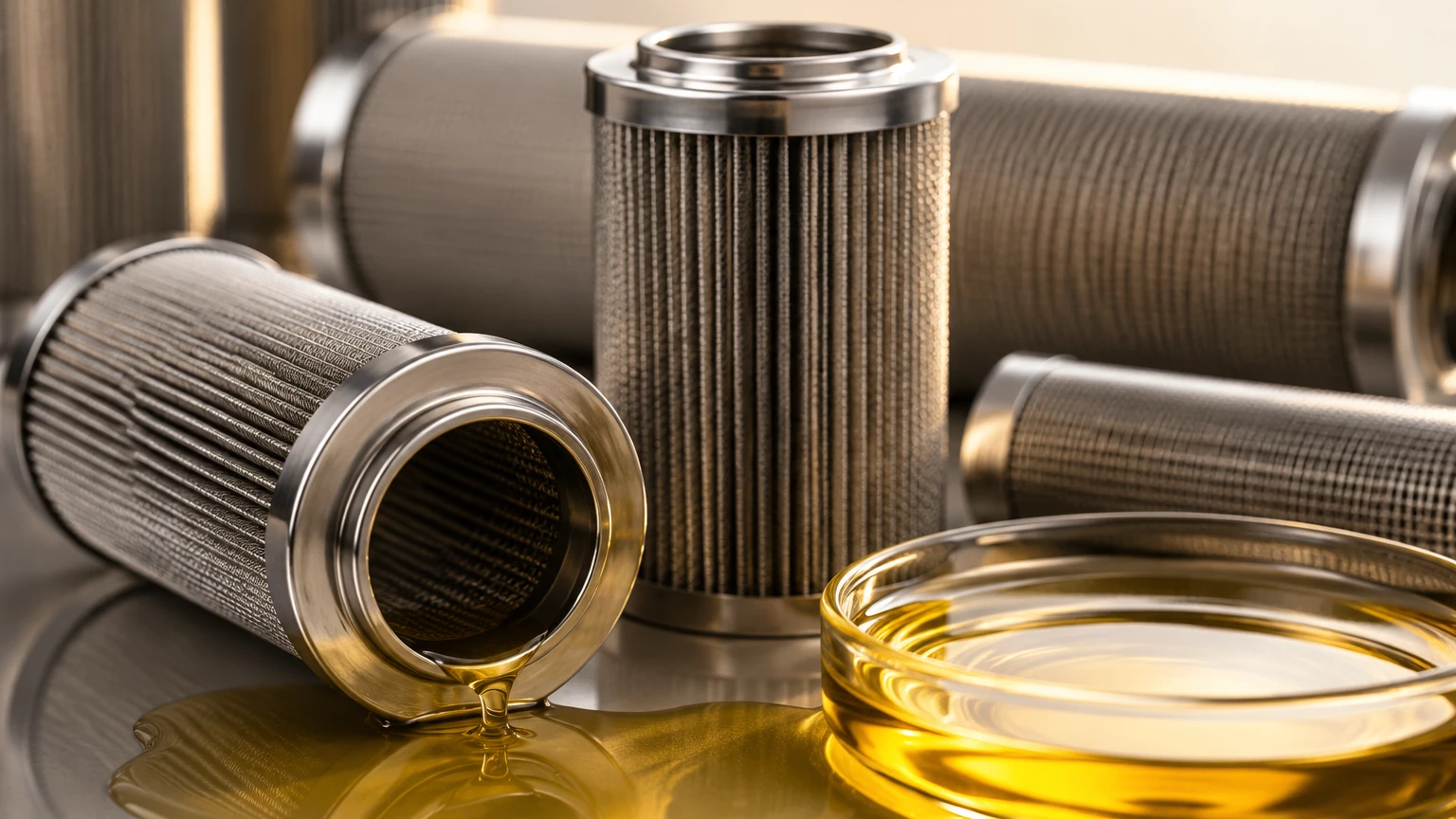
Kaifil specializes in manufacturing stainless steel filter elements that excel in these demanding roles, providing the mechanical strength required for high-pressure applications where traditional cellulose or fiberglass media might collapse or migrate.
Material Selection: Why Stainless Steel?
When specifying an element filter oil, the choice of filter media is the most critical decision. While disposable glass fiber or paper elements are common, stainless steel wire mesh offers distinct advantages in industrial B2B applications.
Durability and Pressure Resistance
Stainless steel (typically Grade 304, 316, or 316L) provides exceptional structural rigidity. In high-viscosity oil applications or cold-start conditions, the pressure differential ($ΔP$) across the filter can spike significantly. Stainless steel mesh elements can withstand these high differential pressures without the risk of media migration—a phenomenon where filter fibers break off and enter the downstream flow, potentially damaging sensitive components.
Chemical and Thermal Compatibility
Many industrial processes involve high-temperature oils or chemically aggressive synthetic fluids. Stainless steel is inherently resistant to corrosion and can operate at temperatures far exceeding the limits of polymer-based media. This makes it the preferred choice for oil filtration in chemical processing, refineries, and heavy manufacturing.
Cleanability and Sustainability
One of the most significant advantages of a stainless steel element filter oil is that it is often cleanable and reusable. Through ultrasonic cleaning or backwashing, the accumulated contaminants can be removed, restoring the element’s flow characteristics. This reduces the recurring costs associated with purchasing, storing, and disposing of single-use cartridges, aligning with corporate sustainability goals.
Technical Specifications and Performance Metrics
To evaluate the performance of an element filter oil, engineers must look beyond the simple "micron rating." Several technical metrics define the true capability of the filter.
Absolute vs. Nominal Rating
A nominal rating is an empirical value indicating the filter's ability to retain a majority of particles of a certain size. However, for critical industrial systems, an absolute rating is required. An absolute rating signifies that the filter will capture 99.9% (or a specified high percentage) of particles at that micron size. Kaifil’s precision-woven wire mesh ensures a consistent pore size, providing reliable absolute filtration levels.
Beta Ratio (β)
The Beta Ratio is the industry standard for measuring filtration efficiency. It is the ratio of particles of a given size upstream of the filter to the number of particles downstream. For example, a $β_{10} = 1000$ means that for every 1000 particles of 10-micron size entering the filter, only one passes through. High-performance oil elements are engineered to maintain high Beta ratios even as the pressure differential increases.
Dirt Holding Capacity (DHC)
DHC refers to the amount of contaminant a filter can retain before the pressure drop reaches a critical level (the bypass or change-out pressure). A pleated stainless steel design significantly increases the surface area of the element filter oil, which in turn increases the DHC and extends the service interval between cleanings or replacements.
Challenges in Oil Filtration
Selecting an element filter oil is not without its complexities. Several operational factors can impact the effectiveness of the filtration system.
Viscosity Fluctuations
Oil viscosity changes with temperature. During a cold start, the oil is thicker, leading to a higher initial pressure drop. If the filter element is not correctly sized or if the media is too restrictive, the system may force the oil through a bypass valve, allowing unfiltered oil to circulate. Engineering the element with the correct mesh weave and surface area is essential to mitigate this risk.
Flow Fatigue
In systems with rapidly changing flow rates, the filter media is subjected to constant mechanical flexing. Over time, this can lead to "flow fatigue," where the pores in a low-quality mesh might enlarge or the wire strands might break. High-quality stainless steel elements are designed with support layers to prevent this mechanical degradation.
Air Entrainment and Foaming
If air is trapped in the oil, it can cause cavitation and oxidative stress. The structure of the filter element should allow for smooth fluid transition to minimize the agitation that contributes to foaming. Precision-engineered wire mesh provides a more laminar flow path compared to the tortuous paths found in depth-style disposable media.
Maintenance and Replacement Cycles
Effective maintenance of the element filter oil is vital for protecting the larger industrial system. Most modern systems utilize differential pressure indicators (gauges or electronic sensors) to signal when an element is becoming clogged.
1. Monitoring ΔP: As the filter captures debris, the resistance to flow increases. When the pressure drop reaches a predetermined limit, the element must be cleaned or replaced.
2. Oil Analysis: Regular oil sampling can reveal if the filter is performing as expected. If particle counts rise despite a clean filter, it may indicate that the element has been bypassed or that the media has failed.
3. Cleaning Protocols: For stainless steel elements, the cleaning process must be handled carefully. Ultrasonic baths are the most effective method for removing fine particles lodged deep within the mesh weave. It is important to verify the integrity of the mesh after cleaning to ensure no damage occurred.
Customization and OEM Solutions
Every industrial application has unique constraints, from space limitations in a hydraulic power unit to specific flow requirements in a large-scale lubrication system. Standard off-the-shelf filters often fall short of meeting these specialized needs. Kaifil provides extensive OEM and customization capabilities for the element filter oil market.
Engineers can specify customized dimensions, end-cap configurations (such as threaded, O-ring, or flat gaskets), and reinforcement structures. Furthermore, the choice of weave—such as plain weave, twilled weave, or Dutch weave—allows for the fine-tuning of the balance between filtration fineness and flow permeability. By working closely with a manufacturer, purchasing teams can ensure they receive a component that is perfectly matched to their equipment’s operational parameters.
Conclusion: Making Informed Procurement Decisions
The selection of an element filter oil is a technical decision that impacts the longevity and efficiency of the entire industrial operation. By prioritizing high-quality materials like stainless steel and focusing on absolute filtration ratings, companies can reduce unexpected downtime and lower their long-term maintenance costs.
When evaluating suppliers, it is essential to confirm their manufacturing standards, material certifications, and ability to provide technical support for specific application challenges. A reliable filtration partner does more than just supply a part; they provide the engineering expertise necessary to optimize fluid cleanliness. For more information on customized stainless steel filtration solutions and to explore our full range of industrial components, please visit our Main Page.
By understanding the relationship between mesh geometry, fluid viscosity, and pressure dynamics, engineers can select an element filter oil that provides consistent performance in the most demanding industrial environments. Whether you are managing a chemical processing plant or maintaining a fleet of hydraulic machinery, the right filter element is the cornerstone of a robust contamination control strategy.
