


Abluftfilter Industrie
In the landscape of modern manufacturing, the management of exhaust air is not merely a matter of environmental compliance but a critical factor in operational efficiency and equipment longevity. The term abluftfilter industrie encompasses a wide range of filtration systems designed to remove contaminants—ranging from fine dust and aerosols to volatile organic compounds and corrosive gases—from industrial air streams. For engineers and facility managers, selecting the correct filtration medium is a technical challenge that requires a deep understanding of fluid dynamics, material science, and the specific chemical properties of the process exhaust.
Industrial exhaust air filtration serves three primary purposes: protecting the environment by meeting emission standards, safeguarding the health of workers, and preventing the accumulation of debris in downstream equipment such as heat exchangers, fans, and ductwork. Achieving these goals requires a move away from generic solutions toward precision-engineered components that can withstand the rigors of industrial environments.
Technical Criteria for Industrial Exhaust Air Filtration
Selecting an exhaust air filter for industrial use involves more than choosing a micron rating. Several engineering variables must be balanced to ensure the system operates reliably without excessive energy consumption or frequent downtime.
Filtration Efficiency and Particle Size Distribution
The primary metric for any filter is its ability to capture particles of a specific size. In industrial exhaust, particle size distribution (PSD) can vary significantly. Mechanical filters, such as those utilizing stainless steel wire mesh, are often characterized by their absolute or nominal filtration ratings. For critical applications in the pharmaceutical or chemical sectors, absolute ratings are preferred as they guarantee that 99.9% of particles above a certain size are captured. Understanding the PSD of the exhaust stream allows engineers to specify a filter that provides the necessary cleanliness without creating unnecessary resistance.
Pressure Drop and Energy Consumption
Pressure drop, or differential pressure ($ΔP$), is the difference in total pressure between the upstream and downstream sides of the filter. Every Pascal of pressure drop must be overcome by the system's fans, leading to increased energy consumption. A high-quality abluftfilter industrie solution is designed to maximize the surface area—often through pleating or multi-layered mesh structures—to keep the initial pressure drop low and extend the time it takes for the filter to reach its terminal pressure drop (the point at which it must be cleaned or replaced).
Flow Rate and Face Velocity
The volume of air passing through the filter per unit of time, typically measured in cubic meters per hour ($m^3/h$), determines the required size of the filtration unit. Face velocity—the speed of the air as it hits the filter surface—must be carefully controlled. If the velocity is too high, particles may be forced through the media (media migration) or the filter structure may deform. Conversely, if the velocity is too low, the system may become unnecessarily bulky and expensive.
Material Selection: The Case for Stainless Steel
While synthetic fibers and paper-based media are common in HVAC applications, demanding industrial processes often require the durability of metal. Stainless steel filtration components, such as those found on the Main Page of specialized manufacturers, offer several advantages in exhaust air applications.
Temperature Resistance
Industrial exhaust often reaches temperatures that would melt or degrade synthetic media. Stainless steel alloys, such as 304 or 316L, maintain their structural integrity at temperatures exceeding 400°C. This makes them indispensable for exhaust filtration in smelting, glass manufacturing, and high-temperature chemical reactions.
Chemical Compatibility and Corrosion Resistance
Exhaust air in the chemical processing and pharmaceutical industries frequently contains corrosive vapors or acidic gases. Stainless steel 316L, with its addition of molybdenum, provides superior resistance to pitting and crevice corrosion. In environments where moisture is present alongside corrosive agents, metal filters prevent the premature failure common with non-metallic alternatives.
Mechanical Strength and Durability
Industrial exhaust systems can experience pressure surges, vibrations, and physical impact from heavy particulate matter. Stainless steel wire mesh and sintered metal filters provide the mechanical strength necessary to resist these forces without tearing or collapsing. This durability translates to a longer service life and a lower risk of catastrophic filter failure.
Customization and Engineering of Filter Components
No two industrial exhaust streams are identical. Therefore, the "one-size-fits-all" approach rarely yields optimal results. Customization is essential for integrating filtration into existing infrastructure and meeting specific performance targets.
Tailored Geometry and Housing
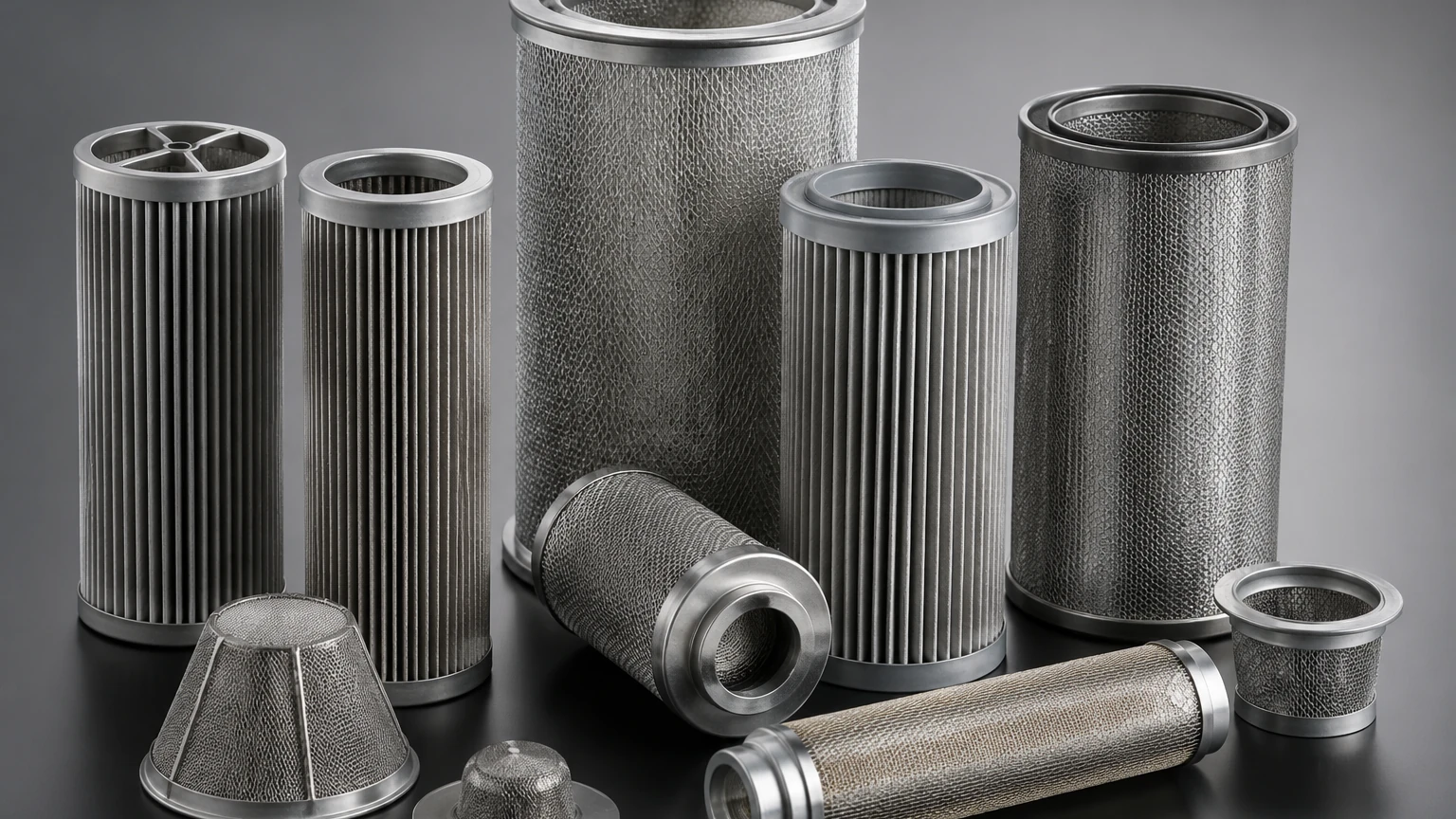
Space constraints often dictate the design of an abluftfilter industrie. Manufacturers like Kaifil specialize in creating custom filter cartridges, discs, and cylinders that fit precisely into specialized housings. Whether the application requires a cylindrical cartridge for a high-pressure line or a large-format panel filter for a ventilation stack, custom geometry ensures a leak-proof fit and optimized airflow.
Layered and Sintered Mesh Structures
For complex filtration tasks, multiple layers of wire mesh can be combined. A coarse outer layer may act as a pre-filter to capture large debris, while finer inner layers handle the primary filtration. Sintering these layers together creates a porous metal plate that is exceptionally strong and provides precise pore size control. This allows for the filtration of fine aerosols and dust in high-pressure exhaust streams.
Maintenance and the Importance of Cleanability
A significant advantage of metal-based industrial exhaust filters is their cleanability. Unlike disposable filters, which contribute to the waste stream and require frequent replacement, stainless steel filters can often be regenerated.
Cleaning Methods
Depending on the contaminant, various cleaning methods can be employed:
* Backpulsing/Backwashing: Using a reverse flow of air or liquid to dislodge accumulated particles.
* Ultrasonic Cleaning: Using high-frequency sound waves in a cleaning solvent to remove fine particles from deep within the mesh.
* Chemical Cleaning: Using specific solvents or acids to dissolve accumulated resins or chemical deposits.
* Thermal Cleaning: Burning off organic contaminants in a controlled furnace.
Determining Replacement Cycles
While metal filters are durable, they are not infinite. Engineers must monitor the pressure drop across the filter. If the baseline pressure drop after cleaning begins to rise steadily, it indicates that "blinding" or permanent clogging is occurring within the depth of the media. Establishing a clear maintenance schedule based on differential pressure readings is vital for preventing system overloads.
Industry-Specific Applications
The requirements for an abluftfilter industrie vary significantly across different sectors:
* Chemical Processing: Filters must handle aggressive vapors and prevent the release of toxic particulates. Here, 316L stainless steel is the standard for its corrosion resistance.
* Food and Beverage: Exhaust from frying, drying, or powder handling must be filtered to prevent grease buildup and dust explosions. Filters must be made of food-grade materials and be easy to sanitize.
* Pharmaceuticals: High-potency active pharmaceutical ingredients (HPAPIs) require ultra-fine filtration to ensure that no trace of the product escapes into the environment. Precision metal mesh provides the necessary reliability for these high-stakes applications.
* Hydraulic and Heavy Machinery: Exhaust air from oil reservoirs and hydraulic systems often contains oil mist. Coalescing metal filters are used to capture these droplets and return them to the system or a collection point.
Evaluating Total Cost of Ownership (TCO)
When purchasing industrial filtration solutions, the initial purchase price is only one component of the total cost. A comprehensive TCO analysis should include:
1. Initial Investment: The cost of the filter element and housing.
2. Energy Costs: The cost of electricity required to overcome the filter's pressure drop over its lifespan.
3. Maintenance Costs: Labor and materials required for cleaning or replacing the filter.
4. Disposal Costs: For disposable filters, the cost of hazardous waste disposal can be significant.
5. Downtime Costs: The lost production value when the system is shut down for filter maintenance.
In many high-demand industrial scenarios, a more expensive, permanent stainless steel filter provides a much lower TCO than cheaper disposable options due to its longevity, cleanability, and lower average pressure drop.
Conclusion for Engineering and Purchasing Teams
Selecting an abluftfilter industrie requires a rigorous technical evaluation of the process conditions. Engineers must prioritize material compatibility, mechanical strength, and the ability to handle specific flow rates without excessive energy loss. By opting for customized stainless steel filtration components, industrial facilities can achieve a balance between high filtration efficiency and operational economy. For those seeking detailed specifications on custom metal filtration components, reviewing technical data and manufacturing capabilities on the Main Page is a recommended step in the procurement process. Proper selection today prevents costly maintenance failures and environmental non-compliance tomorrow.
