


Wind Turbine Filter
In the demanding environment of renewable energy, the reliability of a wind turbine filter is a fundamental determinant of operational uptime and asset longevity. Wind turbines operate in some of the most challenging conditions on earth, from salt-laden offshore environments to high-altitude regions with extreme temperature fluctuations. Within these structures, complex mechanical systems—specifically the gearbox, hydraulic pitch controls, and cooling circuits—rely on ultra-clean fluids to function. Even microscopic particulate contamination can lead to catastrophic component failure, resulting in expensive downtime and specialized repair logistics.
For engineers and maintenance professionals, selecting the correct filtration solution involves understanding the interplay between fluid dynamics, material science, and the specific mechanical demands of the turbine. This guide explores the technical nuances of wind turbine filters, focusing on high-performance stainless steel components that provide the durability required for modern energy infrastructure.
The Critical Role of Filtration in Wind Energy Infrastructure
A wind turbine is essentially a massive precision instrument. The gearbox, which converts the slow rotation of the blades into the high-speed rotation required by the generator, is the most critical and vulnerable component. It operates under immense torque and varying loads, which generates significant heat and wear particles.
A high-quality wind turbine filter serves as the primary line of defense against both internally generated wear debris (such as metal shavings from gear teeth) and external contaminants that may enter the system during maintenance or through seals. Without effective filtration, these particles circulate through the lubrication system, causing abrasive wear, surface fatigue, and eventually, gear or bearing failure.
Beyond the gearbox, hydraulic systems are responsible for blade pitch control and nacelle yawing. These systems require precise pressure regulation; any particulate matter in the hydraulic fluid can cause valve sticking or seal erosion, compromising the turbine's ability to optimize its position relative to the wind. For a comprehensive overview of industrial filtration options, technical teams often consult the Main Page of specialized manufacturers to evaluate material compatibility and design specifications.
Technical Specifications for Wind Turbine Gearbox Filters
Gearbox lubrication systems typically use high-viscosity oils that must be filtered effectively even during cold starts when the oil is thick. The wind turbine filter used in these applications must balance high dirt-holding capacity with low pressure drop.
Micron Ratings and Efficiency
Modern wind turbine gearboxes often require "offline" or "kidney loop" filtration in addition to the main full-flow filter. These systems typically target a cleanliness level of ISO 4406 16/14/11 or better. To achieve this, filters must provide high capture efficiency at the 3-micron to 10-micron range. Engineers must look for the Beta ratio (βx[c]), which indicates the filter's efficiency at a specific particle size. For example, a β10(c) ≥ 1000 rating means the filter is 99.9% efficient at removing particles 10 microns and larger.
Pressure Differential and Bypass Valves
Because wind turbines often operate in cold climates, the filter must handle high-pressure differentials (ΔP) during startup. A robust wind turbine filter housing includes a bypass valve designed to open if the pressure drop across the element becomes too high, ensuring the gearbox is never starved of oil. However, the goal of high-performance stainless steel mesh filters is to maximize the surface area to keep the ΔP as low as possible for as long as possible, extending the interval between bypass events.
Hydraulic System Filtration: Pitch and Yaw Control
Hydraulic systems in wind turbines are sensitive to fine particulates. The pitch control system adjusts the angle of the blades to manage rotor speed and protect the turbine in high winds. This requires rapid, precise movements of hydraulic actuators.
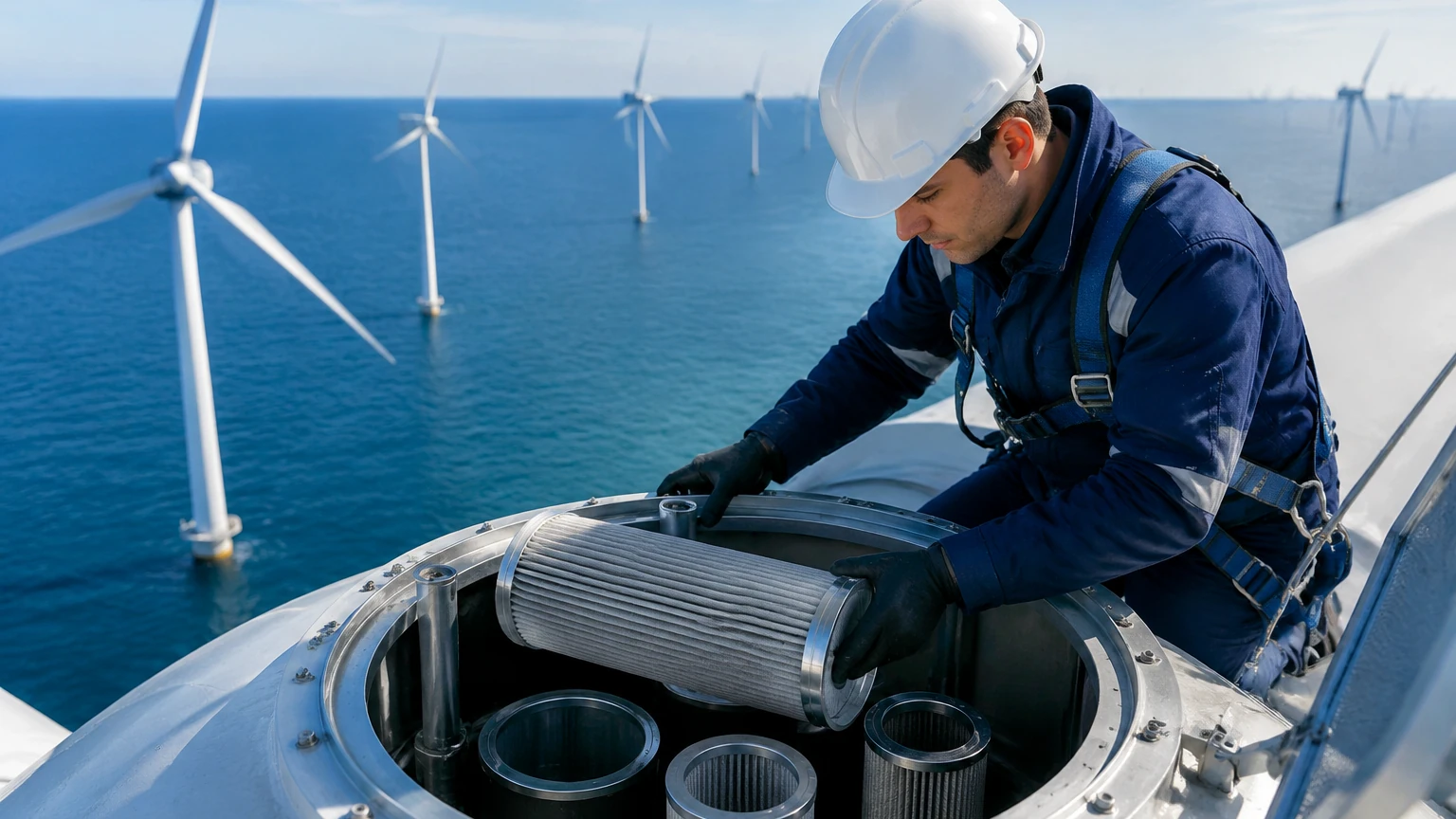
A wind turbine filter in the hydraulic circuit must be capable of withstanding high operating pressures, often exceeding 200 bar. In these applications, stainless steel pleated filter cartridges are frequently preferred over traditional cellulose or fiberglass media. The structural integrity of stainless steel prevents media migration—where bits of the filter material itself break off and enter the fluid stream—which is a common failure mode in lower-quality synthetic filters.
Key considerations for hydraulic filters include:
- Collapse Pressure: The filter element must be rated to withstand the maximum system pressure in the event of a total blockage.
- Fluid Compatibility: Filters must be inert to the specific hydraulic fluids used, including fire-resistant or biodegradable synthetic esters often required in environmentally sensitive offshore sites.
Material Selection: Why Stainless Steel Wire Mesh is Essential
In the context of a wind turbine filter, material selection is not merely a matter of cost but of survival. Traditional disposable filters made of paper or glass fiber are common, but they have limitations in terms of moisture resistance and mechanical strength.
Corrosion Resistance
Offshore wind farms are constantly exposed to salt spray. Even in nacelles that are relatively well-sealed, humidity and salt can penetrate the lubrication and hydraulic systems. Using 304 or 316L stainless steel for filter media and support structures ensures that the filter itself does not become a source of corrosion.
Mechanical Durability
Stainless steel wire mesh offers superior resistance to fatigue. Wind turbines are subject to constant vibration and mechanical shocks. A wire mesh wind turbine filter maintains its pore structure and filtration integrity under these conditions, whereas fiber-based media may shift or "channel," allowing contaminants to pass through.
Cleanability and Reusability
While many wind turbine filters are replaced during scheduled maintenance, high-grade stainless steel components offer the possibility of ultrasonic cleaning and reuse in certain secondary applications. This can reduce the total cost of ownership and the environmental impact of waste disposal, aligning with the green energy ethos of the wind industry.
Evaluating Performance: Beta Ratio and Dirt-Holding Capacity
When specifying a wind turbine filter, engineers must move beyond the simple "micron rating" and look at the performance curves.
1. Dirt-Holding Capacity (DHC): This measures how much contaminant a filter can trap before the pressure drop reaches a critical level. A higher DHC means longer service intervals. For remote wind farms, where a technician's visit requires a crane or a boat, extending the service interval from 6 months to 12 months provides massive logistical savings.
2. Flow Fatigue: This measures the filter's ability to withstand fluctuating flow rates. In wind turbines, pump speeds and fluid temperatures change constantly. A high-performance wind turbine filter must be tested to withstand thousands of flow cycles without structural failure.
Maintenance Strategies and Replacement Cycles
The maintenance of a wind turbine filter is typically governed by either a fixed schedule (e.g., every 5,000 operating hours) or condition-based monitoring.
Condition-Based Monitoring
Modern turbines are equipped with differential pressure sensors across the filter housing. When the ΔP reaches a pre-set limit, an alarm is triggered in the SCADA (Supervisory Control and Data Acquisition) system. This allows maintenance teams to replace the wind turbine filter exactly when needed, preventing premature replacement or, conversely, avoiding operation in bypass mode.
Oil Analysis
Regular oil analysis is the best way to verify if the wind turbine filter is performing correctly. If the particle count (ISO 4406) begins to rise despite the filter being relatively new, it may indicate that the filter media is bypassed or that an internal component is wearing at an accelerated rate that exceeds the filter's DHC.
Custom OEM Solutions for Wind Turbine Manufacturers
Every turbine design has unique spatial constraints and flow requirements. Off-the-shelf filtration units often fail to meet the specific needs of next-generation 10MW+ turbines. This is where custom manufacturing becomes vital.
Customized wind turbine filter solutions allow for:
- Optimized Pleat Geometry: Maximizing surface area within a compact footprint.
- Integrated Sensors: Designing filter heads with built-in ports for temperature, pressure, and oil condition sensors.
- Specialized End Caps: Ensuring a perfect, leak-proof fit within proprietary housing designs.
Manufacturers like Kaifil work closely with turbine OEMs to develop filtration components that are specifically engineered for the torque and thermal profiles of their gearboxes. By controlling the weaving process of the stainless steel mesh and the precision of the assembly, these custom filters provide a level of reliability that generic alternatives cannot match.
Total Cost of Ownership (TCO) Considerations
When purchasing a wind turbine filter, the initial price is often the least significant factor in the TCO equation. The real costs associated with filtration include:
- Logistics: The cost of transporting technicians and parts to a remote site.
- Downtime: The lost revenue from a turbine that is not generating power due to a gearbox failure or a clogged filter.
- Component Longevity: The cost of replacing a $500,000 gearbox because a $200 filter failed.
Investing in high-quality, stainless steel filtration components reduces these risks. A robust filter ensures that the oil remains within the required cleanliness specifications, thereby extending the life of the bearings and gears and maximizing the return on investment for the wind farm operator.
Conclusion
The wind turbine filter is a small but critical component in the global transition to renewable energy. As turbines grow larger and are deployed in harsher environments, the demands on filtration systems will only increase. By prioritizing high-grade materials like stainless steel, demanding rigorous performance data such as Beta ratios and DHC, and considering custom OEM designs, engineers can ensure their assets remain productive for their full 20-to-25-year design life. For those seeking technical specifications or customized filtration components, visiting the Main Page of an experienced manufacturer is the first step toward optimizing turbine reliability and performance.
