


Custom Strainers
In industrial fluid handling and processing, the efficiency of a system is often determined by its ability to manage particulate matter without compromising flow dynamics. While standard, off-the-shelf filtration components serve basic needs, complex industrial environments—ranging from chemical processing to high-pressure hydraulic systems—frequently require custom strainers. These engineered components are designed to meet specific spatial constraints, chemical compatibility requirements, and precise filtration ratings that standard products cannot accommodate.
For engineers and procurement professionals, selecting the right custom strainers involves a deep understanding of fluid mechanics, material science, and the specific operational demands of the application. This guide explores the technical considerations, design parameters, and performance expectations essential for implementing effective custom filtration solutions.
The Engineering Necessity of Customization
Standard strainers are manufactured to fit common pipe sizes and generic pressure ratings. However, industrial processes rarely follow a "one size fits all" model. Customization becomes necessary when the process fluid, flow rate, or environmental conditions deviate from the norm.
Spatial and Geometry Constraints
In many retrofit projects or compact skid designs, there is insufficient space for a standard Y-strainer or basket strainer. Custom strainers can be engineered with unique inlet/outlet offsets, specialized housing shapes, or compact footprints to fit within existing infrastructure without requiring extensive piping modifications. This flexibility allows for the integration of high-capacity filtration in restricted areas.
Extreme Operational Parameters
Standard components often have temperature and pressure limits that are insufficient for heavy industrial use. Custom-fabricated strainers can be designed to withstand cryogenic temperatures or high-heat environments exceeding 500°C. Furthermore, for high-pressure hydraulic or steam applications, custom wall thicknesses and reinforced mesh structures ensure structural integrity under intense mechanical stress.
Material Selection and Chemical Compatibility
The longevity of a strainer is directly linked to its material composition. In aggressive chemical environments or food-grade applications, selecting the appropriate alloy is critical to prevent corrosion, contamination, and premature failure.
1. Stainless Steel 304/304L: The most common choice for general industrial use, providing excellent strength and basic corrosion resistance. It is suitable for water treatment and less aggressive chemical environments.
2. Stainless Steel 316/316L: Containing molybdenum, this alloy offers superior resistance to chlorides and pitting. It is the industry standard for marine environments, pharmaceutical manufacturing, and chemical processing.
3. Duplex and Super Duplex: For highly corrosive environments, such as oil and gas extraction or desalination plants, duplex stainless steels provide higher yield strength and exceptional resistance to stress corrosion cracking.
4. Specialty Alloys: In cases involving extreme acidity or high-temperature oxidation, materials like Monel, Hastelloy, or Inconel may be utilized in custom strainer designs to ensure a long service life.
By consulting the Main Page of a specialized manufacturer like Kaifil, engineers can identify the material grades and manufacturing techniques best suited for their specific chemical exposures.
Technical Design Parameters for Custom Strainers
When designing custom strainers, several technical factors must be calculated to ensure the component performs as expected without causing system-wide issues like cavitation or excessive energy consumption.
Micron Rating and Mesh Selection
The primary function of a strainer is to remove particles of a specific size. This is defined by the micron rating. Custom strainers utilize various media types:
* Wire Mesh: Available in plain, twilled, or Dutch weaves, wire mesh offers precise aperture sizes and high open-area ratios.
* Perforated Metal: Used as a support structure or for coarse filtration (straining), perforated metal provides high mechanical strength.
* Wedge Wire: Ideal for heavy-duty applications, wedge wire resists clogging and is easier to clean due to its V-shaped profile.
Open Area Ratio (OAR)
One of the most critical metrics in strainer design is the Open Area Ratio. This is the ratio between the total area of the holes in the strainer element and the cross-sectional area of the inlet pipe. A common engineering standard is a 6:1 ratio. A higher OAR results in a lower pressure drop across the strainer and extends the time between cleaning cycles. Custom strainers allow engineers to maximize this ratio within a given housing size.
Pressure Drop ($ΔP$)
Every strainer introduces some resistance to flow. The pressure drop must be carefully managed to ensure that downstream equipment receives the required pressure. Factors influencing $ΔP$ include fluid viscosity, flow velocity, and the percentage of the strainer that is currently clogged. Custom designs can incorporate larger baskets or pleated elements to increase surface area and minimize initial pressure loss.
Common Configurations in Industrial Applications
Custom strainers are not limited to a single form factor. Depending on the maintenance requirements and the nature of the fluid, different configurations are employed.
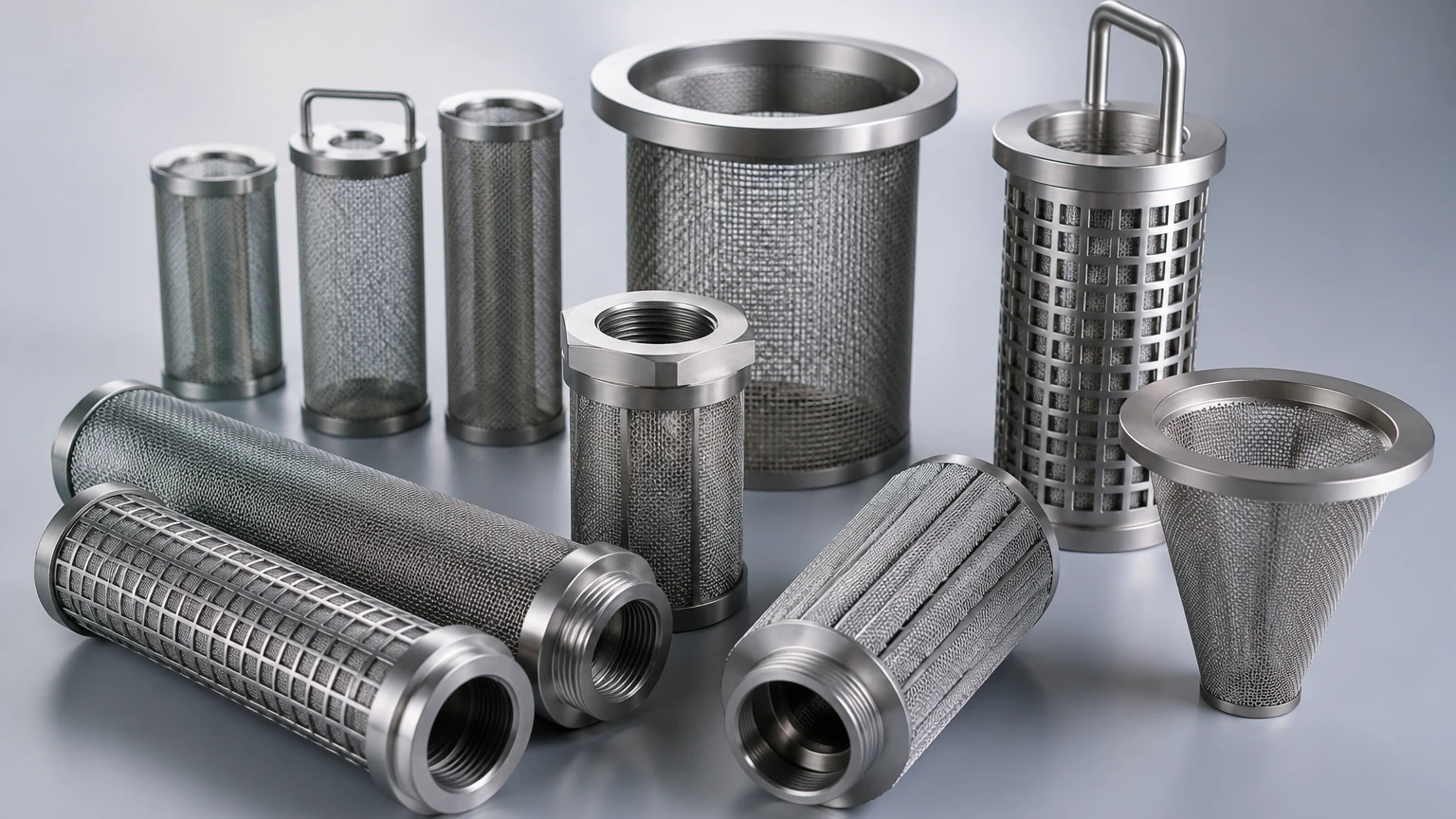
Custom Basket Strainers
Basket strainers are designed for applications where high flow rates and high solids loading are expected. The "basket" design allows for a larger holding capacity for debris. Customizations often include quick-opening covers for tool-less maintenance, magnetic inserts to capture fine ferrous particles, and specialized coatings to reduce friction.
T-Type and Y-Type Variations
Y-strainers are typically used for steam or gases where the amount of debris is minimal. T-type strainers offer a more compact profile and can be serviced without removing the entire unit from the line. Customizing these involves adjusting the leg length or the angle of the strainer element to optimize flow and ease of access for technicians.
Temporary and Conical Strainers
Often used during system start-up or commissioning, these "witch's hat" or conical strainers are placed between flanges. Custom versions can be reinforced with heavy-duty perforated metal to handle the high-velocity debris often found in new piping systems.
Industry-Specific Requirements
Different sectors have unique regulatory and performance benchmarks that custom strainers must meet.
Food and Beverage
In this industry, "hygienic design" is paramount. Custom strainers must feature smooth internal surfaces (often electro-polished) to prevent bacterial growth. They must also be compatible with Clean-in-Place (CIP) processes, meaning they can be sanitized without being disassembled.
Pharmaceutical and Biotech
Filtration in the pharmaceutical sector requires extreme precision and traceability. Custom strainers often utilize 316L stainless steel with documented material certifications. The filtration media must be capable of capturing minute particulates while maintaining high flow rates for sensitive biological fluids.
Chemical Processing
Chemical plants deal with a wide range of viscosities and corrosive agents. Custom strainers in this sector often feature specialized gaskets (such as PTFE or Viton) and heavy-walled housings to prevent leaks and withstand the exothermic reactions that may occur within the process line.
Maintenance, Durability, and Total Cost of Ownership
While the initial cost of custom strainers may be higher than standard parts, the Total Cost of Ownership (TCO) is often lower. A well-engineered custom solution reduces downtime, protects expensive downstream equipment (like pumps and turbines), and requires less frequent replacement.
Cleaning and Serviceability
Custom designs can incorporate features that simplify maintenance. For example, duplex strainers allow for continuous operation; while one side is being cleaned, the flow is diverted to the other. In systems where manual cleaning is difficult, custom strainers can be designed with backwashing capabilities, using a portion of the filtered fluid to flush debris from the element.
Structural Reinforcement
In high-velocity systems, the mesh element can be subject to fatigue and "fluttering," which eventually leads to mechanical failure. Custom strainers often include internal support cages or external reinforcement rings to ensure the mesh remains stable under fluctuating flow conditions.
Selecting a Manufacturing Partner
Choosing a manufacturer for custom filtration components requires evaluating their technical expertise and production capabilities. A reliable partner should offer:
* Engineering Support: The ability to review system schematics and recommend specific mesh types or housing designs.
* Quality Control: Adherence to international standards such as ISO 9001, ensuring that every component meets the specified tolerances.
* Customization Range: Proficiency in working with various stainless steel grades and weaving patterns to create tailored solutions.
Kaifil specializes in these precision metal filtration components, providing the engineering depth required for demanding industrial applications. Their focus on durability and filtration accuracy ensures that custom strainers perform reliably in the most challenging environments.
Conclusion
Custom strainers are essential components for optimizing industrial fluid systems. By moving beyond standard specifications, engineers can address specific challenges related to flow rate, chemical compatibility, and spatial limitations. Whether it is a reinforced basket for a chemical plant or a high-precision mesh for a pharmaceutical line, the right custom strainer protects equipment, ensures product quality, and improves overall process efficiency.
When evaluating your next filtration project, consider the long-term benefits of an engineered solution. For detailed product specifications and to explore the range of available filtration technologies, visit the Main Page to connect with technical experts who can assist in developing a solution tailored to your operational needs.
