


Foam Filters
In industrial filtration, selecting the appropriate media requires a deep understanding of fluid dynamics, contaminant characteristics, and environmental constraints. Foam filters, specifically reticulated open-cell structures, represent a versatile category of filtration media used across diverse sectors, from HVAC systems to complex chemical processing. Unlike traditional woven wire mesh or pleated paper, foam filters offer a unique three-dimensional depth filtration capability that balances high dust-holding capacity with relatively low pressure drop.
For engineers and procurement professionals, evaluating foam filters involves more than just selecting a pore size. It requires an analysis of material compatibility, thermal stability, and the mechanical rigors of the specific application. As a manufacturer specializing in precision filtration, Kaifil provides this guide to help technical teams navigate the complexities of foam-based media and understand how they integrate into broader industrial filtration strategies. To explore a full range of high-performance filtration components, visit the Main Page.
Understanding the Reticulation Process and Structure
The performance of foam filters is rooted in the "reticulation" process. Standard foam production usually results in a closed-cell or partially closed-cell structure, where thin membranes exist between the strands (struts) of the foam. In filtration applications, these membranes are removed through a process called thermal or chemical reticulation.
Thermal reticulation involves placing the foam in a vacuum chamber filled with an explosive gas mixture. Upon ignition, the flash flame consumes the high-surface-area membranes but leaves the thicker structural struts intact. The result is a 100% open-cell structure that allows fluids and gases to pass through with minimal resistance while providing a complex, tortuous path for particles to be trapped.
The Significance of PPI (Pores Per Inch)
The primary metric for defining foam filters is PPI. Unlike the micron ratings used for stainless steel wire mesh or filter cartridges, PPI describes the linear density of the pores. Common industrial grades range from 10 PPI (very coarse) to 100 PPI (very fine).
* 10–30 PPI: Used for high-velocity air filtration, large particle capture, and pre-filtration for more delicate secondary filters.
* 45–70 PPI: Standard for general industrial machinery, small engine air intakes, and mist elimination.
* 80–100 PPI: Utilized in high-efficiency applications where fine particulate capture is required, though at the cost of higher initial pressure drop.
Material Science: Choosing the Right Substrate
While the structure of foam filters is consistent, the base material determines the filter’s lifespan and suitability for specific environments. In industrial B2B contexts, three primary material categories dominate the market.
Polyurethane (PU) Foams
Polyurethane is the most common material for foam filters due to its elasticity and cost-effectiveness. It is generally divided into two types:
1. Polyether-based: Offers superior resistance to moisture and humidity (hydrolysis resistance). It is the preferred choice for outdoor applications or environments with high water vapor.
2. Polyester-based: Provides better resistance to hydrocarbons, oils, and many common chemicals. However, it is susceptible to degradation in high-humidity or high-temperature aqueous environments.
Metal Foams
For applications exceeding the thermal or chemical limits of polymers, metal foams—often made from nickel, copper, or stainless steel—are employed. These are produced by plating or coating a reticulated polymer foam with metal and then burning away the polymer core. Metal foam filters are essential in high-temperature gas filtration, catalyst supports, and applications requiring high thermal conductivity.
Ceramic Foams
Primarily used in the foundry industry for molten metal filtration, ceramic foams can withstand extreme temperatures (up to 1600°C). They are critical for removing slag and non-metallic inclusions from molten aluminum, iron, and steel alloys.
Engineering Performance Metrics
When specifying foam filters for an OEM project or a plant upgrade, engineers must look beyond the physical dimensions. Several technical factors dictate the total cost of ownership and system efficiency.
Pressure Drop (ΔP)
Pressure drop is the loss of fluid pressure as it passes through the filter media. Foam filters are prized for their low initial ΔP compared to dense felt or paper media. However, as the depth of the foam fills with contaminants, the ΔP increases. Engineers must calculate the "terminal pressure drop"—the point at which the filter must be cleaned or replaced to prevent system failure or excessive energy consumption in pumps and fans.
Dust Holding Capacity (DHC)
Because foam filters utilize the entire volume of the media (depth filtration) rather than just the surface, they possess a high DHC. This makes them ideal for environments with high particulate loads where surface-loading filters would clog too quickly. The DHC is directly influenced by the thickness of the foam and the PPI rating.
Face Velocity
The speed at which the fluid approaches the filter face is the face velocity. If the velocity is too high, particles may be forced through the open-cell structure (migration), reducing filtration efficiency. Conversely, if it is too low, the system may not meet the required throughput. Standard industrial foam filters are typically rated for velocities between 100 and 500 feet per minute (fpm), depending on the PPI.
Foam Filters vs. Stainless Steel Wire Mesh
At Kaifil, we often receive inquiries regarding the choice between foam filters and stainless steel wire mesh. While both serve critical roles, their applications rarely overlap entirely.
| Feature | Foam Filters (Polymer) | Stainless Steel Wire Mesh |
| :— | :— | :— |
| Filtration Type | Depth Filtration | Surface/Barrier Filtration |
| Temperature Limit | Low to Moderate (<120°C) | High (Up to 800°C+) |
| Cleanability | Limited (Washable/Disposable) | Excellent (Ultrasonic/Backwash) |
| Chemical Resistance | Variable (Polymer dependent) | Excellent (Corrosion resistant) |
| Precision | Nominal (PPI-based) | Absolute (Micron-rated) |
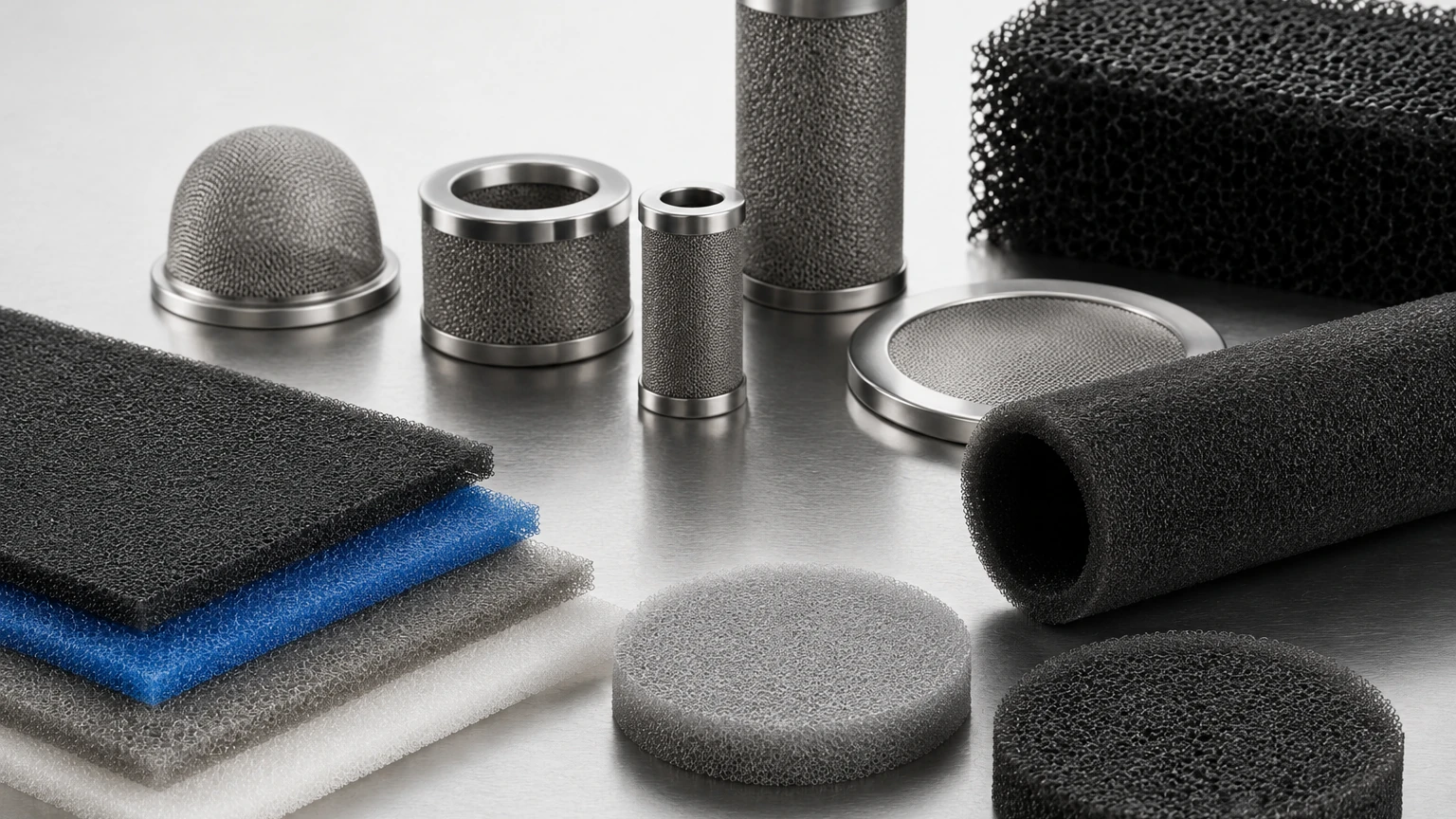
In many industrial systems, these two media are used in a multi-stage approach. A coarse foam filter may act as a pre-filter to protect a high-precision stainless steel filter cartridge. This configuration extends the life of the more expensive stainless steel component by removing the bulk of the particulate matter before it reaches the final stage. For detailed specifications on precision metal components, please refer to the Main Page.
Key Industrial Applications
HVAC and Air Handling
Foam filters are widely used in industrial HVAC systems to protect coils and blowers from dust and debris. Their ability to be washed and reused makes them a sustainable choice for large-scale facilities.
Compressed Air and Gas Systems
In compressor intakes, foam filters prevent atmospheric dust from entering the compression chamber, which would otherwise lead to premature wear of pistons or screws. They also serve as effective silencers, dampening the acoustic noise generated by high-velocity air intake.
Hydraulic and Lubrication Systems
While high-pressure hydraulic lines typically require stainless steel or micro-glass elements, foam filters are frequently used in reservoir breathers. They prevent airborne contaminants from being drawn into the hydraulic tank as fluid levels fluctuate.
Medical and Laboratory Equipment
In medical devices like oxygen concentrators, fine-pore foam filters (80–100 PPI) are used to ensure the air delivered to the patient is free of dust and microorganisms, while maintaining the quiet operation required in clinical settings.
Risks, Limitations, and Maintenance
Despite their advantages, foam filters are not a "set and forget" solution. Failure to monitor their condition can lead to several industrial risks:
1. Environmental Degradation: Polymer foams can become brittle over time when exposed to UV light, ozone, or certain chemical vapors. This can lead to "media migration," where bits of the foam itself break off and contaminate the downstream process.
2. Hydrolysis: As mentioned, polyester-based foams can turn into a sticky, unserviceable mass if exposed to high humidity and heat over long periods.
3. Cleaning Limitations: While many foam filters are marketed as washable, they cannot be cleaned indefinitely. Aggressive solvents or high-pressure water can tear the delicate struts of the reticulated structure, permanently altering the filtration efficiency.
Replacement Cycles
In a B2B environment, replacement cycles should be determined by scheduled differential pressure readings. For disposable foam inserts, a common practice is to replace the media when the pressure drop reaches double the initial (clean) value.
Selection Guidance for Procurement and Engineering Teams
Before finalizing a purchase order for foam filters or integrated filtration systems, technical teams should confirm the following parameters with their supplier:
* Fluid Compatibility: Provide a full chemical profile of the fluid or gas, including trace contaminants.
* Operating Temperature: Confirm both the steady-state and peak temperatures the filter will encounter.
* Dimensional Tolerances: Foam is a flexible material; ensure the housing design accounts for the necessary compression to prevent fluid bypass around the edges of the filter.
* Compliance Requirements: For food, beverage, or pharmaceutical applications, ensure the foam material meets FDA or relevant local regulatory standards for food contact or biocompatibility.
Conclusion
Foam filters are a fundamental component in the industrial filtration toolkit, offering a balance of efficiency and economy for depth filtration needs. By understanding the nuances of PPI, material selection, and the mechanical limitations of reticulated structures, engineers can optimize their systems for longevity and performance.
Whether you are designing a new air intake system or seeking to improve the pre-filtration stage of a chemical process, selecting the right media is critical. Kaifil remains committed to providing high-quality, customized filtration solutions that meet the rigorous demands of modern industry. For further technical assistance, product specifications, or to discuss customized stainless steel filtration components that complement your foam filter stages, please visit our Main Page.
