


Refinery Products Filtration
In the oil and gas industry, the integrity of downstream products depends heavily on the efficiency of the separation and purification stages. Refinery products filtration is a critical process designed to remove solid contaminants, catalysts, and moisture from various hydrocarbon streams. As refineries strive for higher purity standards to meet environmental regulations and protect sensitive downstream equipment, the selection of filtration media becomes a primary engineering concern.
Industrial filtration in a refinery setting is not a one-size-fits-all solution. It requires a deep understanding of fluid dynamics, material science, and the specific chemical properties of the refined products. From crude oil distillation to the final polishing of jet fuel or diesel, metal-based filtration components—specifically stainless steel wire mesh and sintered cartridges—play a vital role in maintaining operational uptime and product consistency.
The Critical Role of High-Precision Filtration in Refining
Refining processes involve complex chemical reactions and physical separations occurring under extreme conditions. Contaminants such as pipe scale, rust, sand, and catalyst fines can severely degrade the quality of the final product and damage expensive hardware like high-pressure pumps, nozzles, and turbine blades. Effective refinery products filtration ensures that these particles are intercepted before they cause mechanical wear or chemical interference.
For engineers, the goal is to achieve the required ISO cleanliness levels while minimizing the pressure drop across the filter element. A high pressure drop indicates that the filter is reaching its dirt-holding capacity, which can lead to reduced flow rates and increased energy consumption. By utilizing precision-engineered stainless steel filters, refineries can achieve a balance between fine filtration accuracy and high-flow efficiency. These components are designed to withstand the high differential pressures common in hydraulic and chemical processing lines within the refinery.
Key Challenges in Refinery Products Filtration
Refinery environments present some of the most demanding conditions for filtration equipment. Several factors must be considered during the engineering and procurement phases:
1. High Temperature and Pressure
Many refinery streams, such as those found in hydrotreating or catalytic cracking units, operate at elevated temperatures. Traditional polymer-based filters often fail or degrade under these conditions. Stainless steel filtration components are preferred because they maintain structural integrity and filtration accuracy at temperatures exceeding 300°C (572°F) and under significant mechanical stress.
2. Chemical Compatibility and Corrosion
Refinery products often contain corrosive elements, including sulfur compounds, organic acids, and salts. Choosing the correct alloy is essential to prevent premature filter failure. While 304 stainless steel is suitable for many general applications, 316L is often the standard for refinery products filtration due to its superior resistance to pitting and crevice corrosion in chloride-rich or acidic environments.
3. Catalyst Recovery and Protection
In processes like Fluid Catalytic Cracking (FCC), the recovery of expensive catalyst fines is both an economic and operational necessity. Filtration systems must be capable of capturing extremely fine particles (often in the sub-10 micron range) while allowing the main product stream to pass through with minimal resistance. Failure to capture these fines can result in contaminated slurry oil and increased maintenance costs for downstream heat exchangers.
Selecting Materials for Harsh Industrial Environments
The choice of material is the foundation of any reliable filtration system. In the context of refinery products filtration, stainless steel is the material of choice due to its durability and cleanability.
* Stainless Steel 304: Offers good corrosion resistance and is cost-effective for non-acidic hydrocarbon streams and general water treatment within the refinery.
* Stainless Steel 316L: Contains molybdenum, which provides enhanced resistance to chemicals and prevents carbon precipitation during welding. This is critical for maintaining the integrity of the filter mesh and cartridge seams.
* Specialty Alloys: For highly specialized applications involving extreme acidity or high-temperature oxidation, alloys such as Monel or Inconel may be utilized in the construction of the wire mesh or sintered metal components.
When evaluating materials, engineers must also consider the "cleanability" of the filter. Unlike disposable paper or glass fiber elements, stainless steel filters can be cleaned via backwashing, ultrasonic cleaning, or chemical baths, significantly reducing the total cost of ownership over the life of the plant.
Structural Components: From Wire Mesh to Filter Cartridges
The architecture of the filter element determines its performance characteristics. In refinery applications, several common structures are employed:
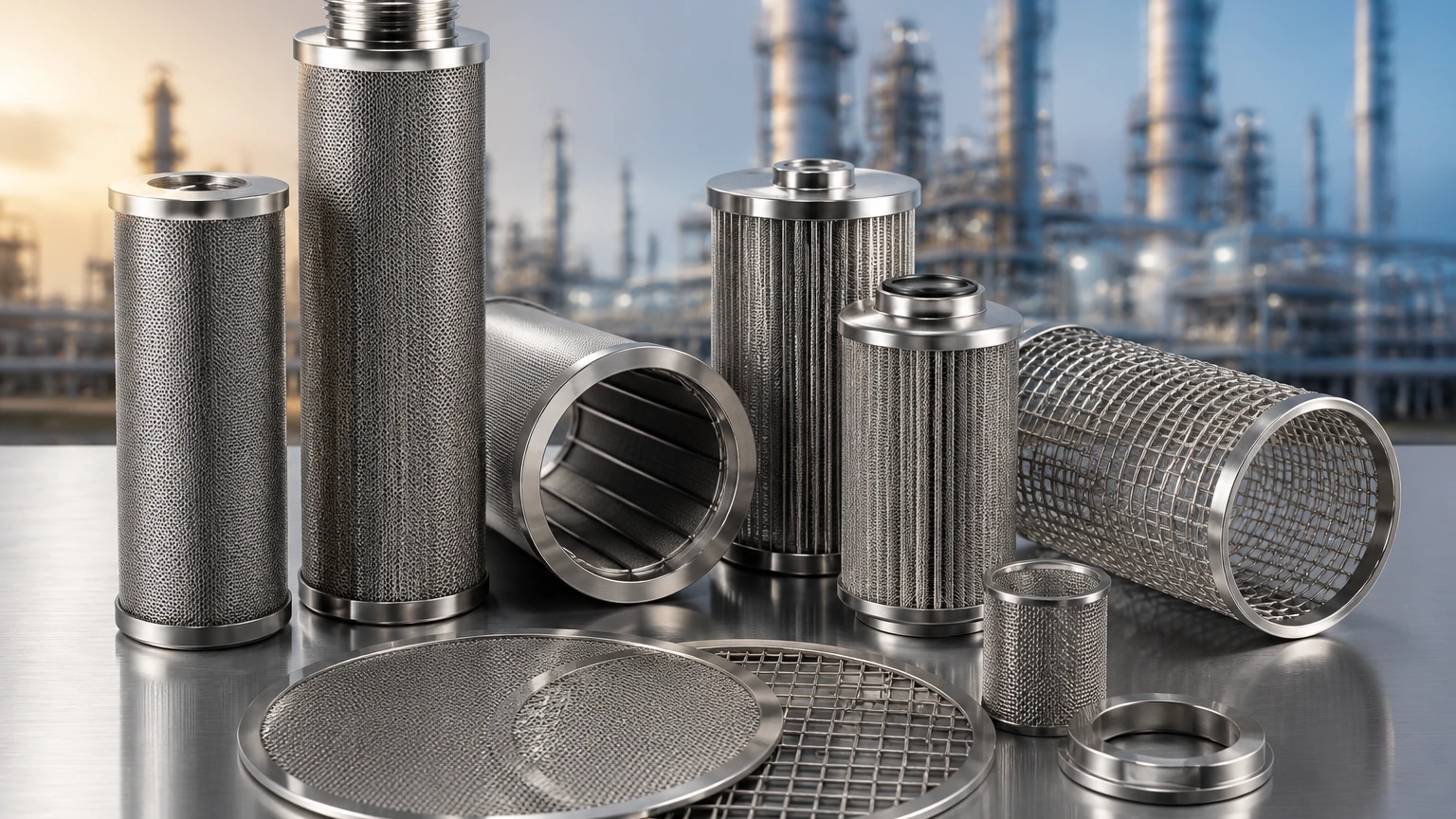
Wire Mesh Filters
Stainless steel wire mesh is a versatile medium that can be woven into various patterns, such as plain weave, twill weave, or Dutch weave. Dutch weave patterns are particularly effective for refinery products filtration because they provide a dense, multi-layered structure that offers high mechanical strength and precise micron ratings. These are often used in basket strainers and as the primary media in high-flow filtration vessels.
Sintered Metal Filter Cartridges
Sintering involves bonding multiple layers of wire mesh or metal fibers together using heat and pressure without melting the material. This creates a porous, rigid structure with exceptional stability. Sintered cartridges are ideal for high-pressure hydraulic systems and gas filtration where the risk of media migration (the shedding of filter fibers into the fluid stream) must be eliminated.
Pleated Filter Elements
To increase the effective filtration area within a limited footprint, stainless steel mesh is often pleated. Pleating allows for a much larger surface area compared to a standard cylindrical element, which translates to a lower initial pressure drop and a longer service life between cleaning cycles. This is a critical design feature for refineries looking to optimize space and reduce maintenance frequency.
Evaluating Filtration Performance and Efficiency
When sourcing components for refinery products filtration, technical professionals must look beyond simple micron ratings. A comprehensive evaluation includes several key metrics:
1. Filtration Accuracy (Micron Rating): This defines the size of the particles the filter is designed to remove. It is important to distinguish between "nominal" ratings (an approximate value) and "absolute" ratings (the size at which 99.9% of particles are retained). For critical refinery stages, absolute-rated stainless steel mesh is usually required.
2. Permeability and Flow Rate: The filter must allow the required volume of fluid to pass through at a specific pressure. Engineering teams must calculate the flux rate to ensure the filter does not become a bottleneck in the production line.
3. Dirt-Holding Capacity: This refers to the total amount of contaminant the filter can collect before the pressure drop reaches a critical limit. A higher dirt-holding capacity reduces the frequency of backwashing or element replacement.
4. Mechanical Strength: The filter must be able to withstand "collapse pressure"—the maximum differential pressure the element can endure before structural failure occurs. This is especially important in high-viscosity lube oil filtration or heavy fuel oil processing.
Maintenance, Cleaning, and the Total Cost of Ownership
One of the primary advantages of using stainless steel components in refinery products filtration is the ability to reuse the media. In a large-scale industrial facility, the cost of disposing of contaminated single-use filters can be substantial, both in terms of procurement and environmental waste management.
Cleaning Methods
* Backpulsing/Backwashing: This involves reversing the flow of the fluid to dislodge particles trapped on the surface of the mesh. It is often automated within the filtration system to allow for continuous operation.
* Ultrasonic Cleaning: For deeply embedded contaminants in sintered media, ultrasonic baths use high-frequency sound waves to create cavitation bubbles that strip away debris without damaging the metal structure.
* Chemical Cleaning: Using specific solvents or acids to dissolve organic or inorganic deposits. This must be done with care to ensure the cleaning agent is compatible with the filter alloy.
By investing in high-quality, cleanable stainless steel filters, refinery operators can achieve a lower total cost of ownership. While the initial capital expenditure for metal filters is higher than for disposables, the longevity and reduced downtime provide a significant return on investment over several years of service.
Custom Engineering for Specific Refinery Applications
Standard off-the-shelf filtration products often fall short of the specific requirements of a modern refinery. Customization is frequently necessary to accommodate unique flow rates, specific housing dimensions, or unusual chemical compositions.
Professional manufacturers work closely with refinery engineers to develop bespoke solutions. This process involves selecting the optimal mesh weave, determining the necessary reinforcement layers (such as perforated metal cores), and designing custom end-fittings to ensure a leak-proof seal within the existing filter housing. Whether it is a custom-sized wire mesh cone for a startup strainer or a high-capacity sintered cartridge for a chemical reactor, precision engineering ensures that the filtration component performs exactly as required by the process specifications.
For those seeking to optimize their industrial filtration systems, it is essential to partner with a manufacturer that understands the technical nuances of metal filtration. You can Review product options and application support on the Main Page to see how custom stainless steel solutions are applied across various industrial sectors.
Conclusion
Refinery products filtration is a cornerstone of modern industrial processing. By removing contaminants and protecting downstream assets, high-performance filtration systems ensure the safety, efficiency, and profitability of refinery operations. Stainless steel wire mesh and filter cartridges offer the durability, thermal stability, and precision required to handle the most challenging hydrocarbon streams.
When selecting filtration components, engineers should prioritize material quality, structural integrity, and the ability to clean and reuse the media. Through careful selection and custom engineering, refineries can achieve superior product purity and operational reliability, meeting the rigorous demands of the global energy market.
