


Coalescer Filter Element
In industrial fluid processing, the presence of entrained water in hydrocarbons or oil aerosols in compressed gas streams can lead to catastrophic equipment failure, catalyst poisoning, and compromised product quality. A coalescer filter element is a precision-engineered component designed to solve these challenges by separating two immiscible phases—typically water from fuel or oil from air—through the physical process of coalescence. Unlike standard particulate filters that simply trap solids, a coalescer must manage fluid dynamics to merge microscopic droplets into larger masses that can be easily removed by gravity.
For engineers and procurement specialists, selecting the correct coalescer filter element requires an understanding of media science, fluid chemistry, and structural integrity. As a manufacturer specializing in custom stainless steel filtration solutions, Kaifil provides the technical foundation necessary for high-performance separation in demanding environments. You can explore our full range of engineering capabilities on our Main Page.
The Engineering Principles of Coalescence
The operation of a coalescer filter element is a multi-stage process that goes beyond simple mechanical sieving. It relies on the interaction between the dispersed phase (the droplets to be removed) and the filter media. The process generally follows three distinct phases:
1. Interception and Attachment
As the contaminated fluid passes through the depth of the filter media, the small droplets (often sub-micron in size) come into contact with the fibers. This occurs through various mechanisms, including Brownian motion for very small particles, inertial impaction for larger droplets, and direct interception. The media must be formulated to have a high affinity for the dispersed phase to ensure these droplets "stick" to the fiber surface.
2. Coalescence (Growth)
Once attached, the droplets travel along the length of the fibers, driven by the fluid flow. As they move, they collide with other captured droplets, merging to form larger drops. This growth is the core of the "coalescence" process. The media's pore structure must be carefully graduated—tighter on the upstream side to capture small droplets and more open on the downstream side to allow the enlarged drops to pass through without re-atomizing.
3. Release and Separation
When the droplets reach a sufficient size, the drag forces of the flowing fluid overcome the adhesive forces holding them to the fibers. The large droplets are released from the downstream side of the element. Due to the difference in density between the two fluids (e.g., water being heavier than diesel), the large droplets settle into a collection sump or rise to the top, depending on the specific gravity of the phases involved.
Media Composition and Structural Design
The performance of a coalescer filter element is dictated by its material composition. Industrial applications often demand a combination of high separation efficiency and chemical resistance.
Fibrous Media
Most high-efficiency coalescers utilize borosilicate glass microfibers or synthetic polymers. These materials offer high surface area-to-volume ratios, which are essential for maximizing droplet contact. In many liquid-liquid applications, the media is treated with specialized coatings to adjust the surface tension, making the fibers either hydrophobic (water-repelling) or hydrophilic (water-attracting) depending on the objective.
Stainless Steel Support and Reinforcement
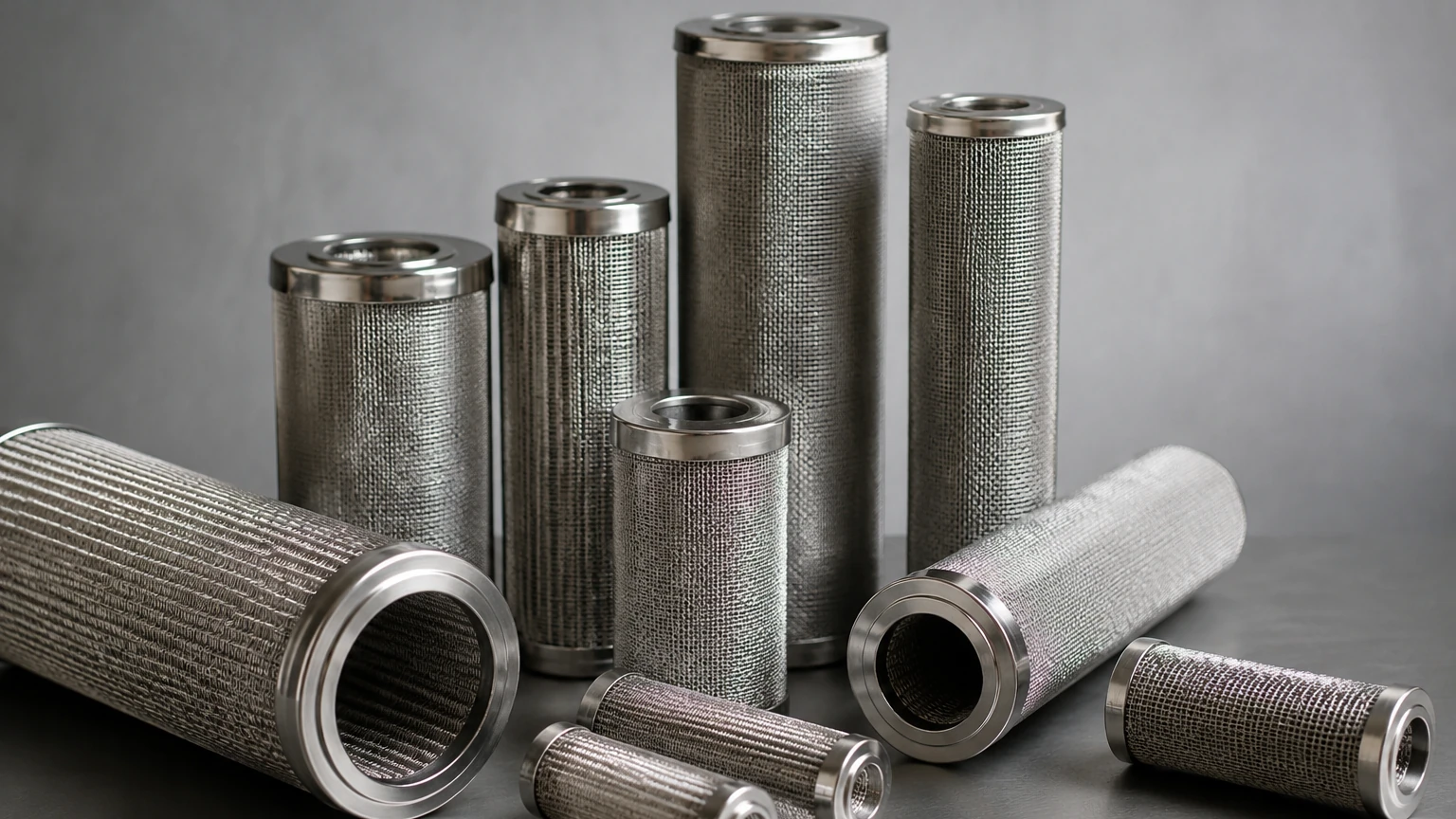
While the fibrous media performs the separation, the structural integrity of the element often relies on metal components. In high-pressure hydraulic systems or corrosive chemical processing, stainless steel inner and outer cages are used to prevent media migration and element collapse. Kaifil specializes in providing these precision metal components, ensuring that the coalescer can withstand high differential pressures without compromising the delicate fiber matrix.
Pleated vs. Depth Configurations
Coalescers are available in pleated designs, which maximize surface area for high-flow applications, or depth-style cylindrical elements, which provide a longer residence time for difficult-to-separate emulsions. The choice depends heavily on the fluid's viscosity and the concentration of the dispersed phase.
Key Performance Indicators (KPIs) for Evaluation
When evaluating a coalescer filter element for an industrial system, engineers must look beyond the initial purchase price and focus on technical metrics that impact the total cost of ownership.
* Separation Efficiency: This is usually expressed in parts per million (ppm). For example, a high-quality jet fuel coalescer might be required to reduce water content from 5,000 ppm down to less than 15 ppm.
* Differential Pressure (Delta P): This is the pressure drop across the filter. A lower clean pressure drop allows for lower energy consumption by pumps or compressors. However, as the element becomes saturated with droplets, the pressure drop will naturally increase.
* Beta Ratio and Micron Rating: While coalescers focus on liquid separation, they also act as particulate filters. A dual-rated element ensures that solid contaminants do not plug the coalescing media prematurely.
* Saturation Point: This is the point at which the media is fully loaded with the dispersed phase. A well-designed element maintains a stable pressure drop even when fully saturated, provided the flow rate remains within design limits.
Selection Criteria for Industrial Applications
To ensure the longevity and effectiveness of a coalescer filter element, several application-specific factors must be confirmed during the design phase:
Fluid Compatibility
The chemical nature of both the continuous and dispersed phases must be compatible with the media, binders, and end-cap adhesives. For instance, certain additives in lubricating oils can "blind" a coalescer, significantly reducing its lifespan. In such cases, stainless steel or specialized synthetic media may be required.
Surface Tension and Interfacial Tension (IFT)
Interfacial tension is a measure of the force between the two immiscible liquids. If the IFT is very low (below 15-20 dynes/cm), the droplets are extremely stable and difficult to coalesce. Standard coalescers may fail in low-IFT environments, requiring specialized media treatments or longer residence times.
Flow Velocity
Coalescence is a velocity-sensitive process. If the fluid moves too quickly through the media, the droplets may be sheared back into smaller sizes before they can settle, a phenomenon known as "carryover." Conversely, if the flow is too slow, the droplets may not collide frequently enough to grow. Engineers must size the housing to ensure the "face velocity" remains within the manufacturer's recommended range.
Common Risks and Troubleshooting
Failure to properly maintain or select a coalescer filter element can lead to several operational issues:
1. Surfactant Poisoning: Surface-active agents (surfactants) can coat the filter fibers, neutralizing their ability to attract or repel water. This is a common issue in fuel systems where detergents or anti-icing additives are present.
2. Particulate Plugging: If the fluid contains a high load of solid debris, the coalescer media will clog before it can perform its separation function. In these scenarios, a dedicated pre-filter (such as a stainless steel wire mesh filter) should be installed upstream to protect the coalescer.
3. Media Migration: In low-quality elements, the high velocity of the fluid can strip fibers from the media, downstream into the clean fluid. Using elements with robust stainless steel support structures, like those designed by Kaifil, mitigates this risk.
Replacement Cycles and Maintenance
Determining when to replace a coalescer filter element is critical for protecting downstream equipment. Unlike particulate filters, which are changed based solely on differential pressure, coalescers may need replacement if the downstream fluid quality degrades, even if the pressure drop is acceptable.
In most industrial settings, elements are replaced when the differential pressure reaches a pre-set limit (typically 15-25 psi) or after a specific time interval (e.g., 12 months) to prevent media degradation. Regular sampling of the downstream fluid is the most reliable way to verify that the element is still performing its primary separation task.
Customization and OEM Solutions
Every industrial process has unique variables, from the specific gravity of the fluids to the spatial constraints of the factory floor. Off-the-shelf coalescer elements often fail to meet the exact requirements of specialized machinery. This is where custom manufacturing becomes essential.
Kaifil works closely with engineering teams to develop bespoke filtration components. Whether you require a specific stainless steel grade for high-temperature gas coalescence or a custom-sized cartridge for a legacy hydraulic system, our technical expertise ensures the final product meets rigorous performance standards. By controlling the manufacturing process—from material selection to the final assembly of the filter cartridge—we provide solutions that optimize filtration efficiency and durability.
For more information on how we support industrial filtration through custom engineering and high-quality manufacturing, visit our Main Page to review our product options and application support. Understanding the nuances of the coalescer filter element is the first step toward achieving a cleaner, more efficient, and more reliable industrial operation.
