


Filter 25 Micron
In industrial filtration, the selection of a specific micron rating is a decision that directly impacts process efficiency, equipment longevity, and product purity. A filter 25 micron rating occupies a strategic middle ground in the filtration spectrum. It is fine enough to remove visible particulates and protect sensitive downstream components, yet coarse enough to maintain high flow rates without the excessive pressure drops associated with sub-10-micron filtration. For engineers and procurement specialists, understanding the technical nuances of 25-micron filtration is essential for optimizing industrial systems.
At its simplest, a 25-micron filter is designed to capture particles that are 25 micrometers (0.025 millimeters or approximately 0.000984 inches) in diameter. To put this into perspective, the average human hair is roughly 70 microns in diameter, while the lower limit of human visibility is approximately 40 microns. Therefore, a 25-micron filter is performing "invisible" work, removing contaminants that cannot be seen but can cause significant mechanical wear or chemical interference.
Understanding 25-Micron Filtration Efficiency: Nominal vs. Absolute
One of the most critical distinctions an engineer must make when specifying a filter 25 micron component is the difference between nominal and absolute ratings. This distinction determines how the filter will perform under actual operating conditions.
Nominal Ratings
Nominal filtration ratings are an industry-standardized but somewhat loose classification. A nominal 25-micron rating typically means the filter can trap a large percentage (often between 60% and 90%) of particles that are 25 microns or larger. However, nominal filters may allow some particles of the rated size to pass through due to the irregular geometry of the filter media or the presence of "straight-through" paths. These are often used in non-critical applications or as pre-filters to extend the life of more expensive secondary filters.
Absolute Ratings
An absolute 25-micron rating implies a much higher efficiency, typically 98.7% or higher (often defined by a Beta Ratio of $\beta_x \geq 75$). In an absolute-rated stainless steel filter, the pore structure is precisely controlled—often through specialized weaving or sintering processes—to ensure that no particle larger than 25 microns can pass through the media under specified test conditions. For critical hydraulic systems or pharmaceutical processing, absolute ratings are the standard requirement to ensure system integrity.
For technical teams evaluating these options, the Main Page of the Kaifil website provides comprehensive data on how different manufacturing techniques achieve these specific efficiency levels.
Material Science: Why Stainless Steel for 25-Micron Applications?
While 25-micron filters can be made from polymers, cellulose, or glass fibers, stainless steel remains the material of choice for demanding industrial environments. The choice of material affects not only the filtration accuracy but also the total cost of ownership and the filter's compatibility with the process fluid.
Corrosion and Chemical Resistance
Stainless steel 304 and 316L are the primary alloys used in precision filtration. 316L, in particular, contains molybdenum, which provides superior resistance to chlorides and acidic environments. In chemical processing or marine applications, a 25-micron stainless steel filter maintains its structural integrity where synthetic fibers might degrade or leach contaminants into the fluid stream.
Thermal Stability
Industrial processes often operate at extreme temperatures. Polymer-based filters may soften or lose their pore structure at temperatures exceeding 100°C. Stainless steel filters, however, can operate effectively at temperatures ranging from cryogenic levels up to 500°C or higher, depending on the seal materials and housing design. This makes them indispensable for steam filtration and high-temperature oil systems.
Mechanical Strength and High Differential Pressure
A filter 25 micron component must withstand the "Delta P" (differential pressure) that occurs as the filter becomes loaded with contaminants. Stainless steel wire mesh and sintered structures offer high collapse strength, preventing the media from rupturing or bypassing when the pressure spikes. This durability allows for high-pressure cleaning cycles, such as backpulsing or ultrasonic cleaning, which are not possible with disposable media.
Structural Configurations: Mesh, Sintered, and Pleated
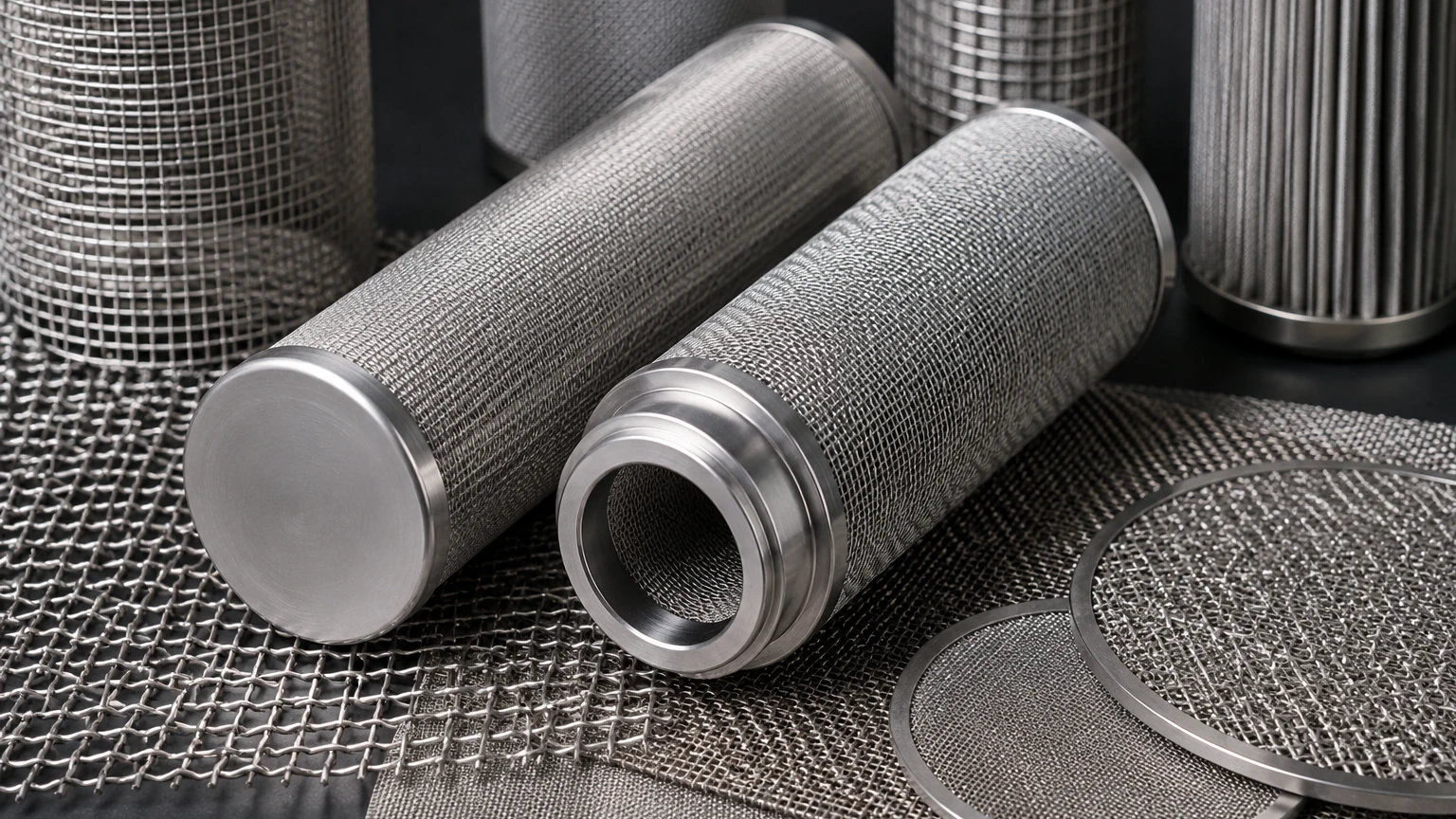
The physical architecture of the filter media determines how a 25-micron rating is achieved and how the filter performs over time. There are three primary structures used in professional-grade metal filtration.
Woven Wire Mesh
For a 25-micron rating, simple plain weaves are rarely sufficient. Instead, manufacturers utilize specialized weaves such as Plain Dutch Weave (PDW) or Twilled Dutch Weave (TDW). These weaves use a higher density of smaller diameter wires in the shute (crosswise) direction, creating a tortuous path that provides precise 25-micron surface filtration. Wire mesh is ideal for applications where easy surface cleaning is required.
Sintered Metal Media
Sintered filters are created by bonding multiple layers of wire mesh or metal fibers together using heat and pressure without melting the base metal. A 25-micron sintered filter often incorporates a fine filtration layer protected by coarser support layers. This creates a rigid, porous structure that offers excellent depth filtration, allowing the filter to trap particles within the media rather than just on the surface.
Pleated Filter Cartridges
When high flow rates are required within a compact housing, pleating is the preferred solution. By folding the 25-micron stainless steel mesh into a series of pleats, the effective filtration surface area is significantly increased—often by a factor of three to five compared to a standard cylindrical filter. This increased area results in a lower initial pressure drop and a much higher dirt-holding capacity, extending the time between maintenance intervals.
Engineering Considerations: Pressure Drop and Flow Dynamics
When integrating a filter 25 micron into a system, engineers must calculate the impact on fluid dynamics. The relationship between flow rate, viscosity, and pressure drop is central to filter sizing.
1. Clean Pressure Drop: Every filter creates a baseline resistance to flow. For a 25-micron metal filter, this is influenced by the open area of the mesh. A Dutch weave may have a lower open area percentage than a square mesh, requiring a larger filter housing to maintain the desired flow rate without excessive initial pressure loss.
2. Fluid Viscosity: High-viscosity fluids (such as heavy oils or polymers) require more force to pass through 25-micron pores. If the fluid is highly viscous, the filter must be sized larger to prevent the system from reaching its bypass pressure too quickly.
3. Particle Loading: As particles accumulate, the effective pore size decreases, and the pressure drop increases. Engineers must determine the "terminal pressure drop"—the point at which the filter must be cleaned or replaced to prevent system failure or media damage.
Industrial Application Scenarios
The 25-micron threshold is ubiquitous across several key industries due to its versatility.
Hydraulic and Lubrication Systems
In hydraulic circuits, 25-micron filtration is often used in the return line or as a suction strainer for large pumps. It effectively removes wear particles (metal shavings, silica) that can score cylinder walls or clog control valves. By maintaining fluid cleanliness at the 25-micron level, companies can significantly extend the Mean Time Between Failures (MTBF) for expensive hydraulic components.
Food and Beverage Processing
For the clarification of syrups, oils, and juices, a 25-micron filter provides the necessary clarity without stripping away essential flavors or nutrients that might be caught by tighter 1-micron or 5-micron filters. Stainless steel construction ensures compliance with food safety regulations and allows for Clean-in-Place (CIP) sterilization.
Chemical and Petrochemical
In the chemical industry, 25-micron filters are used to protect spray nozzles from clogging and to recover expensive catalysts from process streams. Their ability to withstand aggressive solvents and high pressures makes them a staple in refinery operations.
Maintenance, Cleaning, and Total Cost of Ownership
One of the primary advantages of a stainless steel filter 25 micron over disposable alternatives is reusability. While the initial capital expenditure (CAPEX) for a stainless steel cartridge is higher than a polypropylene melt-blown filter, the total cost of ownership (TCO) is often lower due to the elimination of recurring replacement costs and disposal fees.
Cleaning Methods
* Backwashing: Reversing the flow of the fluid to dislodge particles from the surface of the mesh.
* Ultrasonic Cleaning: Using high-frequency sound waves in a cleaning solvent to remove deeply embedded particulates from sintered or pleated media.
* Chemical Cleaning: Using specialized surfactants or acids to dissolve organic or mineral deposits without damaging the stainless steel substrate.
Replacement Cycles
Even with regular cleaning, metal filters eventually reach a point where the pressure drop can no longer be restored to baseline levels. This is usually due to "permanent fouling" or mechanical fatigue. However, a well-maintained 25-micron stainless steel filter can last for several years in applications where disposable filters would need to be changed weekly.
Conclusion: Selecting the Right 25-Micron Solution
Selecting a filter 25 micron component requires a balance of material science, fluid dynamics, and operational requirements. Whether the goal is to protect a high-pressure pump, clarify a food product, or ensure the purity of a chemical batch, the choice of filter structure and material is paramount. By focusing on stainless steel solutions, industrial operators gain the benefits of durability, cleanability, and precise performance.
For engineers looking to customize these filtration components to specific housing dimensions or flow requirements, consulting with a manufacturer that specializes in OEM stainless steel solutions is the most effective path forward. To explore the full range of customization options and technical specifications for industrial-grade filtration, visit the Main Page of Kaifil’s technical resource center. Understanding these variables ensures that the filtration system remains an asset to the production process rather than a bottleneck.
