


Sintered Glass Funnel
In laboratory and pilot-scale chemical processing, the sintered glass funnel is a fundamental tool for solid-liquid separation. Often referred to as a fritted glass funnel or a Büchner funnel with a permanent filter, this component eliminates the need for disposable filter papers, which can introduce contaminants or fail under high-vacuum conditions. For engineers and technical professionals, understanding the material properties, porosity grades, and operational limits of sintered glass is essential before scaling up to industrial filtration solutions.
While the sintered glass funnel is a staple in analytical chemistry and small-batch pharmaceutical development, its performance characteristics often serve as the baseline for designing larger, more robust industrial systems. As production requirements move from the laboratory bench to the factory floor, the limitations of glass—such as fragility and limited pressure resistance—necessitate a transition to more durable materials. For those exploring high-performance industrial alternatives, visiting the Main Page of a specialist manufacturer like Kaifil provides insight into how these filtration principles are applied at scale using stainless steel and other precision alloys.
Technical Composition and Manufacturing
The sintered glass funnel is typically constructed from high-quality borosilicate glass 3.3, known for its excellent thermal shock resistance and broad chemical compatibility. The "sintered" portion of the funnel is the porous disc (the frit) fused into the body of the funnel.
The Sintering Process
Sintering is a thermal process where glass powder or granules are heated to a temperature just below their melting point. At this temperature, the surfaces of the glass particles soften and fuse together at their contact points. This creates a rigid, porous structure with a labyrinth of interconnected channels. The size of the glass granules used determines the final porosity of the disc. Finer granules result in smaller pores and higher filtration accuracy, while coarser granules allow for higher flow rates.
Structural Integrity
Unlike a standard Büchner funnel that requires a separate filter paper, the sintered disc is an integral part of the glass assembly. This design ensures that the entire filtration surface is chemically inert and capable of withstanding aggressive solvents that would otherwise degrade cellulose-based filter media. However, the fusion point between the disc and the funnel wall is a common area of mechanical stress, requiring careful handling during temperature changes or vacuum applications.
Porosity Grades and Selection Criteria
One of the most critical decisions for an engineer is selecting the correct porosity grade. Sintered glass funnels are categorized by the average pore size of the fritted disc. Different international standards (such as ISO 4793 or ASTM) define these grades, but they generally follow a scale from P0 (coarsest) to P5 (finest).
| Grade (ISO) | Pore Size (µm) | Typical Application |
| :— | :— | :— |
| P0 (G0) | 160 – 250 | Coarse filtration, gas distribution, support for other media |
| P1 (G1) | 100 – 160 | Coarse precipitates, gas washing bottles |
| P2 (G2) | 40 – 100 | Medium precipitates, crystalline solids |
| P3 (G3) | 16 – 40 | Fine precipitates, analytical work, mercury filtration |
| P4 (G4) | 10 – 16 | Very fine precipitates, analytical chemistry |
| P5 (G5) | 1.1 – 1.6 | Bacteria removal, ultra-fine clarification |
Engineering Considerations for Grade Selection
Selecting a grade is a balance between filtration efficiency and flow rate (flux). A P5 funnel provides exceptional clarity but results in a significant pressure drop ($ΔP$). Conversely, a P0 funnel offers high throughput but may allow smaller particles to pass through (bleed-through). Engineers must also consider the "cake" formation; as solids accumulate on the surface of the sintered glass funnel, the cake itself begins to act as a secondary filter medium, potentially increasing filtration efficiency but decreasing the flow rate over time.
Operating Principles and Vacuum Filtration
Sintered glass funnels are primarily used in vacuum filtration setups. The funnel is typically fitted into a filtering flask (Kitasato flask) using a rubber bung or a ground glass joint. A vacuum pump is then used to create a pressure differential that pulls the liquid through the porous disc.
Pressure and Thermal Limits
Because glass is a brittle material, it has strict operational boundaries:
1. Pressure Differential: Most sintered glass funnels are designed for a maximum pressure differential of 1 bar (14.5 psi). Exceeding this can lead to implosion of the flask or cracking of the sintered disc.
2. Thermal Shock: While borosilicate glass handles heat well, rapid temperature changes (exceeding 100°C/minute) can cause thermal stress. If a funnel is heated to sterilize it or to facilitate the filtration of a hot saturated solution, it must be cooled slowly.
3. Mechanical Stress: The sintered disc should never be subjected to sudden mechanical impacts or high-pressure back-pulsing, which are common cleaning techniques in industrial metal filtration but can shatter glass frits.
Chemical Compatibility and Maintenance
One of the primary reasons for choosing a sintered glass funnel is its near-universal chemical resistance. Borosilicate glass is resistant to water, neutral and acid solutions, concentrated acids and their mixtures, as well as to chlorine, bromine, iodine, and organic substances.
Limitations
There are notable exceptions where glass should not be used:
* Hydrofluoric Acid (HF): HF reacts with silica, rapidly dissolving the glass structure.
* Hot Concentrated Phosphoric Acid: This will also attack the glass surface over time.
* Strong Alkalis: Concentrated, hot alkaline solutions (like NaOH or KOH) will etch the glass, widening the pores and eventually compromising the structural integrity of the frit.
Cleaning Procedures
Maintaining the porosity of a sintered glass funnel is vital for its longevity. If the pores become clogged (blinded), the filtration rate will drop significantly. Standard cleaning methods include:
* Chemical Dissolution: Using a solvent or acid that dissolves the precipitate without attacking the glass. For example, hydrochloric acid can remove carbonate scales, while aqua regia may be needed for certain metal residues.
* Ultrasonic Cleaning: Placing the funnel in an ultrasonic bath can help dislodge trapped particles from the labyrinthine structure. However, this must be done carefully to avoid stress fractures.
* Back-washing: Running clean solvent in the reverse direction under low pressure can help clear the pores, though this is less effective in glass than in metal filters.
Transitioning from Lab to Industry: Glass vs. Stainless Steel
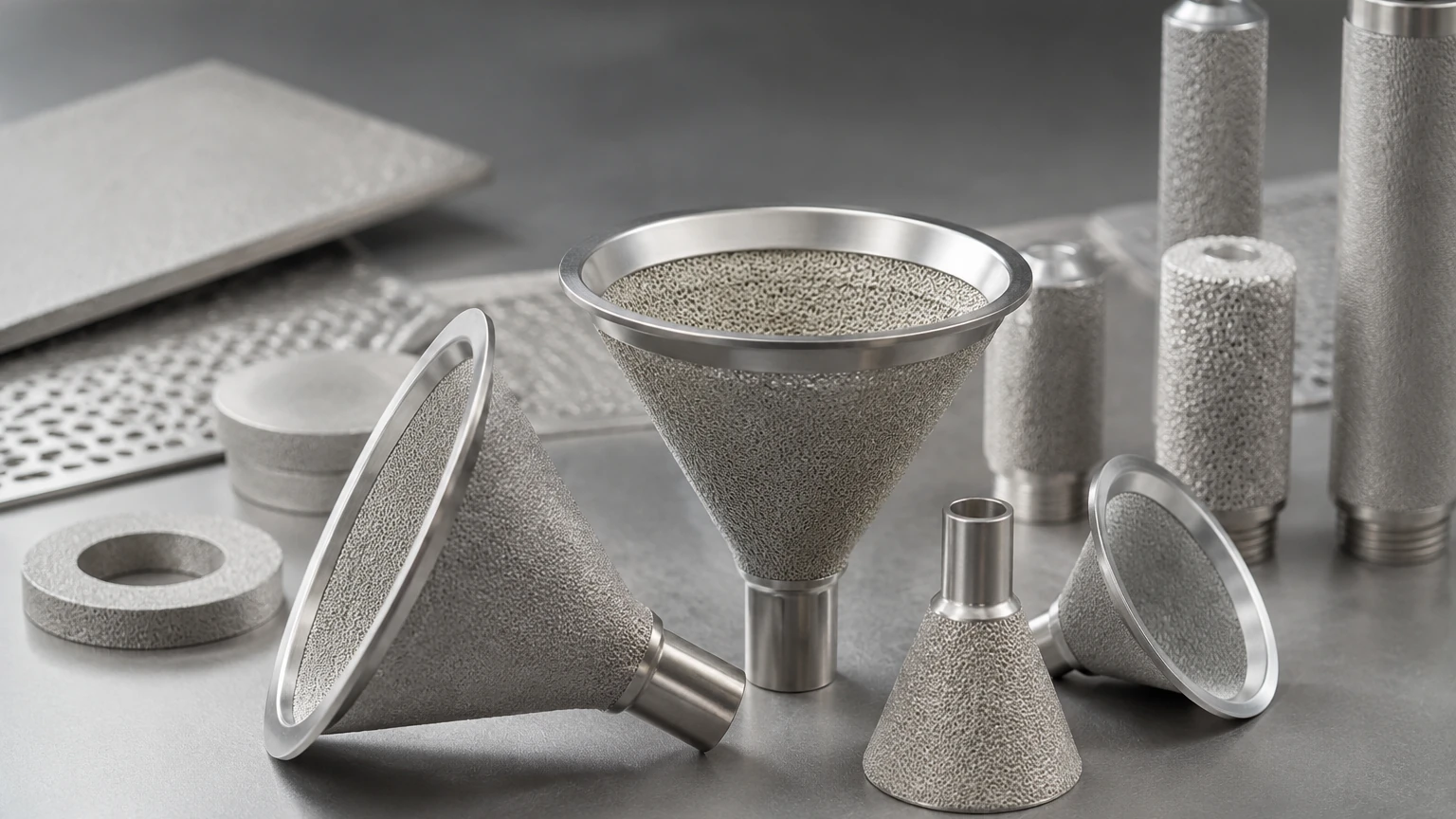
While the sintered glass funnel is an excellent tool for research and development, it often reaches its limit in pilot plant or full-scale production environments. This is where the engineering principles of sintering are applied to metals, specifically stainless steel.
Why Scale Up to Metal?
Industrial processes demand higher durability and larger surface areas than glass can provide. Stainless steel sintered filters, which you can explore on the Main Page of industrial filtration providers, offer several advantages over glass in a B2B context:
1. Mechanical Strength: Metal filters can withstand significantly higher pressure differentials and mechanical shocks. This allows for faster filtration cycles and the use of high-pressure back-pulsing for automated cleaning.
2. Scalability: While glass funnels are limited in size due to weight and fragility, stainless steel filter cartridges and plates can be manufactured in large dimensions and manifolded together for high-volume processing.
3. Weldability and Integration: Metal sintered components can be welded directly into piping systems or pressure vessels, ensuring a leak-proof, sanitary seal that is difficult to achieve with glass joints in an industrial setting.
4. Temperature Extremes: Sintered metal can operate at much higher temperatures than borosilicate glass, making it suitable for hot gas filtration and high-temperature chemical synthesis.
Comparing Performance
In terms of filtration accuracy, sintered stainless steel can match the fine micron ratings of a P5 sintered glass funnel. However, the metal version provides a more uniform pore distribution and better resistance to the "blinding" that often plagues glass frits in heavy-duty applications. For engineers designing a production line, the total cost of ownership (TCO) of a metal system is often lower due to reduced breakage and longer replacement cycles.
Summary of Selection Requirements
Before purchasing a sintered glass funnel or moving toward an industrial sintered metal solution, technical teams should confirm the following information:
* Particle Size Distribution: What is the smallest particle that must be retained? This dictates the required porosity grade.
* Chemical Composition: Are there any traces of HF or strong alkalis that could degrade the filter medium?
* Operating Temperature: Will the process involve rapid heating or cooling cycles?
* Flow Rate Requirements: What is the target volume per hour? This determines the necessary filtration surface area.
* Cleaning Protocol: Is the precipitate valuable (requiring easy recovery) or a waste product? This influences whether a smooth surface or a deep labyrinthine structure is preferred.
In conclusion, the sintered glass funnel remains an indispensable tool for precise, small-scale filtration where chemical purity is paramount. However, for industrial applications requiring robustness, high pressure, and longevity, the same sintering technology applied to stainless steel is the professional standard. By understanding the fundamental mechanics of these porous structures, engineers can ensure efficient separation processes from the initial lab test through to global production.
