


Condensation Gas
In industrial process engineering, managing the transition between gaseous and liquid phases is a critical challenge. The term "condensation gas" refers to gas streams that are at or near their dew point, where a reduction in temperature or an increase in pressure leads to the formation of liquid droplets. This phenomenon is prevalent in chemical processing, power generation, and compressed air systems. Without effective filtration and separation strategies, the presence of condensate in a gas stream can lead to equipment failure, reduced thermal efficiency, and product contamination.
For engineers and procurement teams, understanding the behavior of condensation gas is essential for selecting the correct filtration hardware. Stainless steel filtration solutions, such as those produced by Kaifil, play a pivotal role in protecting downstream components by removing entrained liquids and solid particulates from these volatile streams.
The Mechanics of Condensation in Industrial Gas Streams
Condensation occurs when the partial pressure of a vapor in a gas mixture exceeds its saturated vapor pressure. In a practical industrial setting, this is typically triggered by two primary factors: cooling and compression.
Temperature-Induced Condensation
As a gas travels through piping, it may lose heat to the environment. If the temperature drops below the dew point, the gas can no longer hold the same amount of moisture or chemical vapor in a gaseous state. This results in the formation of a fine mist or aerosol. In high-velocity streams, these droplets can collide and coalesce into larger slugs of liquid, which pose a significant risk of water hammer or mechanical impact damage to turbines and compressors.
Pressure-Induced Condensation
According to the laws of thermodynamics, increasing the pressure of a gas while keeping temperature constant will eventually lead to condensation if the gas is not superheated. This is a common occurrence in multi-stage compression cycles. Between stages, gas is often cooled to increase density and efficiency, which almost inevitably leads to the formation of "condensation gas" that must be filtered before entering the next stage of compression.
Risks Associated with Unmanaged Condensate
Ignoring the presence of liquid in a gas stream is a recipe for operational downtime. The risks are multifaceted, affecting both the physical integrity of the system and the quality of the output.
1. Corrosion and Erosion: Many industrial gases become highly corrosive when they transition to a liquid state. For example, sulfur-rich flue gases or CO2-heavy streams can form acids when they condense. Furthermore, high-velocity liquid droplets can erode valve seats and pipe bends through a process known as liquid droplet erosion (LDE).
2. Instrument Inaccuracy: Sensors, flow meters, and analytical instruments are often designed to work with single-phase fluids. The presence of condensation gas can cause erratic readings, leading to poor process control.
3. Microbial Growth: In food, beverage, and pharmaceutical applications, moisture in gas lines (such as nitrogen or CO2) provides a breeding ground for bacteria and mold, compromising the sterility of the process.
4. Reduced Heat Transfer: In heat exchangers, a film of condensate on the tubes acts as an insulator, significantly reducing the efficiency of heat transfer and increasing energy consumption.
Role of Stainless Steel Filtration in Managing Condensation Gas
To mitigate these risks, engineers employ various filtration and separation technologies. Stainless steel is the material of choice for these applications due to its mechanical strength, thermal stability, and resistance to corrosion.
Coalescing Filters
Coalescing is the most effective method for removing liquid aerosols from a gas stream. These filters use a multi-layered media—often a combination of fine wire mesh and sintered fibers—to capture sub-micron droplets. As the gas passes through the media, the droplets are forced to follow a tortuous path, causing them to collide and grow into larger drops. Gravity then pulls these larger drops to the bottom of the filter housing, where they can be drained.
Demisters and Mist Eliminators
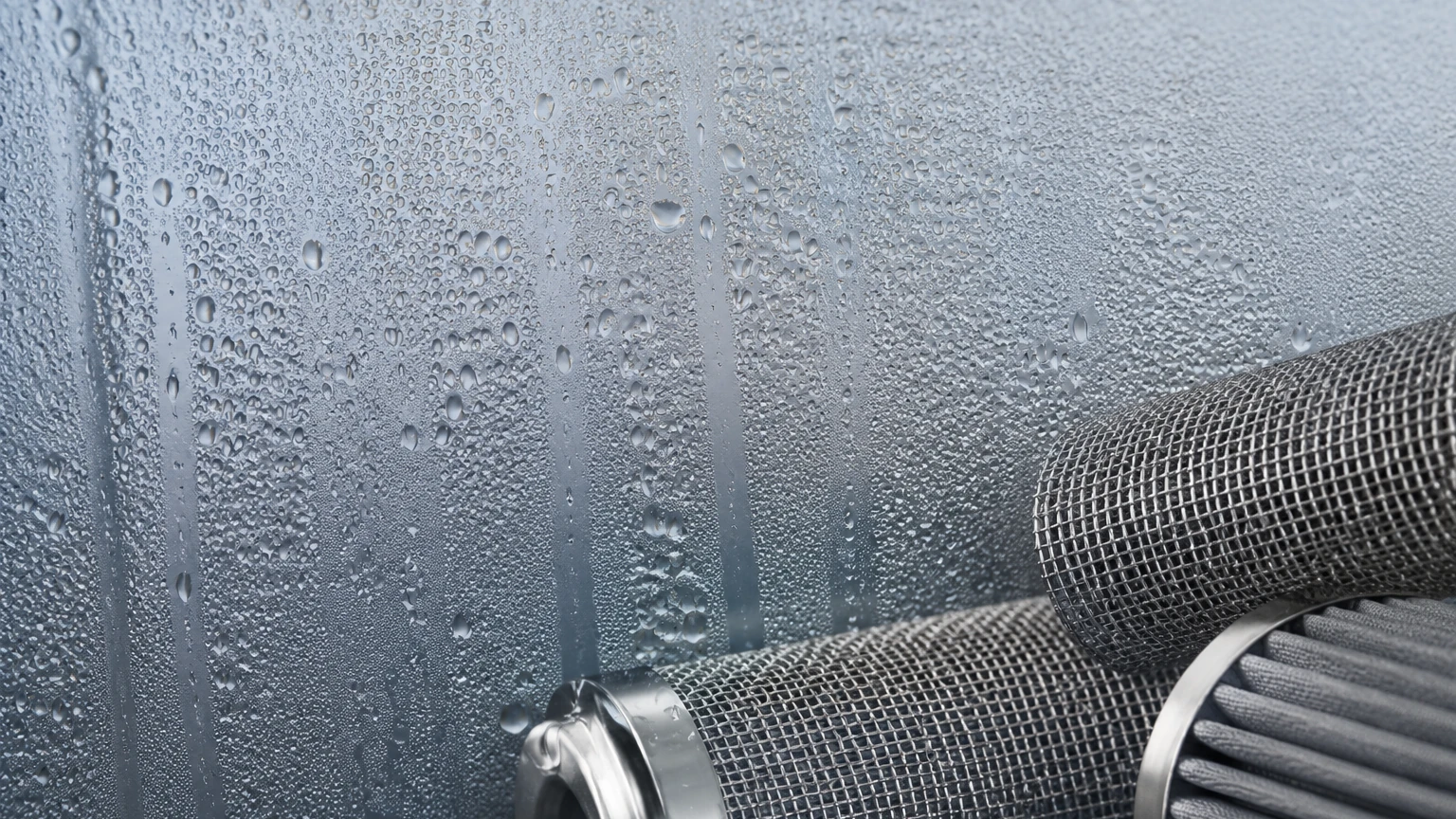
For larger droplets, stainless steel wire mesh demisters are used. These consist of knitted wire mesh pads that provide a high surface area for impingement. As the condensation gas flows through the mesh, the liquid droplets strike the wires, adhere, and eventually fall away. These are particularly useful in knock-out drums and separator vessels.
Sintered Metal Filters
In high-pressure or high-temperature environments where traditional mesh might deform, sintered metal filter cartridges provide the necessary structural integrity. These components can withstand the aggressive cleaning cycles required in heavy industrial applications while maintaining precise filtration ratings.
Engineering Selection Criteria for Condensation Gas Filters
When specifying a filter for a system prone to condensation, several technical parameters must be evaluated to ensure long-term performance and a low total cost of ownership.
Material Compatibility
Not all stainless steels are created equal. While Grade 304 is suitable for many general applications, Grade 316L is preferred for condensation gas streams containing chlorides or acidic components due to its superior pitting resistance. For extreme environments, specialized alloys like Hastelloy or Monel may be integrated into the filter design.
Micron Rating and Efficiency
The size of the droplets in a condensation gas stream can vary from 0.1 microns to over 100 microns. A multi-stage filtration approach is often the most efficient. A coarse pre-filter or demister removes the bulk liquid, followed by a high-efficiency coalescer to capture the fine mist. Engineers must balance the required filtration efficiency with the allowable pressure drop across the system.
Pressure Drop (Delta P)
As a filter captures liquid, the effective flow area decreases, leading to an increase in pressure drop. It is vital to select a filter with a high dirt-holding and liquid-holding capacity. Monitoring the differential pressure across the filter is the standard method for determining when a filter element requires cleaning or replacement.
Drainage Design
A filter is only as good as its ability to remove the captured liquid. The filter housing must include a properly sized sump and a reliable drainage mechanism—either a manual valve or an automatic float drain. In vacuum systems, specialized liquid seal traps are required to prevent air from entering the system during drainage.
Customization and OEM Solutions
Industrial systems are rarely "one size fits all." Customization is often necessary to integrate filtration into existing piping layouts or to meet specific flow requirements. Kaifil specializes in providing tailored solutions, from custom-dimensioned wire mesh inserts to complete filter cartridge assemblies designed for specific chemical environments. By working directly with a manufacturer, engineers can ensure that the filtration media is optimized for the specific velocity and viscosity of their condensation gas stream.
Key customization options include:
* Variable Mesh Density: Adjusting the weave pattern to optimize for specific droplet sizes.
* Reinforced Cores: Ensuring the filter element can withstand high-pressure surges without collapsing.
* End Cap Configurations: Providing compatibility with various housing brands and sealing methods (e.g., 222, 226, or DOE fittings).
Maintenance and Total Cost of Ownership
While the initial purchase price of a filter is a factor, the total cost of ownership (TCO) is driven by maintenance requirements and the protection the filter provides to downstream equipment. Stainless steel filters offer a significant advantage in TCO because they are cleanable and reusable. Unlike disposable glass fiber or polymer filters, stainless steel elements can be cleaned via ultrasonic baths, backwashing, or chemical cleaning, extending their service life by years.
Regular inspection of the filter media is recommended, especially in systems where the condensation gas may also carry solid particulates like pipe scale or catalyst fines. If the pressure drop does not return to baseline levels after cleaning, it may indicate permanent fouling or structural fatigue, signaling the need for a replacement.
Conclusion
Managing condensation gas is a technical necessity in modern industrial processes. By understanding the thermodynamic triggers of condensation and implementing robust stainless steel filtration strategies, facilities can prevent costly equipment damage and maintain high levels of process purity. Whether the goal is to protect a high-speed compressor or ensure the sterility of a food-grade gas line, the selection of high-quality separation components is the first line of defense.
For more information on selecting the right stainless steel filter cartridges and wire mesh solutions for your specific application, you can explore the technical resources and product specifications available on our Main Page. By focusing on engineering precision and material quality, Kaifil helps global industrial partners achieve reliable and cost-effective filtration performance in the most demanding environments.
