


Sintered Stainless Steel Filter
In industrial filtration, the demand for components that can withstand extreme temperatures, high pressures, and corrosive environments while maintaining precise filtration accuracy is constant. The sintered stainless steel filter has emerged as a primary solution for these demanding applications. Unlike traditional disposable filters or basic wire mesh screens, sintered metal media offer a unique combination of mechanical strength, chemical resistance, and long-term durability. For engineers and procurement teams, understanding the technical nuances of sintering technology is essential for optimizing process efficiency and reducing the total cost of ownership in filtration systems.
Understanding Sintered Stainless Steel Filtration Technology
Sintering is a metallurgical process where metal particles or wire mesh layers are bonded together through heat and pressure without melting the material to the point of liquefaction. In the production of a sintered stainless steel filter, this process occurs in a controlled-atmosphere vacuum furnace. Under high temperatures, atoms diffuse across the boundaries of the particles or wires, creating solid-state molecular bonds at every contact point.
This bonding process results in a porous structure that is incredibly rigid and stable. Unlike non-sintered mesh, where individual wires can shift under pressure—leading to inconsistent pore sizes—a sintered structure maintains its geometric integrity even under significant hydraulic shock or high differential pressures. This stability ensures that the micron rating remains constant throughout the filter's service life, providing reliable protection for downstream equipment and processes.
Types of Sintered Metal Media
When selecting a sintered stainless steel filter, engineers typically choose between two primary types of media: sintered metal powder and sintered wire mesh. Each offers distinct advantages depending on the application requirements.
Sintered Metal Powder
Sintered powder filters are manufactured by compacting stainless steel powder into a mold and then sintering it. This creates a depth-filtration medium with a complex, tortuous path for the fluid. The primary advantage of powder-based filters is their ability to achieve very fine filtration ratings, often down to 0.5 microns. They are particularly effective in gas filtration and applications where high-efficiency particle capture is required at low flow rates.
Sintered Wire Mesh
Sintered wire mesh is created by layering multiple sheets of stainless steel woven wire mesh and bonding them together. A standard configuration is the 5-layer sintered mesh, which typically includes:
1. Protection Layer: Protects the finer filter layer from mechanical damage.
2. Filter Layer: Determines the filtration accuracy and micron rating.
3. Dispersion Layer: Ensures even flow distribution across the filter surface.
4. Support Layers (2): Provide the structural rigidity necessary to withstand high pressure.
Sintered mesh filters are preferred for surface filtration applications where high flow rates and easy cleanability are priorities. Because the filtration occurs on a single plane (the filter layer), particles are easily removed during backwashing or ultrasonic cleaning.
Engineering Performance and Selection Criteria
Selecting the correct sintered stainless steel filter requires a detailed analysis of the operating environment. Engineers must evaluate several critical parameters to ensure the filter performs as expected without premature failure.
Filtration Accuracy (Micron Rating)
Filtration accuracy is defined by the size of the particles the filter is designed to retain. It is important to distinguish between "nominal" and "absolute" ratings. A sintered stainless steel filter typically provides an absolute rating, meaning it will capture 99.9% of particles at the specified micron size. Common ratings range from 1 micron to 200 microns. For critical applications like pharmaceutical processing or fine chemical production, absolute ratings are necessary to ensure product purity.
Permeability and Pressure Drop
Permeability refers to the ability of the filter medium to allow fluid to pass through. A high-quality filter should offer low initial pressure drop (ΔP) to minimize energy consumption and pump wear. The relationship between flow rate, fluid viscosity, and pressure drop must be calculated using Darcy’s Law. If the pressure drop is too high from the outset, the functional lifespan of the filter between cleaning cycles will be significantly shortened.
Mechanical Strength and Structural Integrity
One of the greatest advantages of stainless steel filters is their mechanical robustness. They can operate in high-pressure environments where polymer-based filters would collapse. When designing a filter cartridge, engineers must consider the maximum differential pressure the unit will encounter. Sintered media can often withstand differential pressures exceeding 20 bar (290 psi) depending on the support structure and housing design.
Material Compatibility and Environmental Resistance
The choice of alloy is fundamental to the longevity of a sintered stainless steel filter. While several grades are available, 304 and 316L are the industry standards.
* Grade 304: Suitable for general industrial applications where moisture is present but corrosive chemicals are minimal. It offers good strength and cost-effectiveness.
* Grade 316L: The "L" stands for low carbon, which improves weldability and resistance to intergranular corrosion. 316L contains molybdenum, providing superior resistance to chlorides and organic acids. This makes it the preferred choice for marine, chemical, and pharmaceutical applications.
* Specialty Alloys: In extremely aggressive environments, alloys such as 904L, Inconel, or Hastelloy may be used to prevent pitting and stress corrosion cracking.
Temperature resistance is another key factor. Sintered stainless steel filters can typically operate at temperatures up to 450°C (842°F) in oxidizing atmospheres and even higher in reducing environments, far surpassing the limits of synthetic filter media.
Industrial Applications and Use Cases
Due to their versatility, sintered stainless steel filters are utilized across a broad spectrum of industries where process reliability is non-negotiable.
Chemical and Petrochemical Processing
In chemical manufacturing, filters are exposed to aggressive solvents, high temperatures, and high-pressure catalysts. Sintered filters are used for catalyst recovery, polymer filtration, and the removal of impurities from corrosive liquids. Their ability to be cleaned and reused makes them more economical than disposable alternatives in high-volume chemical streams.
Pharmaceutical and Biotechnology
In these sectors, hygiene and precision are paramount. Sintered stainless steel filters are used for steam filtration (SIP – Sterilization in Place), gas sparging, and the filtration of active pharmaceutical ingredients (APIs). The smooth surface finish and lack of media migration (fiber shedding) ensure that the filtered product remains uncontaminated.
Food and Beverage Industry
From filtering frying oils at high temperatures to clarifying beverages, sintered metal filters provide a food-grade solution that complies with stringent safety regulations. They are often used in steam filtration to ensure that the steam used for cleaning equipment is free of pipe scale and other particulates.
Hydraulic and Lubrication Systems
High-pressure hydraulic systems require filtration that can handle rapid flow fluctuations and high viscosity fluids. Sintered mesh cartridges protect sensitive valves and pumps from wear-inducing particles, extending the overall life of the machinery.
Maintenance, Cleaning, and Total Cost of Ownership
While the initial investment in a sintered stainless steel filter is higher than that of a disposable filter, the total cost of ownership is often lower due to its reusability. A properly maintained filter can last for years.
Cleaning Methods
The ability to clean a filter depends on the nature of the contaminant and the filter structure. Common methods include:
* Backpulsing/Backwashing: Using a reverse flow of fluid or gas to dislodge particles from the surface. This is highly effective for sintered wire mesh.
* Ultrasonic Cleaning: Using high-frequency sound waves in a cleaning solvent to remove deeply embedded particles from the pores of sintered powder media.
* Chemical Cleaning: Soaking the filter in surfactants, acids, or caustic solutions to dissolve organic or inorganic deposits.
* Thermal Cleaning: Using high heat to burn off organic contaminants, followed by ultrasonic cleaning to remove the ash.
Determining Replacement Cycles
Despite their cleanability, filters will eventually reach a point where the permanent pressure drop (the pressure drop after cleaning) is too high. Monitoring the rate of pressure increase over time allows maintenance teams to predict when a filter is nearing the end of its functional life, preventing unexpected downtime.
Customization and OEM Considerations
Industrial filtration systems are rarely one-size-fits-all. Most applications require a customized approach to ensure the filter fits existing housings and meets specific flow requirements. When working with a manufacturer like Kaifil, engineers can specify various design parameters:
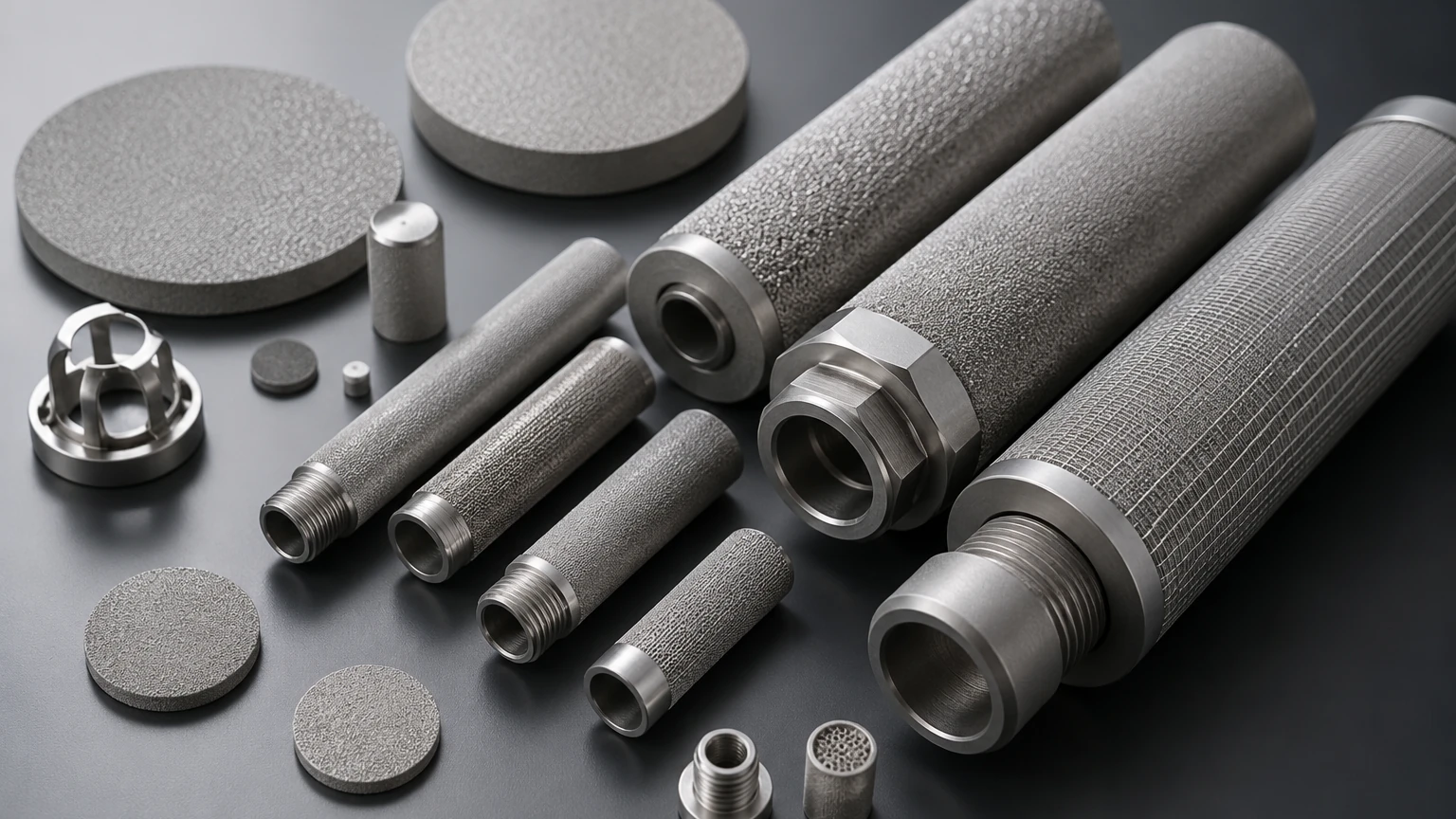
* End Fittings: Options include DOE (Double Open End), SOE (Single Open End) with various O-ring configurations (e.g., 222, 226), threaded connections (NPT/BSP), or custom flanges.
* Reinforcement: For high-pressure applications, internal perforated cores or external cages can be added to the filter element.
* Pleating: To increase the effective filtration area and extend the time between cleanings, sintered wire mesh can be pleated.
* Geometry: Beyond standard cylindrical cartridges, sintered media can be fabricated into discs, cones, plates, or complex manifold assemblies.
By collaborating closely with a professional manufacturer, purchasing teams can ensure that the filtration components are engineered for the specific chemical, thermal, and mechanical stresses of their facility. This technical partnership is vital for achieving optimal filtration performance and operational efficiency.
For more information on customized stainless steel filtration solutions and technical specifications, visit the Main Page to explore professional product options and application support.
