


Pentair Big Blue Filter Change
In industrial and commercial water treatment systems, maintaining high flow rates while ensuring consistent particulate removal is critical to operational efficiency. The Pentair Big Blue filter housing has become a standard component in these environments due to its high-capacity design and versatility. However, the performance of any filtration system is only as reliable as its maintenance schedule. A systematic approach to a Pentair Big Blue filter change is essential for preventing pressure drops, avoiding bypass, and protecting downstream equipment such as boilers, cooling towers, and high-precision membrane systems.
For engineers and facility managers, understanding the technical nuances of filter replacement goes beyond simple maintenance. it involves evaluating the compatibility of filter media, the integrity of seals, and the potential need for more robust materials like stainless steel when application demands exceed the limits of standard plastic housings. This guide provides a technical overview of the replacement process, performance indicators, and engineering considerations for optimizing filtration systems.
The Role of Big Blue Housings in Industrial Water Treatment
The Pentair Big Blue housing is characterized by its large diameter (typically 4.5 inches), which allows for higher flow rates and a greater surface area compared to standard 2.5-inch housings. These units are often constructed from reinforced polypropylene, offering excellent chemical resistance for a wide range of aqueous applications. They are commonly utilized in pre-filtration for reverse osmosis (RO) systems, sediment removal in municipal water processing, and point-of-entry (POE) filtration in commercial facilities.
Because these housings accommodate large-capacity cartridges, they are capable of handling flow rates ranging from 20 to 50 gallons per minute (GPM), depending on the specific cartridge type and micron rating. However, the increased surface area also means that these filters can accumulate significant amounts of debris. If the maintenance interval is ignored, the resulting pressure differential can lead to housing stress or, in extreme cases, structural failure of the filter media itself.
Identifying the Need for a Pentair Big Blue Filter Change
Determining the optimal time for a Pentair Big Blue filter change should be based on empirical data rather than a fixed calendar date. In industrial settings, several key performance indicators (KPIs) signal that a filter has reached its terminal pressure drop.
Differential Pressure (ΔP)
Most professional filtration installations include pressure gauges at the inlet and outlet of the housing. A new, clean filter typically exhibits a pressure drop of 1 to 3 PSI. As the filter media captures contaminants, the resistance to flow increases. For most sediment and carbon cartridges used in Big Blue housings, a differential pressure of 10 to 15 PSI is the standard threshold for replacement. Exceeding this limit can cause the filter media to compress, leading to "unloading" where captured particles are forced through the media and back into the effluent stream.
Flow Rate Attenuation
In systems without precise pressure monitoring, a noticeable decrease in flow rate at downstream discharge points is a primary indicator. This is particularly critical in hydraulic or cooling applications where a specific volume of water is required to maintain thermal equilibrium. If the pump is working harder to maintain the same flow, the filter is likely blinded.
Visual Inspection and Water Quality
For transparent or semi-transparent housings, visual accumulation of sediment is a clear sign. More importantly, if downstream water quality analysis shows an increase in turbidity or a breakthrough of specific contaminants (such as chlorine in carbon systems), the filter must be changed immediately, regardless of the pressure readings.
Technical Procedure for Replacing Filter Elements
Performing a Pentair Big Blue filter change in an industrial context requires adherence to safety protocols to prevent water hammer, leaks, or injury. The following steps outline the professional procedure for element replacement.
1. System Isolation: Close the inlet and outlet valves to isolate the filter housing from the main pressurized line. If a bypass line is installed, open the bypass valve to ensure continued operation of the facility during maintenance.
2. Pressure Relief: Most Big Blue housings are equipped with a red pressure-relief button on the cap. Depress this button until the internal pressure is equalized with the atmosphere. Failure to relieve pressure will make the housing sump nearly impossible to unscrew and may damage the threads.
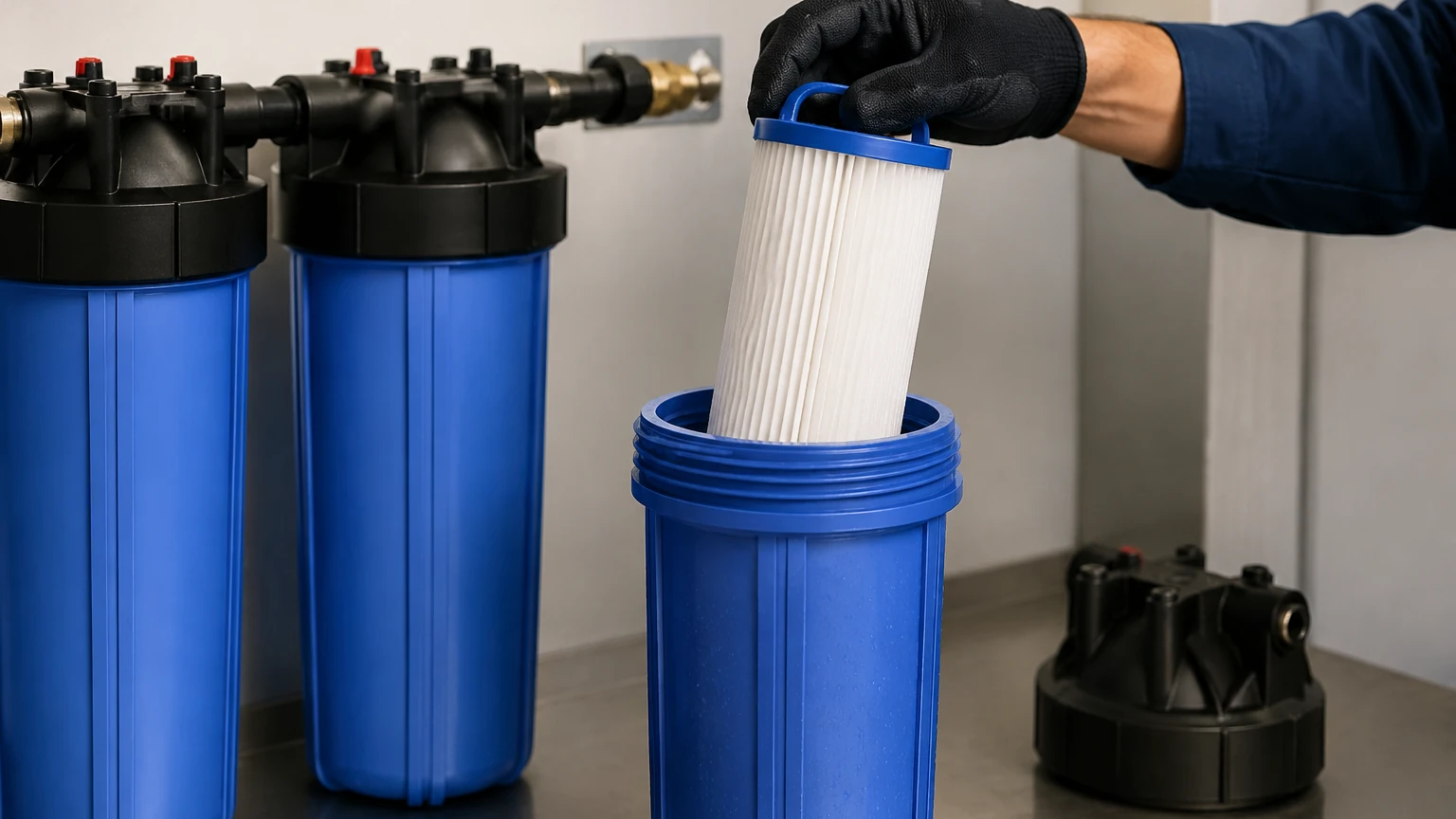
3. Sump Removal: Using a high-strength housing wrench, rotate the sump clockwise (when looking down from the top) to loosen it. Support the weight of the sump as it detaches, as a 20-inch Big Blue housing filled with water and sediment can be quite heavy.
4. Cleaning and Inspection: Remove the spent cartridge and dispose of it according to local environmental regulations. Inspect the interior of the sump for biofilm or heavy sediment. It is recommended to sanitize the housing with a mild bleach solution or a specialized cleaning agent to prevent bacterial growth.
5. O-Ring Maintenance: The O-ring is the most common point of failure leading to leaks. Remove the O-ring, wipe it clean, and inspect it for cracks or flat spots. Apply a thin layer of food-grade silicone lubricant to ensure a proper seal. If the O-ring shows any sign of wear, replace it with a new one made of compatible material (typically Buna-N or EPDM).
6. Cartridge Installation: Place the new filter element onto the standpipe at the bottom of the sump. Ensure it is centered to prevent bypass. Reattach the sump to the cap, hand-tightening it first, and then using the wrench to secure it firmly. Do not over-tighten, as this can deform the O-ring.
7. System Re-pressurization: Slowly open the inlet valve to allow the housing to fill with water. Press the pressure-relief button to bleed out trapped air. Once water begins to spray from the relief valve, release the button and slowly open the outlet valve. Check for leaks over the next 10 to 15 minutes of operation.
Engineering Evaluation of Replacement Cartridges
When selecting a replacement for a Big Blue system, engineers must choose between various media types based on the specific requirements of the process. While standard polypropylene melt-blown filters are common, they may not be the most cost-effective or efficient choice for all industrial applications.
* Melt-Blown Polypropylene: These are depth filters ideal for capturing a wide range of particle sizes. They are disposable and offer a high dirt-holding capacity but have a higher initial pressure drop.
* Pleated Polyester or Cellulose: These provide a much larger surface area than melt-blown filters, allowing for higher flow rates and lower initial ΔP. They are often used when precise micron ratings (1 to 5 microns) are required.
* Stainless Steel Wire Mesh: For high-temperature applications or environments where chemical compatibility is a concern, standard plastic cartridges may fail. In these instances, custom stainless steel filter elements can be designed to fit within Big Blue housings. These offer the advantage of being cleanable and reusable, significantly reducing the total cost of ownership over time.
For organizations looking to optimize their filtration hardware or explore customized metal filtration components that exceed the capabilities of standard plastic housings, visiting the Main Page of a specialist manufacturer like Kaifil provides access to advanced engineering support and material specifications.
Maintaining Seal Integrity and Preventing Bypass
One of the most overlooked aspects of a Pentair Big Blue filter change is the prevention of bypass. Bypass occurs when fluid takes the path of least resistance, flowing around the filter media rather than through it. This is often caused by improper seating of the cartridge or failure of the internal seals.
In high-demand industrial environments, the vibration from pumps or thermal expansion and contraction can cause plastic housings to shift slightly. It is critical to ensure that the cartridge is perfectly aligned with the internal guides of the housing cap. If the cartridge is even slightly tilted, the seal at the top and bottom will be compromised, allowing unfiltered water to enter the clean stream. For critical applications, engineers often prefer cartridges with double O-ring seals or specialized gaskets that provide a more positive mechanical lock than the standard friction-fit designs.
Upgrading to Custom Stainless Steel Filtration Solutions
While Pentair Big Blue housings are effective for many applications, they have limitations regarding temperature (usually maxing out at 100-125°F) and pressure (max 90-100 PSI). In heavy industrial processing, such as chemical manufacturing or high-temperature food production, these limits are easily reached.
When standard solutions fall short, transitioning to custom stainless steel filtration systems becomes necessary. Stainless steel housings and filter elements, like those manufactured by Kaifil, provide superior durability and can be engineered to meet specific ASME pressure vessel codes. These systems are not only capable of handling higher temperatures and more aggressive chemicals but also allow for the integration of precision-engineered wire mesh that provides absolute filtration ratings rather than the nominal ratings typically found in disposable Big Blue cartridges.
Customization allows for the adjustment of filtration accuracy, the addition of specialized mounting brackets, and the inclusion of advanced monitoring ports for automated maintenance alerts. By evaluating the total lifecycle cost—including the frequency of filter changes, labor costs, and the environmental impact of disposable waste—many facilities find that investing in high-performance metal filtration components provides a better long-term ROI.
Conclusion
A Pentair Big Blue filter change is a fundamental maintenance task that, when performed correctly, ensures the longevity and reliability of industrial water systems. By monitoring differential pressure, following a rigorous replacement procedure, and ensuring seal integrity, facility managers can prevent costly downtime and equipment damage. However, as process requirements become more demanding, engineers should remain open to evaluating whether standard plastic systems are sufficient or if a transition to customized, high-precision stainless steel filtration solutions is required to meet the evolving needs of their operations.
