


Industrial Filter Housings
In industrial process engineering, the efficiency of a filtration system is not determined solely by the filter media itself, but by the integrity and design of the vessel that contains it. Industrial filter housings serve as the critical interface between the process piping and the filtration element, acting as a pressure vessel that must withstand operational stresses while ensuring zero-leakage performance. For engineers and procurement teams, selecting the correct housing is a multi-faceted decision involving material science, fluid dynamics, and mechanical engineering standards.
As a specialized manufacturer of stainless steel filtration solutions, Kaifil provides high-performance components designed to meet the rigorous demands of chemical processing, pharmaceuticals, and food production. Understanding the nuances of these vessels is essential for optimizing system uptime and ensuring product purity.
The Role of Industrial Filter Housings in Process Engineering
Industrial filter housings are engineered to hold filter cartridges, bags, or baskets securely in place, directing the flow of fluid through the media to remove contaminants. Beyond simple containment, these housings must manage hydraulic pressure, thermal expansion, and chemical exposure. A poorly specified housing can lead to fluid bypass—where unfiltered liquid escapes around the edges of the filter element—effectively rendering the entire filtration process useless.
In high-purity applications, such as those found on the Main Page of technical filtration specifications, the housing must also facilitate complete drainage and cleaning to prevent bacterial growth or batch cross-contamination. The mechanical design must account for the "dirty" side (inlet) and the "clean" side (outlet), ensuring that the internal seals remain intact even under fluctuating pressure conditions.
Material Selection and Chemical Compatibility
The choice of material for industrial filter housings is the most significant factor in determining the service life of the equipment. While plastic housings may suffice for low-pressure water applications, industrial processes typically demand the durability of metallic alloys.
Stainless Steel 304 vs. 316L
Stainless steel is the industry standard due to its corrosion resistance and mechanical strength.
- 304 Stainless Steel: Suitable for general industrial applications, including water treatment and non-corrosive chemicals. It offers excellent structural integrity at a lower cost point.
- 316L Stainless Steel: The "L" denotes low carbon content, which improves weldability and resistance to intergranular corrosion. 316L contains molybdenum, making it essential for applications involving chlorides, acids, or high-salinity environments. It is the preferred choice for pharmaceutical and food-grade processes where surface passivity is critical.
Surface Finishes and Electropolishing
For many B2B buyers, the internal surface finish is as important as the alloy itself. In the food and pharmaceutical sectors, housings must often meet specific Ra (Roughness Average) values. Mechanical polishing or electropolishing removes microscopic peaks and valleys where contaminants could lodge, facilitating CIP (Clean-in-Place) and SIP (Steam-in-Place) protocols.
Design Parameters: Pressure, Temperature, and Flow Rate
Engineering an effective filtration system requires precise data regarding the operating environment. When evaluating industrial filter housings, three primary variables dictate the mechanical specifications:
1. Design Pressure and Temperature
Housings must be rated for the maximum possible pressure the system might experience, including potential pressure spikes from pump starts or valve closures. Most industrial vessels are designed according to ASME Section VIII or the Pressure Equipment Directive (PED). It is vital to confirm that the housing’s pressure rating remains valid at the maximum operating temperature, as the tensile strength of metals decreases as heat increases.
2. Flow Rate and Pressure Drop (ΔP)
The housing size is determined by the required flow rate. If a housing is too small, the fluid velocity becomes too high, leading to an excessive initial pressure drop. This leaves less "room" for the filter element to load with contaminants before reaching its terminal pressure drop, necessitating more frequent filter changes. Engineers should aim for a design where the housing itself contributes less than 2-3 PSI to the total system pressure drop.
3. Connection Types
Integration into existing piping requires careful selection of inlet and outlet connections. Options include:
- NPT/BSPT Threaded: Common for smaller, low-pressure systems.
- Flanged (ANSI/DIN/JIS): Standard for high-pressure and large-diameter industrial piping.
- Tri-Clamp (Sanitary): Essential for applications requiring frequent disassembly for cleaning.
Types of Industrial Filter Housings: Cartridge vs. Bag Systems
Depending on the contaminant load and the required filtration accuracy, engineers must choose between different housing architectures.
Cartridge Filter Housings
These are designed for high-precision applications. Cartridge housings can hold a single element or dozens of elements (multi-round housings) to accommodate high flow rates. They are typically used for removing fine particles (sub-micron to 20 microns). The internal design includes a "tubesheet" or "mandrel" system that ensures each cartridge is sealed independently, preventing bypass.
Bag Filter Housings
Bag housings are generally used for higher contaminant loads or as pre-filters. They offer a high dirt-holding capacity and are easier to change out in heavy-duty industrial environments. However, they generally lack the sub-micron precision of cartridge systems. For high-volume water treatment or chemical bulk filtration, bag housings are often the most cost-effective solution.
Multi-Round vs. Single-Round
Single-round housings are used for point-of-use filtration or low-flow pilot plants. Multi-round industrial filter housings are the workhorses of the factory floor, allowing for continuous operation at high volumes. The design of the closure mechanism—whether it is a V-clamp for quick access or a heavy-duty swing-bolt for high-pressure safety—is a key consideration for operational efficiency.
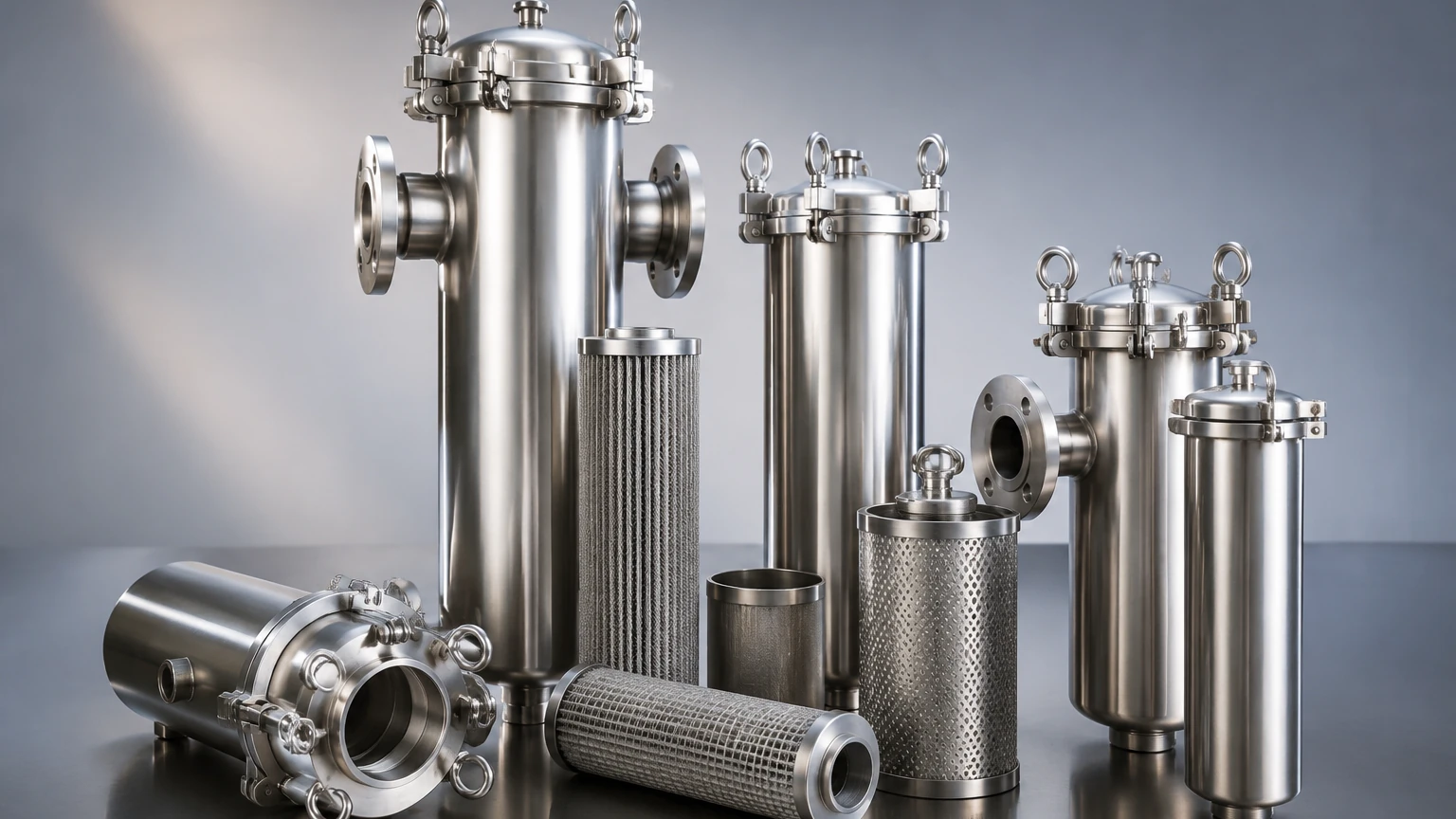
Advanced Features and Customization
Off-the-shelf solutions often fail to meet the specific spatial or functional requirements of a complex industrial plant. Customization is where manufacturers like Kaifil provide the most value.
Custom Internal Geometries
In some processes, the fluid may be highly viscous or shear-sensitive. Customizing the internal flow path can minimize turbulence and prevent product degradation. Additionally, specialized coatings or linings (such as PTFE) can be applied to stainless steel housings to handle extremely aggressive chemicals that would otherwise degrade the metal.
Monitoring and Instrumentation
Modern industrial filtration often requires integrated monitoring. Housings can be fitted with differential pressure gauges, vent valves, and sampling ports. Differential pressure monitoring is the most reliable way to determine when a filter element is spent, allowing maintenance teams to schedule replacements based on actual performance data rather than arbitrary time intervals.
Maintenance and Operational Longevity
The total cost of ownership (TCO) of industrial filter housings is heavily influenced by maintenance requirements. A well-designed housing should allow for rapid element replacement to minimize downtime.
Closure Mechanisms
- V-Band Clamps: Ideal for low-pressure applications where speed is a priority.
- Swing Bolts: The preferred choice for high-pressure industrial environments. They offer superior safety and durability over repeated opening and closing cycles.
- Threaded Caps: Typically found on smaller, high-pressure single-cartridge housings.
Seal Selection
The O-rings or gaskets used in the housing must be compatible with the process fluid. Common materials include Buna-N, EPDM, Viton, and Silicone. Using an incompatible seal can lead to swelling or degradation, causing leaks and potential process contamination.
Evaluating Total Cost of Ownership (TCO)
When purchasing filtration equipment, the initial capital expenditure (CAPEX) for the housing is only one part of the equation. Engineers must consider:
1. Filter Element Cost: Does the housing use standard-sized elements, or is it locked into a proprietary design? Standard sizes allow for more competitive sourcing of replacement cartridges.
2. Labor Costs: How long does it take to change a filter? Features like tool-less closures and davit arms (for lifting heavy lids on large housings) can significantly reduce labor hours.
3. Energy Consumption: A housing with poor flow characteristics increases the load on pumps, leading to higher energy costs over the life of the system.
Conclusion: Selecting the Right Partner
Selecting industrial filter housings is a critical engineering decision that impacts the safety, efficiency, and quality of industrial production. By focusing on material integrity, precise design parameters, and ease of maintenance, technical teams can ensure their filtration systems perform reliably under the most demanding conditions.
Kaifil specializes in manufacturing the high-precision stainless steel components required for these systems. Whether you are designing a new chemical processing line or upgrading a pharmaceutical water system, confirming technical specifications such as pressure ratings, seal compatibility, and surface finish is the first step toward an optimized solution. For more information on custom filtration components and engineering support, visit our Main Page to explore our full range of industrial capabilities.
