


Fluid Filter Manufacturers Aerospace Defense
In the aerospace and defense sectors, the integrity of fluid systems is a non-negotiable requirement for operational safety and mission success. Fluid systems—ranging from hydraulic actuation and fuel delivery to lubrication and coolant circuits—operate under extreme pressures, temperature fluctuations, and mechanical stresses. Consequently, selecting fluid filter manufacturers aerospace defense organizations can rely on requires a deep understanding of material science, precision engineering, and the specific rigors of high-performance environments.
Industrial filtration in these sectors is not merely about removing particulates; it is about maintaining system equilibrium. For engineers and procurement specialists, the challenge lies in identifying partners capable of producing components that offer high filtration efficiency without compromising flow rates or adding excessive weight. This guide examines the technical considerations, material requirements, and evaluation criteria essential for sourcing high-quality filtration solutions for aerospace and defense applications.
The Critical Role of Precision Filtration in Defense Systems
Fluid systems in defense applications, such as those found in armored vehicles, naval vessels, and aircraft, are susceptible to various forms of contamination. These include built-in contaminants from manufacturing, generated contaminants from component wear, and external contaminants introduced during maintenance or operation in harsh environments like deserts or maritime settings.
Fluid filter manufacturers aerospace defense contractors work with must address the specific needs of these systems. For instance, hydraulic systems in flight control surfaces require extremely clean fluid to prevent valve sticking or servo-actuator failure. Even microscopic particles can lead to erosion or catastrophic component failure when moving at high velocities under high pressure.
Furthermore, the filtration components must be designed to withstand "pressure spikes" and vibration without shedding media or collapsing. This necessitates the use of robust materials, primarily stainless steel and specialized alloys, which provide the structural integrity that synthetic or paper-based filters cannot offer in mission-critical scenarios.
Engineering Considerations for High-Performance Filters
When evaluating manufacturers, technical teams must prioritize several engineering parameters that define the performance of a fluid filter. These parameters ensure that the filter performs its primary function while integrating seamlessly into the broader system architecture.
Filtration Accuracy and Micron Ratings
The micron rating of a filter determines the size of particles it can effectively trap. In aerospace and defense, filters often require absolute ratings rather than nominal ratings. An absolute rating signifies that the filter will block a specific percentage (usually 99% or higher) of particles of a given size. Manufacturers like Kaifil specialize in producing wire mesh and sintered metal filters that offer precise pore size control, ensuring that fluid purity levels meet stringent industry standards.
Differential Pressure (ΔP) and Flow Capacity
A common challenge in filtration design is balancing filtration efficiency with pressure drop. As a filter captures more contaminants, the resistance to fluid flow increases, leading to a higher differential pressure. If the ΔP becomes too high, it can trigger bypass valves or, in worst-case scenarios, cause the filter element to collapse. Fluid filter manufacturers aerospace defense specialists must optimize the surface area—often through pleating techniques—to maximize dirt-holding capacity while maintaining a low initial pressure drop.
Temperature and Chemical Compatibility
Aerospace fluids, such as Skydrol or specialized synthetic lubricants, can be chemically aggressive. Additionally, operating temperatures can range from sub-zero arctic conditions to the intense heat of an engine compartment. Stainless steel filtration components are often the preferred choice because they maintain their mechanical properties across these wide temperature ranges and are inert to most hydraulic and fuel chemistries.
Material Selection: Why Stainless Steel Dominates
In the realm of fluid filter manufacturers aerospace defense, material selection is the foundation of reliability. While disposable filters are common in general industrial use, the defense sector frequently turns to metal-based filtration for its durability and cleanability.
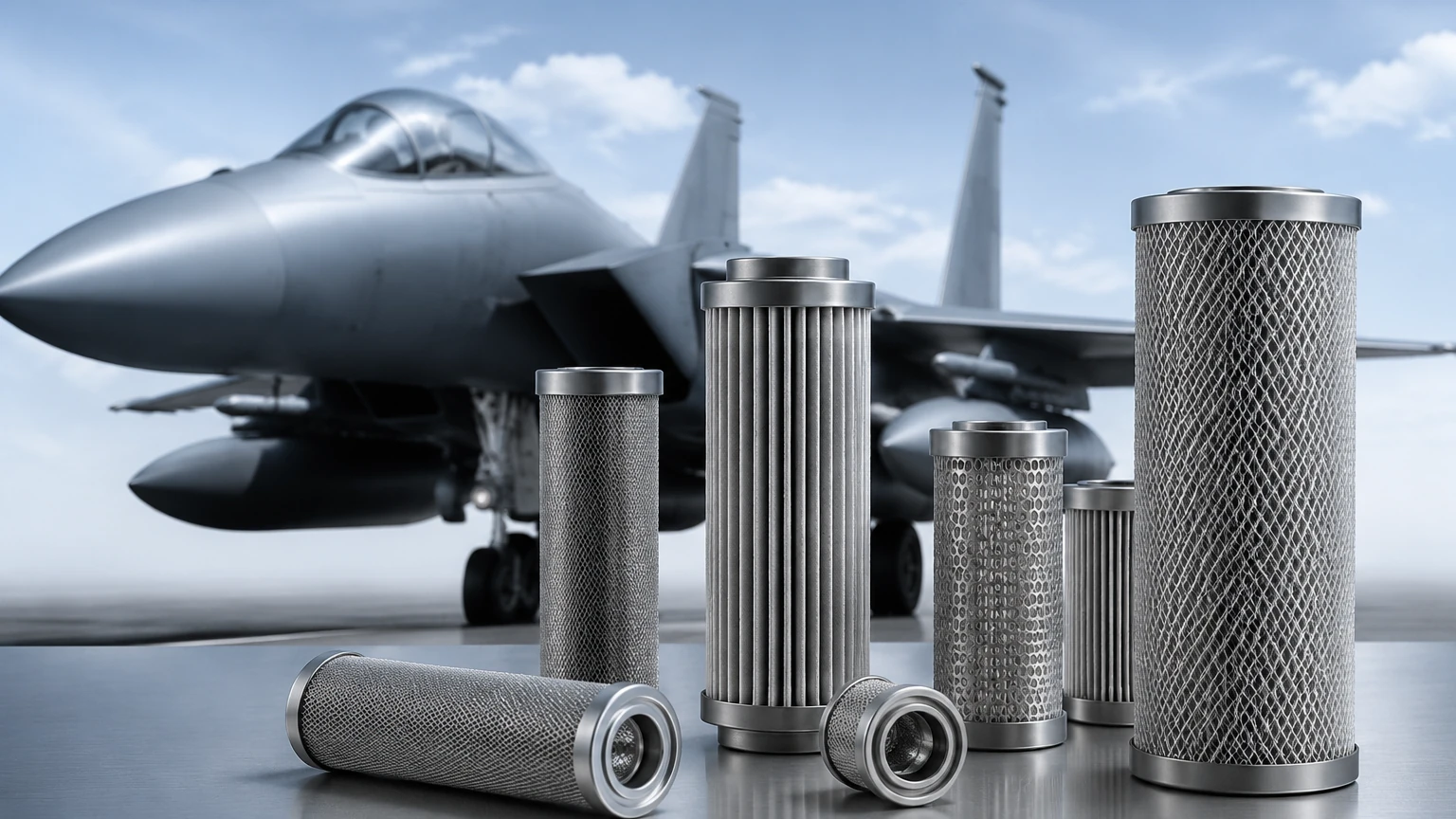
1. Stainless Steel Wire Mesh: Woven wire mesh provides a uniform pore structure and excellent mechanical strength. It can be manufactured in various weaves (plain, twill, or dutch weave) to achieve specific filtration characteristics. Its ability to be pleated significantly increases the effective filtration area within a compact footprint.
2. Sintered Metal Felt: For applications requiring high dirt-holding capacity and fine filtration, sintered metal fiber felt is often used. This material consists of thin stainless steel fibers that are randomly laid and sintered together, creating a high-porosity structure that captures contaminants throughout its depth.
3. Sintered Wire Cloth: By laminating and sintering multiple layers of wire mesh, manufacturers create a rigid, porous material that combines the precision of the mesh with enhanced structural stability. This is ideal for high-pressure applications where the filter must resist deformation.
These materials are not only robust but also offer the advantage of being reusable. In many defense applications, the ability to clean and recertify a filter element provides significant logistical advantages over maintaining a massive inventory of single-use replacements.
Evaluating Fluid Filter Manufacturers for Aerospace and Defense
Selecting a manufacturing partner involves more than reviewing a product catalog. It requires an audit of the manufacturer’s technical capabilities and quality management systems. For those seeking comprehensive information on product ranges and technical support, visiting the Main Page of a specialized manufacturer provides insight into their engineering depth.
Customization and OEM Capabilities
Defense projects rarely utilize off-the-shelf components. Most systems require custom-engineered housings, unique end-cap configurations, or non-standard micron ratings. A manufacturer’s ability to provide OEM (Original Equipment Manufacturer) services is a critical differentiator. This includes the capacity to work from technical drawings, provide rapid prototyping, and scale production from low-volume specialized runs to high-volume series production.
Quality Assurance and Traceability
In high-stakes industries, every component must be traceable back to its raw material source. Manufacturers should provide comprehensive documentation, including material test reports (MTRs) and certificates of conformance. Testing protocols such as the bubble point test (to verify pore size) and pressure fatigue testing are essential to ensure that every unit delivered meets the design specifications.
Technical Support and Problem Solving
The best fluid filter manufacturers aerospace defense organizations partner with act as engineering consultants. They should be able to assist in calculating the required filtration area, predicting service life based on contaminant loading models, and suggesting material upgrades to solve recurring system failures.
Common Risks in Filtration Procurement
Procurement teams must be aware of the risks associated with sub-standard filtration components. The "total cost of ownership" often far exceeds the initial purchase price of the filter. Risks include:
* Media Migration: Lower-quality filters may shed fibers or particles into the downstream fluid, causing the very damage they were intended to prevent.
* Inaccurate Micron Ratings: If a manufacturer cannot guarantee the precision of their weave or sintering process, the filter may allow oversized particles to pass through, leading to accelerated wear on pumps and valves.
* Corrosion and Fatigue: Inadequate material grade selection can lead to stress corrosion cracking or fatigue failure in high-vibration environments, resulting in system downtime and expensive repairs.
By focusing on established manufacturers with expertise in stainless steel and precision metal components, these risks can be mitigated. Organizations like Kaifil provide the manufacturing rigor necessary to satisfy the demanding requirements of industrial and defense-grade filtration.
Sustainability and Maintenance in Defense Filtration
Modern defense logistics are increasingly focused on sustainability and reducing the logistical footprint. Metal filters contribute to this goal by offering a long service life. Unlike polymer-based filters that must be disposed of as hazardous waste when saturated with oil or fuel, stainless steel filters can often be cleaned using ultrasonic baths or chemical cleaning processes.
This cleanability is particularly valuable for remote operations where the supply chain for replacement parts may be strained. Furthermore, the durability of metal components reduces the frequency of replacement, leading to lower long-term costs and higher system availability.
Conclusion: Making Informed Sourcing Decisions
Finding the right fluid filter manufacturers aerospace defense applications require is a process that demands technical scrutiny. Engineers must look beyond basic dimensions and focus on the nuances of material integrity, filtration efficiency, and manufacturing precision.
Whether the application involves hydraulic systems for landing gear, fuel filtration for turbine engines, or cooling systems for advanced electronics, the quality of the filter is a primary determinant of system reliability. By partnering with manufacturers who specialize in custom stainless steel solutions and understand the rigors of industrial environments, defense and aerospace organizations can ensure their fluid systems remain protected against the ever-present threat of contamination.
For technical professionals and purchasing teams looking to optimize their filtration performance, it is essential to engage with manufacturers early in the design phase. To explore a wide range of custom filtration solutions and engineering services, you can Review product options and application support to find the right fit for your specific technical requirements. Through precise engineering and high-quality manufacturing, the challenges of aerospace and defense filtration can be met with confidence.
Download Fluid Filter Manufacturers Aerospace Defense as a PDF
