


Cyclone Precipitator
In industrial gas and liquid processing, the removal of particulate matter is a fundamental requirement for protecting downstream equipment, ensuring product purity, and meeting environmental regulations. The cyclone precipitator, often referred to simply as a cyclone separator, serves as a critical primary separation stage in many of these systems. By utilizing centrifugal force to move particles out of a fluid stream, these devices offer a mechanical solution that is both robust and relatively low-maintenance. However, for engineers and procurement teams, understanding the nuances of cyclone design, its integration with secondary filtration systems, and the material requirements for demanding environments is essential for optimizing total cost of ownership.
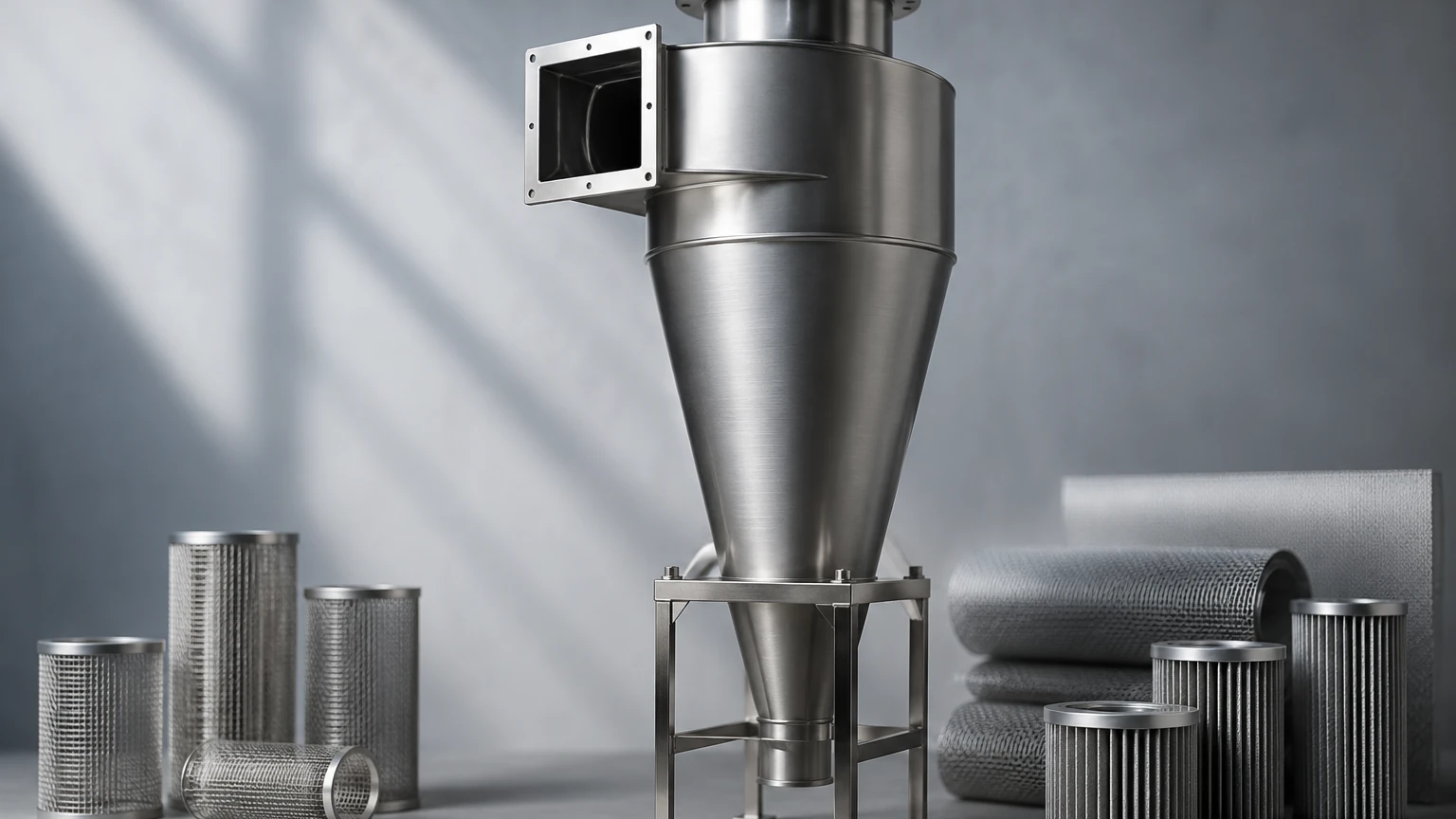
As a manufacturer of high-precision stainless steel filtration components, Kaifil recognizes that the cyclone precipitator is frequently the first line of defense in a multi-stage filtration architecture. While the cyclone handles the bulk of the heavy particulate load, the subsequent stages—often consisting of stainless steel wire mesh or sintered metal cartridges—ensure the final fluid quality meets stringent industrial standards.
Principles of Operation in Cyclone Precipitators
The fundamental operation of a cyclone precipitator relies on the conversion of the linear velocity of an incoming fluid (gas or liquid) into a rotational motion. This is typically achieved through a tangential inlet or a series of stationary vanes at the top of a cylindrical or conical chamber.
As the fluid enters the chamber, it forms a double vortex. The outer vortex moves downward toward the apex of the cone, carrying heavier particles with it. Due to their inertia, these particles are unable to follow the tight curve of the fluid stream and strike the outer wall of the precipitator. Gravity then pulls these particles down into a collection hopper. Meanwhile, the cleaned fluid reverses direction near the bottom, forming an inner vortex that moves upward through the center of the chamber and exits through a "vortex finder" at the top.
The Role of Centrifugal Force
The efficiency of a cyclone precipitator is directly proportional to the centrifugal force exerted on the particles. This force is defined by the formula $F_c = mv^2/r$, where $m$ is the mass of the particle, $v$ is the tangential velocity, and $r$ is the radius of the cyclone. This relationship explains why smaller-diameter cyclones (multicyclones) are generally more efficient at capturing finer particles than larger single units, as the smaller radius increases the centrifugal force for a given velocity.
Key Evaluation Criteria for Industrial Applications
When selecting or designing a cyclone precipitator system, engineers must evaluate several performance metrics to ensure the equipment aligns with the specific needs of the application. These criteria determine not only the initial separation efficiency but also the long-term operational costs.
1. Collection Efficiency and the Cut Point
The most critical metric for any cyclone precipitator is its collection efficiency, which is the percentage of total dust or particulate matter removed from the fluid. This is typically expressed via a fractional efficiency curve, showing efficiency as a function of particle size. The "cut point" ($d_{50}$) is the particle diameter at which 50% of the particles are collected. For most industrial cyclones, the $d_{50}$ ranges from 5 to 10 microns, though high-efficiency designs can achieve lower thresholds.
2. Pressure Drop (Delta P)
Pressure drop is the difference in static pressure between the inlet and the outlet of the precipitator. It represents the energy required to move the fluid through the device. A higher pressure drop usually correlates with higher collection efficiency because it implies higher velocities and stronger centrifugal forces. However, excessive pressure drop increases the load on fans or pumps, leading to higher electricity consumption and potential system fatigue.
3. Material Durability and Corrosion Resistance
In industries such as chemical processing or food and beverage, the material of construction for the cyclone and its internal components is paramount. Standard carbon steel may suffice for non-abrasive, non-corrosive dust at ambient temperatures. However, for applications involving corrosive gases, high-moisture environments, or sanitary requirements, stainless steel (such as 304 or 316L) is the industry standard. Kaifil specializes in providing custom stainless steel components that withstand these harsh conditions, ensuring that the internal surfaces remain smooth to prevent particle buildup and resist chemical degradation.
Integration of Cyclone Precipitators with Advanced Filtration
A common misconception in industrial design is that a cyclone precipitator can serve as a standalone solution for all filtration needs. In reality, cyclones are most effective as pre-separators. They excel at removing large volumes of coarse particles, which significantly reduces the load on downstream filters.
Protecting Secondary Filter Elements
By removing 80% to 95% of the particulate mass, a cyclone precipitator prevents the rapid "blinding" or clogging of fine secondary filters. For instance, in a hydraulic system or a chemical reactor loop, a cyclone might remove the bulk of the scale or catalyst fines, while a Kaifil stainless steel filter cartridge provides the final polish to ensure the fluid meets a specific ISO cleanliness code. This tiered approach extends the service life of expensive filter media and reduces the frequency of maintenance shutdowns.
Custom Internal Components
In some advanced cyclone designs, internal screens or mesh liners are used to enhance separation or to prevent re-entrainment (where collected particles are swept back into the clean air stream). These components must be engineered with precision to ensure they do not introduce unnecessary turbulence or pressure drop. Custom-woven wire mesh from Kaifil can be integrated into these systems to provide a secondary layer of mechanical separation within the cyclone body itself.
Common Risks and Engineering Challenges
Despite their simplicity, cyclone precipitators are subject to several operational risks that can compromise their performance. Engineering teams must account for these factors during the procurement and installation phases.
* Erosion: High-velocity particles striking the walls of the cyclone can cause significant wear, especially in the conical section. Using hardened materials or replaceable stainless steel liners is a common strategy to mitigate this.
* Particle Re-entrainment: If the collection hopper at the bottom of the cyclone is not properly sealed (air leakage), the upward vortex can pull collected dust back into the clean fluid stream. Ensuring a high-quality airlock or rotary valve is essential.
* Fouling and Clogging: If the fluid contains moisture or sticky substances, particles may adhere to the walls of the cyclone or the vortex finder. This changes the internal geometry and drastically reduces efficiency. In such cases, smooth-surface stainless steel finishes and specialized internal coatings are necessary.
* Inaccurate Particle Characterization: If the actual particle size distribution (PSD) is finer than the design PSD, the cyclone will fail to meet its efficiency targets. This often necessitates the addition of a secondary filtration stage using precision metal mesh.
Maintenance and Operational Longevity
The total cost of ownership (TCO) for a cyclone precipitator is generally lower than that of fabric baghouses or electrostatic precipitators because there are no moving parts within the separation chamber. However, a regular maintenance schedule is still required to ensure peak performance.
1. Inspection of Wear Points: Regularly check the inlet transition and the lower cone for thinning of the metal walls.
2. Seal Integrity: Verify that all gaskets and seals on the collection hopper and access doors are airtight. Even a small leak can disrupt the vortex and drop efficiency by 30% or more.
3. Pressure Monitoring: Continuous monitoring of the pressure drop can alert operators to clogging or changes in the process flow that might indicate a failure in the upstream or downstream equipment.
Selecting the Right Solution for Your Facility
When evaluating a cyclone precipitator for a new project or an upgrade to an existing line, it is important to work with partners who understand the entire filtration spectrum. While the cyclone handles the heavy lifting, the final quality of your process fluid depends on the precision of your downstream components.
Engineers should confirm the following data points before finalizing a design:
* Fluid Properties: Density, viscosity, and temperature at operating conditions.
* Particulate Characteristics: Particle size distribution (PSD), shape, and abrasiveness.
* Flow Rate Variability: Cyclones have a limited "turn-down" ratio; efficiency drops significantly if the flow rate falls below the design specification.
* Space Constraints: Vertical height is often a limiting factor for high-efficiency cyclones with long conical sections.
For organizations looking to optimize their industrial filtration systems, Kaifil offers the engineering expertise and manufacturing capability to produce the high-performance stainless steel components required for reliable operation. Whether you need custom filter cartridges to follow a cyclone precipitator or specialized mesh for internal separation, our team provides solutions tailored to your specific technical requirements.
To explore our full range of filtration products and technical support services, visit our Main Page and consult with our engineering team on your next project. By combining the mechanical separation power of a cyclone with the precision of stainless steel filtration, you can achieve a more efficient, durable, and cost-effective industrial process.
