


Filtro De Solvente De Vidro
In the realm of analytical chemistry and industrial research and development, the purity of solvents is a non-negotiable requirement. Whether for High-Performance Liquid Chromatography (HPLC), Gas Chromatography (GC), or specialized pharmaceutical compounding, the presence of microscopic particulates or dissolved gases can compromise results, damage sensitive equipment, and lead to costly downtime. The filtro de solvente de vidro (glass solvent filter) serves as the primary line of defense in these environments.
While glass filtration assemblies are ubiquitous in laboratory settings, understanding their technical nuances, material limitations, and the transition toward industrial-scale stainless steel filtration is essential for engineers and procurement professionals. This guide explores the engineering considerations behind solvent filtration and how to select the right components for demanding industrial applications.
The Role of Solvent Filtration in Precision Industries
Solvent filtration is more than a simple separation process; it is a critical step in mobile phase preparation. In HPLC applications, for example, the stationary phase of the column consists of very fine particles. If the solvent (the mobile phase) contains even trace amounts of particulate matter, these particles can clog the column inlet, leading to increased backpressure and shortened column life.
Furthermore, a filtro de solvente de vidro is frequently used for degassing. As the solvent is pulled through the filter membrane under vacuum, dissolved air is removed. This prevents the formation of bubbles within the pump heads or the detector cell, which would otherwise cause baseline noise and erratic pressure fluctuations. For industrial sectors like chemical processing and pharmaceuticals, ensuring that solvents are both particulate-free and degassed is a fundamental requirement for maintaining the integrity of the analytical process.
Essential Components of a Glass Solvent Filter Assembly
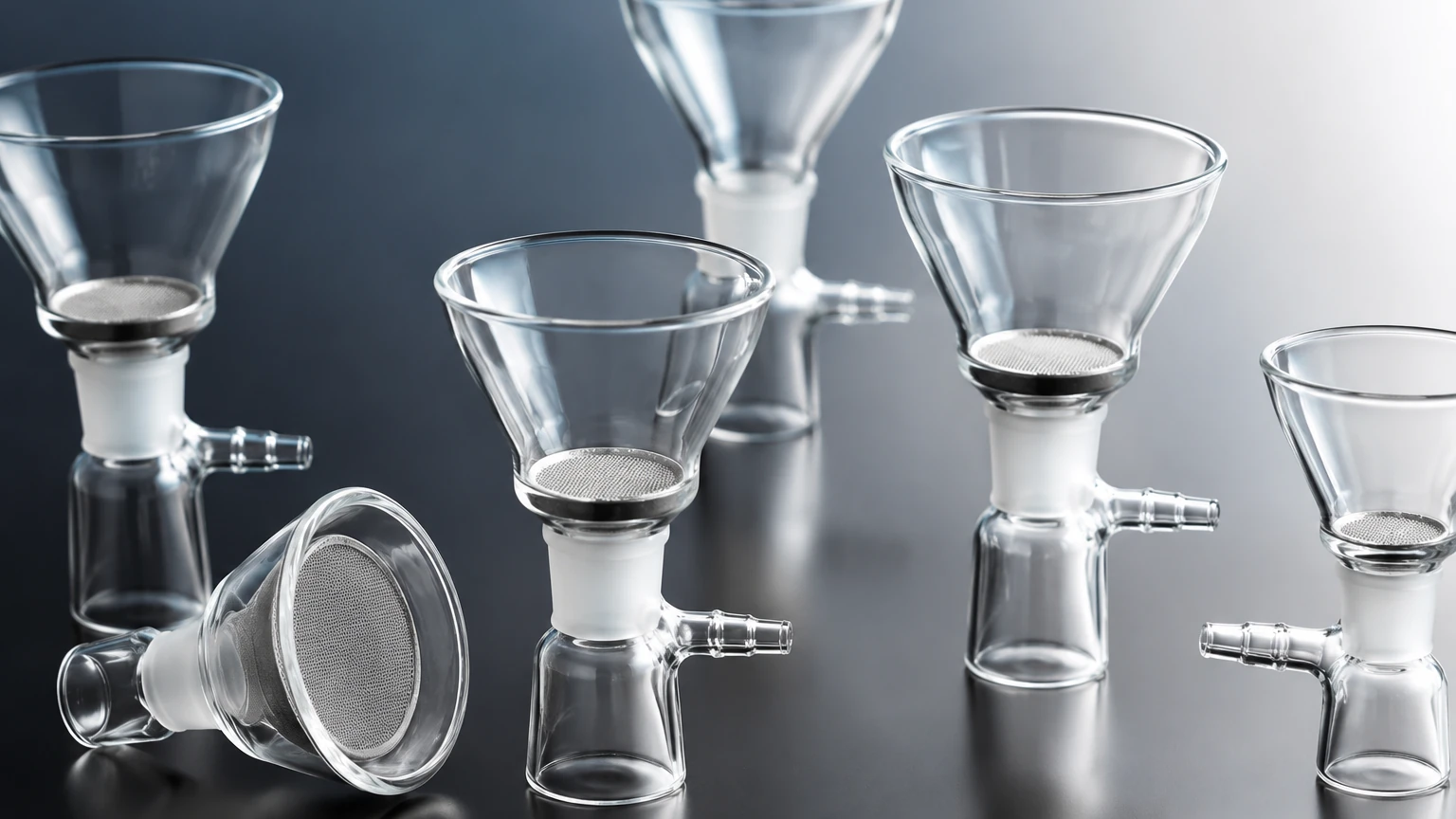
A standard glass solvent filtration system is typically composed of four to five primary components, each designed to withstand chemical exposure and vacuum pressure:
1. The Filter Funnel: Usually made of high-grade borosilicate glass, the funnel holds the unfiltered solvent. It is graduated to allow for precise volume measurement.
2. The Support Base: This is the most critical part of the assembly. It holds the filter membrane (usually 47mm or 50mm in diameter). The support can be made of sintered glass (fritted glass) or a stainless steel screen. In industrial contexts, a stainless steel support is often preferred for its durability and ease of cleaning.
3. The Vacuum Flask (Receiving Bottle): This component collects the filtered and degassed solvent. It must be thick-walled to resist implosion under vacuum.
4. The Aluminum or Stainless Steel Clamp: This secures the funnel to the base, ensuring a leak-proof seal around the filter membrane.
5. The Vacuum Connection: A side-arm on the flask or the base allows for the attachment of a vacuum pump.
For organizations looking to optimize their filtration workflows, reviewing high-performance options on the Main Page can provide insights into how these components are engineered for maximum reliability.
Material Science: Why Borosilicate Glass and Stainless Steel Mesh?
The choice of materials in a filtro de solvente de vidro is dictated by chemical compatibility and thermal resistance. Borosilicate glass 3.3 is the industry standard due to its low coefficient of thermal expansion and excellent resistance to a wide range of acids, organic solvents, and halogens.
However, the support base is where engineering choices become more complex. Sintered glass bases provide a very flat surface for the membrane, which is ideal for delicate cellulose or PTFE filters. However, they can be difficult to clean if fine particles become trapped within the glass pores.
Alternatively, many industrial users opt for a stainless steel mesh support. Stainless steel offers several advantages:
* Durability: It is virtually unbreakable compared to glass frits.
* Cleanability: It can be ultrasonically cleaned or back-flushed more effectively.
* Flow Rates: Precision-woven stainless steel mesh provides a high open area, which can improve flow rates during large-volume filtration tasks.
At Kaifil, we specialize in the manufacturing of these precision metal components, ensuring that the filtration interface meets the rigorous demands of industrial chemical processing.
Technical Specifications and Selection Criteria
When specifying a filtro de solvente de vidro for a facility, engineers must evaluate several technical parameters to ensure the system is fit for purpose:
Filtration Accuracy (Pore Size)
While the glass assembly itself does not determine the pore size, it must be compatible with the membranes required for the application. The most common sizes are 0.45 µm for general particulate removal and 0.22 µm for sterilization and ultra-fine filtration. The support base must provide uniform support to the membrane to prevent rupture under vacuum pressure.
Volume Requirements
Laboratory assemblies typically range from 250ml to 2000ml. For industrial R&D, larger flasks are often required to prepare bulk quantities of mobile phases. It is important to ensure that the vacuum flask is rated for the specific volume and pressure levels intended for use.
Chemical Compatibility
While borosilicate glass is highly resistant, the gaskets and O-rings used in the assembly must be checked against the solvents being used. Common materials include PTFE (Teflon) or Viton. Using an incompatible gasket can lead to solvent contamination as the material degrades.
Operational Guidelines for Industrial Solvents
To maximize the lifespan of a filtro de solvente de vidro and ensure the safety of laboratory personnel, certain operational protocols should be followed:
* Vacuum Management: Always increase vacuum pressure gradually. Sudden pressure changes can cause the glass to fail or the filter membrane to rupture.
* Thermal Shock Avoidance: Although borosilicate glass is resistant to heat, extreme temperature differentials should be avoided. Ensure the glass is at room temperature before introducing very hot or very cold solvents.
* Inspection for Micro-cracks: Before every use, the glass components should be inspected under bright light. Even a small scratch or "star" crack can lead to a catastrophic implosion under vacuum.
* Cleaning Protocols: Solvents used in HPLC must be free of cross-contamination. After filtration, the assembly should be rinsed with a high-purity solvent (like HPLC-grade water or methanol) and allowed to air dry in a dust-free environment.
Transitioning from Laboratory Glass to Industrial Stainless Steel Filtration
As a project moves from the laboratory bench to the production floor, the limitations of glass become apparent. Glass is fragile, limited in volume, and cannot handle high-pressure filtration. This is where the expertise of a manufacturer like Kaifil becomes essential.
In industrial production, the filtro de solvente de vidro is often replaced by stainless steel filter housings and multi-layered wire mesh cartridges. These systems offer several industrial-grade benefits:
1. High Pressure Capability: Unlike glass, which relies on vacuum (limited to approximately 1 bar of differential pressure), stainless steel systems can operate under high pump pressure, allowing for much faster filtration of viscous solvents.
2. Scalability: Stainless steel cartridges can be manufactured in various lengths and diameters to accommodate flow rates of hundreds of liters per minute.
3. Permanent Filtration Media: Instead of disposable membranes, industrial systems often use sintered metal fiber or multi-layer wire mesh that can be cleaned and reused for years, significantly reducing the total cost of ownership.
4. Safety: In a high-traffic industrial environment, the risk of glass breakage is a safety hazard. Stainless steel provides a robust, shatter-proof solution for handling flammable or toxic solvents.
Engineers looking to scale their processes can find comprehensive technical data on custom filtration solutions by visiting the Main Page.
Total Cost of Ownership and Customization
When purchasing filtration equipment, the initial price is only one factor. For a filtro de solvente de vidro, the ongoing costs include replacement membranes, the risk of glass breakage, and the labor involved in cleaning.
For specialized industrial applications, customization is often necessary. This might involve custom-sized stainless steel support screens for a glass assembly or the design of a completely bespoke metal filtration system that mimics the precision of lab-scale glass but with industrial durability. Kaifil works closely with global customers to develop these high-performance components, ensuring that the filtration accuracy and material selection align perfectly with the specific chemical environment.
Conclusion
The filtro de solvente de vidro remains a foundational tool for ensuring solvent purity in the lab. However, as the demand for higher volumes and greater durability increases, the integration of precision metal components becomes vital. By understanding the material properties of borosilicate glass and the advantages of stainless steel supports, engineers can make informed decisions that balance analytical precision with operational efficiency.
Whether you are maintaining a standard laboratory setup or scaling up to a full-scale industrial process, selecting high-quality filtration components is the key to consistent results. For more information on professional-grade filtration products and customized engineering support, explore the resources available at Kaifil.
